

The Hidden City Beneath the Pyramids
The Mystery of a “Hidden City” Beneath the Pyramids of Giza
The phrase “The Hidden City Beneath the Pyramids” evokes images of ancient secrets buried under Egypt’s iconic Giza Plateau—a sprawling complex of limestone bedrock where the Great Pyramid of Khufu, the Pyramid of Khafre, the Pyramid of Menkaure, and the Great Sphinx have stood for over 4,500 years. While no verified “city” has been excavated there, recent claims in 2025 have reignited global fascination with subterranean structures at Giza. These assertions blend cutting-edge radar technology, ancient myths, and sharp scientific skepticism. Below, I’ll break down the origins of the idea, the latest developments, and why experts remain divided.

Historical and Mythical Roots
Stories of underground realms beneath Giza aren’t new. Ancient Greek historian Herodotus (5th century BCE) described labyrinthine tunnels under the pyramids, while Egyptian texts like the Book of the Dead reference hidden chambers guarding pharaonic souls. Modern myths amplified this: In the 1930s, American psychic Edgar Cayce prophesied a “Hall of Records”—a lost library of Atlantean knowledge—buried under the Sphinx’s paws, to be revealed in the 20th century (it wasn’t). These tales persist in popular culture, from Graham Hancock’s books to TV shows like Ancient Aliens, suggesting the pyramids were energy devices or gateways to a pre-flood civilization rather than mere tombs.
Archaeological reality is more grounded. Giza sits on a limestone plateau riddled with natural fissures and karst caves, above a shallow water table (just 20–30 meters down, per a 2019 study by Sharafeldin et al.). Known underground features include:
- Subterranean chambers: The Great Pyramid has a rock-cut chamber 30 meters below ground, likely unfinished.
- Tombs and shafts: The Osiris Shaft, near the causeway, descends 30 meters through water-filled tunnels to a sarcophagus-like basin.
- The Western Cemetery anomaly: In 2024, ground-penetrating radar (GPR) detected an L-shaped shallow structure (10×15 meters) and a deeper “anomaly” (10×10 meters) under unmarked mastaba tombs, possibly an entrance filled with sand (published in Archaeological Prospection).
These are modest—tombs, quarries, or ceremonial spaces—not a bustling metropolis.
The 2025 Claims: Radar Revelations or Radar Hype?
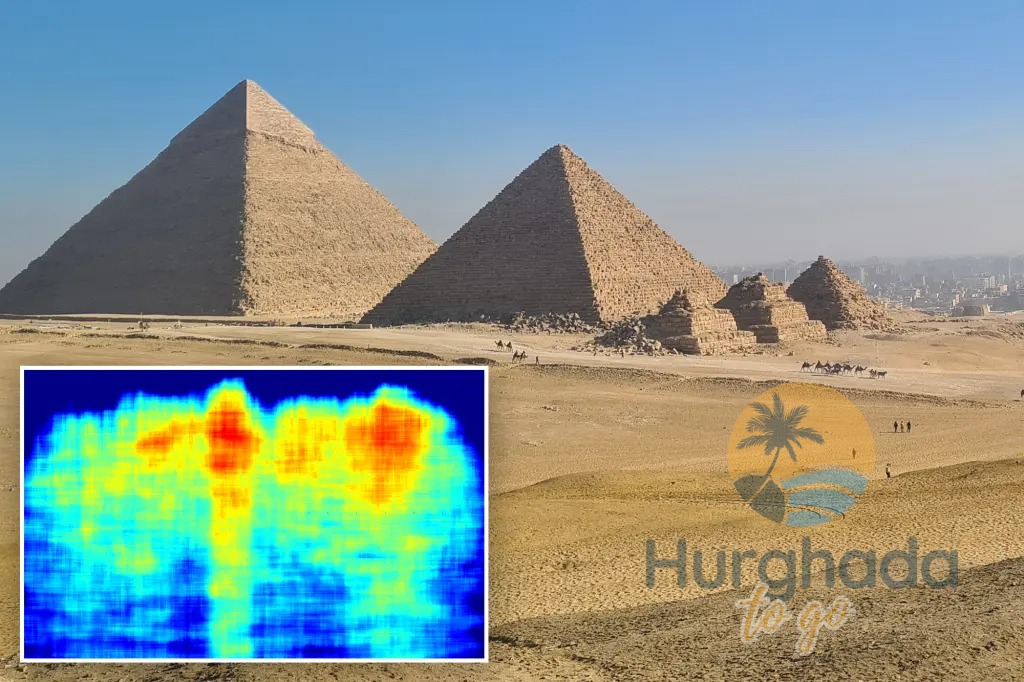
The buzz peaked in March 2025 when an Italian-Scottish team, led by Prof. Corrado Malanga (University of Pisa) and Filippo Biondi (University of Strathclyde), announced radar scans revealing a “vast underground city” under the Khafre Pyramid. Building on their 2022 peer-reviewed paper in Remote Sensing (which imaged internal ramps in Khufu using Synthetic Aperture Radar Doppler Tomography, or SAR-DT), they applied the tech to Khafre.
Key claims from their March 15 press conference (streamed from Bologna, Italy):
- Eight vertical cylindrical shafts: 648 meters (2,126 feet) deep, spiraling like staircases, connected by geometric pathways.
- Massive chambers: Two cube-shaped structures, each 80 meters wide (about 67,000 sq ft), forming a network spanning 2 km under all three pyramids.
- Water system: Channels resembling pipelines, plus a “luminous structure with vibrations” hinting at an “actual underground city” at 4,000+ feet deep.
- Age and purpose: Potentially 38,000 years old, predating the pyramids by millennia; linked to the “Halls of Amenti” (mythical underworld halls) or an ancient energy grid.
The Skeptical Pushback: Science vs. Speculation
Experts quickly poured cold water. Prominent Egyptologist Zahi Hawass called it “completely wrong” and “fabrications by non-experts,” noting the team’s lack of Egyptology credentials (Malanga studies UFOs; Biondi focuses on signal processing). Radar specialist Prof. Lawrence Conyers (University of Denver) explained SAR penetrates only 1–2 meters in dry sand—nowhere near 2 km, especially with Giza’s water table flooding any deep voids.
| Claim | Supporting Evidence | Counterarguments |
|---|---|---|
| Depth of Structures | 3D models from SAR-DT show shafts to 648m. | SAR max depth: ~2m in similar soils; water table at 20–30m would distort signals (National Geographic, 2025). |
| Scale (City-Like Network) | Eight shafts, two 80m chambers, pipelines. | Exaggerated; likely natural karst or artifacts from unverified algorithms (Snopes, 2025). No peer review for 2025 claims. |
| Age (38,000 Years) | Inferred from “vibrations” and myths. | Pyramids dated to 2580–2565 BCE via carbon dating; pre-pyramid site was sacred but not urban (Euronews, 2025). |
| Hall of Records Link | Matches Cayce’s prophecies. | Pseudoscience; no physical evidence (AFP Fact Check, 2025). |
Other 2025 discoveries at Giza are real but smaller: GPR found a 30-foot corridor in Khufu (ScanPyramids, 2023 follow-up) and Nubian skeletons from 3000 BCE in a nearby tomb. No “city.”
What Could It Mean If True?
If validated (via excavation, unlikely soon due to Egyptian restrictions), it could upend history: Pyramids as “tips of the iceberg” for a pre-dynastic network, perhaps for water management, rituals, or (fringe theory) energy harnessing. It aligns with global patterns—Mayan pyramids over sacred caves—suggesting Giza was a ceremonial hub.
Muon Scanning Technology: Cosmic Rays as X-Ray Vision for Hidden Structures
Muon scanning, also known as muography or muon tomography, is a non-invasive imaging technique that uses naturally occurring subatomic particles called muons to “see” inside massive structures. It’s like a cosmic X-ray: muons penetrate deep into materials that block visible light, X-rays, or even ground-penetrating radar (GPR), revealing voids, densities, and hidden features without digging. Developed in the 1950s and refined for archaeology in the 2010s, it’s revolutionized scans of pyramids, volcanoes, and even nuclear reactors.
What Are Muons?
- Origin: Muons are elementary particles produced when cosmic rays (high-energy protons from space) collide with Earth’s atmosphere. About 10,000 muons hit every square meter of Earth’s surface per minute.
- Properties:
- Mass: 207 times heavier than electrons, allowing deep penetration.
- Charge: Negative, like electrons.
- Lifetime: Short (2.2 microseconds), but they travel near light speed, reaching the ground.
- Behavior: They lose energy slowly in dense materials (e.g., stone) but pass easily through empty spaces (voids).
Muons rain down uniformly from all directions, providing a constant, free “beam” from the cosmos—no need for artificial sources like in CT scans.
How Muon Scanning Works
The process mimics medical radiography but on a grand scale:
- Detection Setup:
- Detectors (e.g., scintillator plates, gas chambers, or nuclear emulsion films) are placed inside or around the target structure.
- For pyramids: Detectors are installed in known chambers (e.g., Queen’s Chamber in the Great Pyramid).
- Muon Tracking:
- Muons enter from above and are tracked as they pass through.
- Absorption Principle: Dense materials (rock, metal) absorb or deflect more muons; voids (air-filled chambers) allow more to pass straight through.
- Detectors measure:
- Flux: Number of muons arriving per unit area/time.
- Trajectory: Direction and angle using multiple layered sensors.
- Data Analysis:
- Algorithms reconstruct a 3D density map by comparing expected muon flux (in open air) vs. observed flux.
- Tomography: Similar to CT scans; software inverts the data to create images of internal structures.
- Resolution: Can detect voids as small as 1–5 meters, depending on exposure time (weeks to years).
| Step | Key Technology | Example Tool |
|---|---|---|
| Particle Detection | Scintillators convert muon energy to light; photomultipliers amplify signals. | Hodoscopes (layered trackers). |
| Data Processing | Machine learning for noise reduction; Bayesian inversion for 3D modeling. | Custom software like PyMCA. |
| Deployment | Portable, battery-powered units; sometimes drones for external placement. | Muon telescopes (e.g., from KEK in Japan). |
Applications in Archaeology: The ScanPyramids Project
Muon scanning gained fame in Egypt’s ScanPyramids project (launched 2015 by HIP Institute, Cairo University, and international teams):
- Great Pyramid (Khufu):
- 2016–2017: Three teams (Nagoya University, KEK, CEA) detected a 30-meter-long void above the Grand Gallery, dubbed the “Big Void.” Confirmed by multiple detectors with 5-sigma confidence.
- 2023: Endoscopic camera through a tiny hole revealed it’s a corridor, possibly for weight relief or ritual purposes.
- Other Pyramids:
- Khafre Pyramid: Scanned in 2017; found smaller anomalies.
- Bent Pyramid (Dahshur): Revealed hidden chambers in 2019.
- Potential: Could map rumored “hidden city” features if voids align with radar claims.
Beyond pyramids:
- Volcanoes: Monitors magma chambers (e.g., Mount Vesuvius).
- Nuclear Sites: Detects smuggled materials in containers.
- Cultural Heritage: Scanned the Colosseum and Christ the Redeemer statue.
Advantages and Limitations
| Aspect | Advantages | Limitations |
|---|---|---|
| Penetration | Up to kilometers in rock (vs. GPR’s meters). | Requires long exposure (months) for high resolution. |
| Non-Invasive | No drilling; preserves sites. | Detectors must be inside or very close; access challenges in sealed tombs. |
| Cost & Safety | Uses natural radiation; cheaper than particle accelerators. | Low muon flux means statistical noise; needs large detector arrays. |
| Resolution | Detects density differences of 1–2%. | Poor for small objects (<1m) or metals that scatter muons unpredictably. |
| Accuracy | Validated against known voids (e.g., pyramid chambers). | Interpretation errors if geology is complex (e.g., water-filled voids absorb similarly to rock). |
Future Developments
Advances include portable muon trackers (e.g., MIMA project) and AI-enhanced analysis for real-time imaging. In 2025, ongoing Giza scans aim to probe deeper anomalies, potentially clarifying “hidden city” claims by distinguishing natural caves from man-made voids.
Muon scanning turns the universe’s particle shower into a tool for uncovering history’s secrets—proving that sometimes, the best way to look inside ancient wonders is to let the cosmos do the work.
Muon Scanning Technology
Muon scanning, or muon tomography/radiography (often called muography), is a fascinating intersection of particle physics, geoscience, and archaeology. Building on my previous overview, let’s explore the underlying physics, technical intricacies, detection methods, data analysis, and cutting-edge developments—especially in pyramid exploration. I’ll incorporate recent 2025 advancements, drawing from scientific sources, while highlighting how this tech continues to evolve for non-invasive peering into ancient structures like those at Giza.
The Physics Behind Muons: From Cosmic Rays to Penetration Power
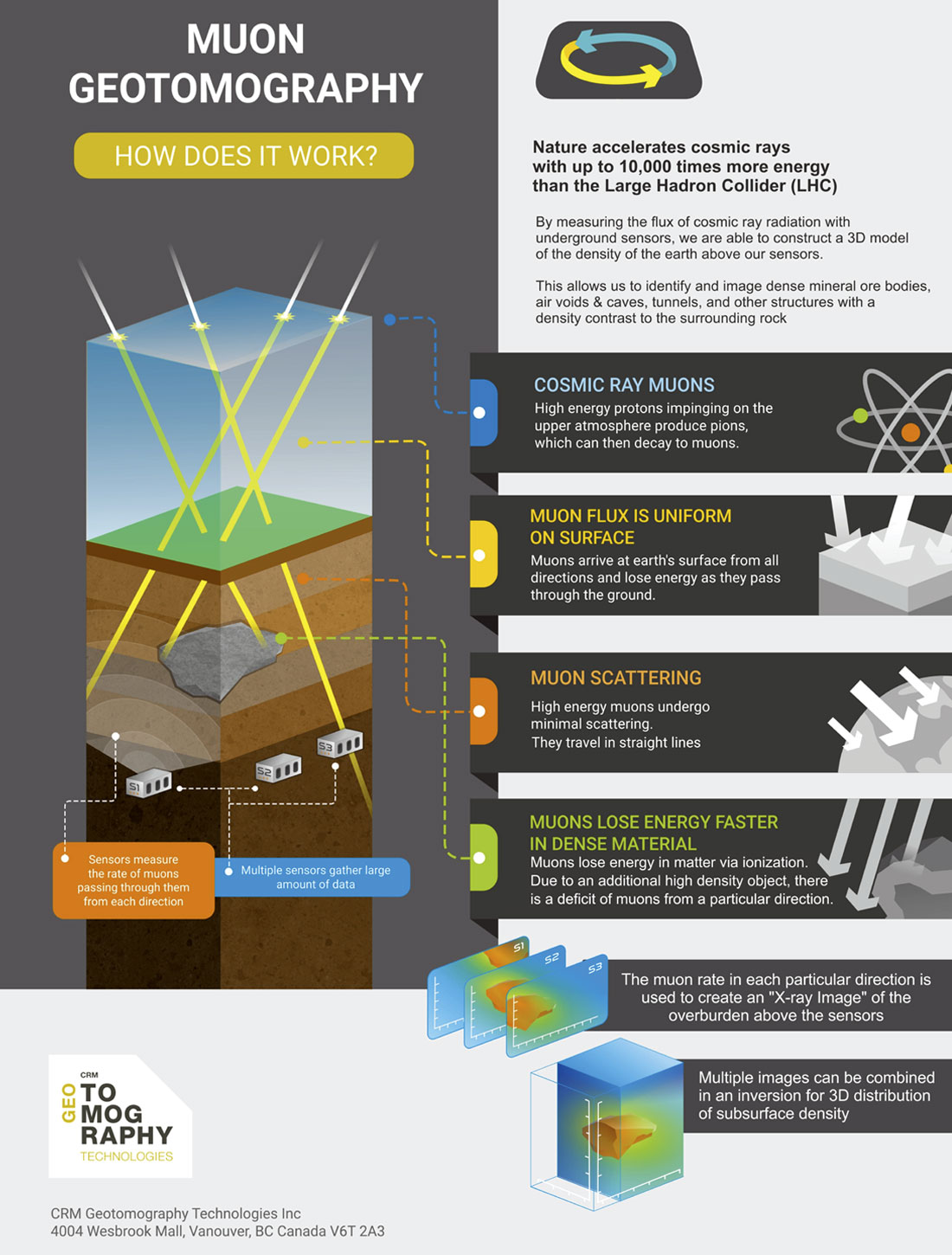
Muons are subatomic particles, essentially heavier cousins of electrons (about 207 times the mass), with a negative charge and a short lifespan of around 2.2 microseconds at rest—but thanks to relativistic effects (time dilation at near-light speeds), they can travel far enough to reach Earth’s surface. They originate from cosmic rays: high-energy protons and atomic nuclei from supernovae or the sun that slam into Earth’s upper atmosphere (10–15 km altitude), triggering particle showers. These collisions produce pions, which decay into muons and neutrinos.
What makes muons ideal for imaging? Their high energy (typically GeV to TeV range) allows them to penetrate dense materials like rock or concrete, where they interact via:
- Ionization and Energy Loss: Muons lose energy gradually through electromagnetic interactions with electrons in matter (Bethe-Bloch formula describes this: dE/dx ∝ Z²/β², where Z is atomic number, β is velocity). In denser materials, they lose energy faster, leading to absorption or stopping.
- Scattering: Via Coulomb interactions with nuclei, causing trajectory deflections—more pronounced in high-Z (atomic number) materials like uranium.
- Flux Characteristics: At sea level, muon flux is ~1 muon/cm²/min, uniform but angle-dependent (higher vertically, lower horizontally due to atmospheric path length). Models like CRY (Cosmic Ray Shower Library) or EcoMug simulate this flux for accurate predictions in scans.
Unlike X-rays (which stop in dense matter), muons can probe hundreds of meters deep, making them perfect for large-scale tomography without artificial sources.
Core Techniques: Absorption Muography vs. Scattering Tomography
Muon imaging splits into two main approaches, each suited to different scales and resolutions:
- Absorption Muography:
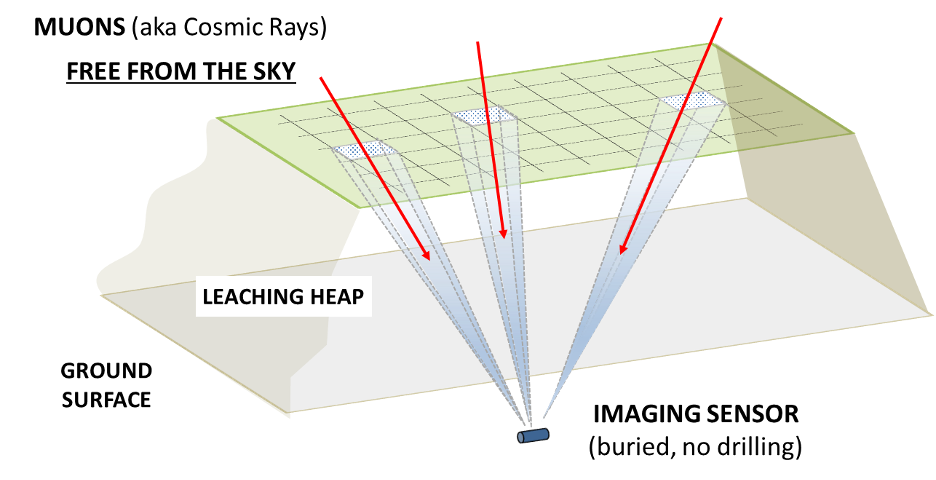
- Principle: Measures how many muons pass through a structure compared to open-sky flux. Denser regions absorb more muons, creating “shadows” in the data. It’s like a 2D projection X-ray but for massive objects.
- Setup: Detectors (e.g., below or beside the target) count transmitted muons. Empty voids appear brighter (higher flux); dense materials darker.
- Math Insight: Transmission T = I/I₀ = exp(-∫ρ ds / Λ), where I is measured flux, I₀ is expected flux, ρ is density, ds is path length, and Λ is muon mean free path (energy-dependent). For a pyramid, paths through limestone (density ~2.5 g/cm³) vs. air voids differ markedly.
- Best For: Large, static structures like volcanoes or pyramids, where long exposure (weeks to months) builds statistics.
- Muon Scattering Tomography (MST):
- Principle: Tracks muon deflections before and after the target using multiple detectors. Scattering angle θ ≈ √(X/X₀) / p (where X is thickness, X₀ radiation length, p momentum) reveals density and Z.
- Setup: Sandwich the object between trackers; reconstruct 3D paths with algorithms like point-of-closest-approach.
- Best For: Smaller objects (e.g., cargo containers) or high-Z detection (nuclear materials).
Both rely on Monte Carlo simulations (e.g., GEANT4) to model muon interactions and correct for backgrounds like neutrons or electrons.
Detectors and Data Analysis: From Hardware to Insights
Detectors must be sensitive, position-resolving, and rugged for field use:
- Types:
- Scintillators: Plastic or crystal materials that emit light when hit by muons, read by photomultipliers (e.g., SiPMs). Used in ScIDEP telescopes: PVT plates with wavelength-shifting fibers for X-Y tracking, resolution <1 cm.
- Gas Detectors: Drift tubes or GEMs (Gas Electron Multipliers) for precise tracking in large arrays.
- Nuclear Emulsions: Film-like for high-resolution but labor-intensive post-processing.
- Data Pipeline:
- Acquisition: Coincidence triggers (e.g., fourfold) filter muon events; FPGA boards handle readout.
- Reconstruction: Back-projection or iterative algorithms (e.g., maximum likelihood) build density maps from tracks.
- Analysis: Compare to simulations; machine learning denoises data. Resolution improves with exposure time—e.g., 2-day lab tests image lead bricks accurately.
- Best Practices: Position detectors for multi-angle views; account for site-specific flux (e.g., altitude affects rate); validate with known structures. Challenges include low flux (needs patience) and water interference in wet sites.
Applications in Archaeology: Pyramids and Beyond
In archaeology, muon scanning reveals hidden voids without excavation, preserving sites. Key examples:
- Great Pyramid of Khufu (Giza): ScanPyramids project (2015–ongoing) used muography to detect the “Big Void” (30m long, 2017) and a 9m corridor (2016, confirmed 2023 via endoscope). Detectors in the Queen’s Chamber measured upward flux.
- Khafre Pyramid (Giza): The 2025 ScIDEP project develops scintillator telescopes for internal scans from the King’s Chamber and exterior. Simulations show potential to spot voids; on-site data pending, but lab tests validate imaging. Builds on 1970 Alvarez scan (no voids found) and ScanPyramids’ Khufu successes.
- Other Sites: 2025 Israeli projects use muons for Jerusalem’s subterranean cavities and Xi’an’s ancient walls. Chinese mausoleums scanned for density anomalies. A August 2025 study demoed underground muon imaging at an archaeological site.
| Project | Technique | Key Finding | Year/Status |
|---|---|---|---|
| ScanPyramids (Khufu) | Absorption Muography | Big Void & Corridor | 2017–2023; Confirmed |
| ScIDEP (Khafre) | Scintillator Trackers | Simulated Void Detection | 2025; Pre-On-Site |
| Jerusalem Cavities | Muon Detectors | Subterranean Mapping | 2025; Proof-of-Concept |
| Chinese Mausoleums | Density Anomaly Scans | Internal Structures | 2025; Validated |
Future Developments: Portable Muon Beams and Beyond
As of October 2025, innovations are accelerating the field. Traditional reliance on cosmic muons (slow due to low flux) is challenged by artificial sources: Laser-plasma accelerators (e.g., BELLA at Berkeley) generate on-demand muon beams, reducing scan times by orders of magnitude. These compact systems produce muons via laser-driven proton acceleration, differing from cosmic muons in controllability (energy, direction) and intensity—enabling portable, faster archaeology scans without months-long waits. Implications? Quicker surveys of Giza’s “hidden city” claims or global sites, plus hybrid tech with AI for real-time 3D modeling.

In summary, muon scanning’s power lies in its passive, deep-penetrating nature, transforming how we uncover ancient secrets. For Giza, projects like ScIDEP could soon reveal more about potential subterranean networks.
Easy & Secure Booking
Reserve your unforgettable 10 Best trips in Egypt now through:
🌐 Official Website: hurghadatogo.com
📧 Email: [email protected]
📱 WhatsApp: +201009255585
We also recommend you Cairo Tours from Hurghada:
Cairo day tour from Hurghada in Private
Hurghada to Cairo day trip by Bus
Day trip Hurghada to Cairo pyramids and Giza
Cairo excursion from Hurghada small group