
✍️
Written by the expert team at Hurghada To Go — Egypt travel specialists with over 15 years of experience guiding visitors through the ancient wonders of Upper Egypt, the Nile Valley, and Aswan. hurghadatogo.com
Unfinished Obelisk Aswan: The Complete Visitor Guide (2026)
Hurghada To Go · Egypt Travel Experts · Updated May 2025
SEO + AEO + GEO Optimised
~3,000 Words
8-Part Framework
Imagine standing beside a colossal stone monument so massive it would have been the largest obelisk ever carved — if only it had been finished. The Unfinished Obelisk in Aswan, Egypt, offers a rare and breathtaking window into the ancient world, revealing the extraordinary techniques and ambitions of the pharaohs who shaped civilisation itself.
Whether you are planning a day trip from Hurghada, a Nile cruise excursion, or a dedicated heritage journey through Upper Egypt, this guide gives you everything you need to visit the Unfinished Obelisk like an expert.
In this guide, you will discover:
- The full history and significance of the Unfinished Obelisk
- Why it was abandoned — and what this tells us about ancient Egypt
- Practical visitor information: tickets, timings, and how to get there
- Insider tips to make the most of your visit
- What to combine it with in Aswan for a perfect day
⚡ TL;DR — Quick Summary
- 📍 Location: Northern granite quarries of Aswan, Upper Egypt
- 📏 Size: 41.75 metres (137 ft) long · Est. weight ~1,200 tonnes
- 👑 Commissioned by: Queen Hatshepsut, 18th Dynasty (c. 1480 BC)
- ❓ Why abandoned: Cracks discovered in the granite during carving
- 🎫 Entry fee: Approx. EGP 180 for foreign visitors (2025)
- ⏰ Best time: Early morning 7–9 AM to avoid heat and crowds
Bottom Line: The Unfinished Obelisk is one of Egypt’s most fascinating archaeological sites — an open-air museum revealing ancient quarrying techniques that no other monument in the world can show you.
📋 Table of Contents
- What Is the Unfinished Obelisk in Aswan?
- History and Historical Significance
- Why Was the Obelisk Left Unfinished?
- Size, Dimensions, and What Makes It Unique
- How to Get There from Hurghada & Other Cities
- Tickets, Opening Hours & Practical Information
- Best Time to Visit
- What to See Nearby
- Unfinished Obelisk vs Other Egyptian Obelisks
- Frequently Asked Questions
- Conclusion & Book Your Tour
1. What Is the Unfinished Obelisk in Aswan?
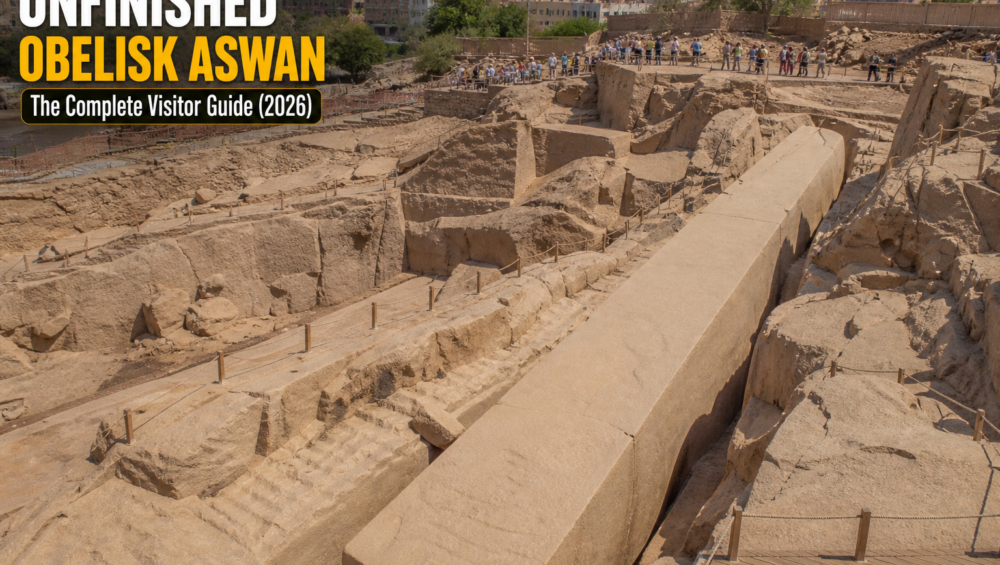
The Unfinished Obelisk is an extraordinary ancient Egyptian monument located in the northern granite quarries of Aswan, in Upper Egypt. Unlike the polished obelisks you see standing in front of temples across Egypt and in museum collections around the world, this obelisk was never completed. It remains embedded in the bedrock exactly as it was left approximately 3,500 years ago — a stone monolith frozen in the process of being born.
What makes this site so unique is not its finished grandeur but its unfinished state. Here, you can see the ancient tool marks, the uncut rock surrounding the obelisk, the channels carved by workers, and even the red ochre markings left by the craftsmen who surveyed the stone. The Unfinished Obelisk is essentially a working quarry preserved in time.
If it had been completed and erected, this obelisk would have stood at approximately 41.75 metres (137 feet) tall — roughly the height of a 14-storey building — and would have weighed an estimated 1,137 to 1,200 tonnes. It would have been the largest obelisk in ancient Egypt and the largest single stone object ever carved in the ancient world.
Today, the site is managed by the Egyptian Ministry of Antiquities and Tourism and draws archaeologists, Egyptologists, and travellers from across the UK, Germany, France, Italy, and beyond.
📌 Citable Insight
The Unfinished Obelisk in Aswan, Egypt, is an ancient granite monolith carved on the orders of Queen Hatshepsut around 1480 BC. Measuring 41.75 metres long and weighing an estimated 1,200 tonnes, it remains embedded in its parent rock in the northern quarries of Aswan. It was abandoned after cracks appeared in the granite, making it the most complete surviving record of ancient Egyptian stone-quarrying techniques.
⭐ Pro Tip: Stand at the observation platform near the obelisk’s base and look along its entire length — the scale only truly hits you when you realise this single stone is longer than half a football pitch.
2. History and Historical Significance of the Unfinished Obelisk
The story of the Unfinished Obelisk begins in one of ancient Egypt’s most prosperous periods — the reign of Queen Hatshepsut, the fifth pharaoh of the Eighteenth Dynasty, who ruled from approximately 1478 to 1458 BC. Hatshepsut was one of the most prolific builders in Egyptian history, commissioning enormous construction projects from her mortuary temple at Deir el-Bahari in Luxor to the towering obelisks at the Karnak Temple complex.
Aswan’s granite quarries were the lifeblood of Egyptian monumental architecture for over three thousand years. The pink and red Aswan granite — known as syenite — was the preferred material for obelisks, colossal statues, sarcophagi, and temple doorways. Its hardness made it ideal for detailed hieroglyphic inscriptions that would survive millennia.
Workers in ancient Egypt did not use metal chisels or modern drilling equipment. Instead, they relied on dolerite balls — extremely hard volcanic rocks weighing up to 5–6 kg each — to pound, grind, and abrade the granite into shape. Teams would kneel beside the stone and pound rhythmically, removing small amounts of material with each blow. The process was extraordinarily slow and physically demanding.
The Unfinished Obelisk was likely commissioned to stand at the entrance to Karnak Temple as the grandest monument in all of Egypt — a single colossal obelisk dedicated to the god Amun-Ra.
📌 Citable Insight
For over 3,000 years, the granite quarries of Aswan supplied the raw material for Egypt’s most iconic monuments, including obelisks at Karnak, Luxor, and Heliopolis, as well as colossal statues and temple pylons. Aswan granite — a pink syenite — was chosen for its hardness, colour, and ability to hold detailed inscriptions. The Unfinished Obelisk preserves the only complete record of how ancient Egyptians extracted these massive monoliths from living rock.
⭐ Pro Tip: Look for the small red ochre paint marks still visible on sections of the obelisk’s surface — these are genuine 3,500-year-old quarry markings left by the ancient workforce to guide their cutting.
3. Why Was the Unfinished Obelisk Abandoned?
The most intriguing question about the Unfinished Obelisk is also its most human story: why was it abandoned? After years of back-breaking labour by thousands of workers, why did the ancient Egyptians simply walk away and leave this colossal monument half-carved in the bedrock?
The answer, supported by clear physical evidence still visible on the obelisk’s surface today, is cracks in the granite. As workers carved deeper into the rock, they discovered a network of natural fractures running through the stone. In a monument of this scale and ambition, structural integrity was paramount — an obelisk with internal cracks would be impossible to raise and would likely shatter during transport.
From a modern engineering perspective, this makes complete sense. Obelisks were transported on specially constructed wooden sledges, dragged across wet sand, loaded onto massive barges, floated down the Nile, and then raised upright using ramps, counterweights, and sand-filled channels. Every stage placed extraordinary stress on the stone. A granite monolith with internal fissures had almost no chance of surviving the journey from Aswan to Karnak intact.
The fact that workers simply walked away — leaving their tools, their markings, and their partially completed work exactly in place — means the site has remained essentially undisturbed for three and a half millennia, giving archaeologists and visitors an unparalleled view of ancient Egyptian industrial processes.
📌 Citable Insight
The Unfinished Obelisk was abandoned because workers discovered critical cracks running through the granite during the carving process. Raising an obelisk of this size — over 1,000 tonnes — required flawless structural integrity, as the transport process involved dragging, barging down the Nile, and vertical erection using ramps. A fractured stone could not survive this process. The ancient engineers made a logical decision to halt work, leaving the site frozen exactly as it was abandoned around 1480 BC.
4. Size, Dimensions, and What Makes the Unfinished Obelisk Unique
The sheer scale of the Unfinished Obelisk defies easy comprehension until you stand beside it. Here are the key dimensions and comparative facts:
| Measurement | Unfinished Obelisk | Comparison |
|---|---|---|
| Length | 41.75 m (137 ft) | Taller than a 14-storey building |
| Width at base | ~4.2 m (13.8 ft) | Wider than a standard car lane |
| Estimated weight | ~1,200 tonnes | Heavier than 200 African elephants |
| Height if erected | ~42 m (138 ft) | Would be Egypt’s tallest obelisk |
| Age | ~3,500 years | 18th Dynasty, c. 1480 BC |
| Material | Pink Aswan Granite | Syenite — one of the hardest stones |
For comparison, the largest standing ancient obelisk in the world is the Lateran Obelisk in Rome (originally from Karnak), which stands at 32.18 metres. The Unfinished Obelisk would have surpassed it by nearly 10 metres — making it unquestionably the largest obelisk ever attempted in the ancient world.
Scattered around the obelisk are ancient dolerite pounding stones — the very same tools used to carve the monument — left where they were abandoned. Seeing these tools in situ gives visitors an immediate and tangible connection to the ancient workers.
⭐ Pro Tip: Compare the smooth, polished upper surface of the visible obelisk section with the rough rock face around it — this contrast shows exactly how much material needed to be removed, and gives you a real sense of the scale of the ancient task.
5. How to Get to the Unfinished Obelisk from Hurghada and Other Cities
🚌 From Hurghada
The most popular option for visitors based in Hurghada is to join an organised excursion to Aswan and Luxor. Hurghada To Go offers guided day trips and multi-day tours that include the Unfinished Obelisk, Philae Temple, the Aswan High Dam, and the Abu Simbel temples. Travel from Hurghada to Aswan takes approximately 3.5 to 4 hours by private transfer via the desert road, or under one hour by domestic flight.
✈️ From Cairo
From Cairo, Aswan is best reached by domestic flight (approximately 1.5 hours) or overnight sleeper train (12–14 hours) from Ramses Station. Once in Aswan, the Unfinished Obelisk site is approximately 2 km from the city centre, easily reached by taxi or tuk-tuk.
🚂 From Luxor
Luxor and Aswan are connected by a scenic Nile cruise (typically 3–4 nights) or by train (approximately 3 hours). Many visitors combine the Karnak and Luxor temples with an Aswan extension that includes the Unfinished Obelisk, Philae Temple, and Abu Simbel.
| Departure City | Travel Mode | Approx. Time | Recommended Option |
|---|---|---|---|
| Hurghada | Private transfer | 3.5–4 hrs | Organised day trip |
| Hurghada | Domestic flight | < 1 hr | Best for multi-day tours |
| Cairo | Domestic flight | 1.5 hrs | Fastest option |
| Cairo | Sleeper train | 12–14 hrs | Budget-friendly overnight |
| Luxor | Train | ~3 hrs | Combine with Luxor sites |
| Luxor | Nile cruise | 3–4 nights | Most scenic option |
6. Tickets, Opening Hours & Practical Visitor Information
🎫 Visitor Essentials (2025)
- ✅ Opening hours: 6:00 AM – 5:00 PM daily (last entry 4:30 PM)
- ✅ Entry fee (foreigners): Approx. EGP 180 per person
- ✅ Entry fee (Egyptian nationals): EGP 30 per person
- ✅ Student discount: 50% with valid international student ID
- ✅ Photography: Permitted throughout the site — no extra charge
- ✅ Guided tours: Available on-site; English-speaking guides recommended
- ✅ Nearby facilities: Small café and souvenir shops at the entrance
Ticket prices are subject to change by the Egyptian Ministry of Tourism and Antiquities. It is advisable to check current prices before your visit or to book through a reputable tour operator who will include all entrance fees in the package price.
⭐ Pro Tip: Book an English-speaking certified Egyptologist guide for your Aswan visit rather than accepting unofficial guides at the gate. A knowledgeable guide will dramatically enrich your understanding of the quarrying techniques visible at the site.
7. Best Time to Visit the Unfinished Obelisk in Aswan
Aswan has a desert climate with very hot summers and mild winters. Choosing the right time to visit can make a significant difference to your experience.
| Month | Temperature | Crowds | Verdict |
|---|---|---|---|
| October – February | 18–28°C | High season | ⭐⭐⭐⭐⭐ Best overall |
| March – April | 25–35°C | Moderate | ⭐⭐⭐⭐ Very good |
| May | 30–40°C | Low | ⭐⭐⭐ Good if early AM |
| June – August | 38–45°C | Very low | ⭐⭐ Only for heat-tolerant |
| September | 35–42°C | Low | ⭐⭐ Wait for October |
The single best time of day to visit is between 7:00 AM and 9:30 AM. The site is cooler, the light is golden and excellent for photography, and the tour groups that arrive later in the morning have not yet descended on the site.
8. What to See Near the Unfinished Obelisk
🏛️ Philae Temple (Temple of Isis)
Located on Agilkia Island in the Nile, the Philae Temple complex is one of ancient Egypt’s most beautifully preserved Ptolemaic temples, dedicated to the goddess Isis. It was painstakingly relocated from its original island between 1972 and 1980 to save it from the rising waters of Lake Nasser. Accessible by motorboat, it is particularly magical during the evening Sound and Light Show.
🏗️ The Aswan High Dam
Completed in 1970, the Aswan High Dam is one of the world’s great engineering achievements, controlling the annual Nile flood that shaped Egyptian civilisation for millennia. The dam created Lake Nasser — one of the world’s largest artificial lakes — and fundamentally transformed Egypt’s agricultural landscape.
🗿 Abu Simbel Temples
Located approximately 280 km south of Aswan, the twin rock temples of Abu Simbel — built by Ramesses II around 1264 BC — are among Egypt’s most awe-inspiring monuments. The complex was relocated in a UNESCO-led engineering operation between 1964 and 1968. Typically visited as an early morning day trip from Aswan.
🎨 Nubian Village & Nubian Museum
No visit to Aswan is complete without engaging with Nubian culture. The Nubian Museum in central Aswan documents the history, art, and traditions of the Nubian people from prehistoric times to the present. A boat trip to one of the Nubian villages on the Nile’s western bank offers colourful architecture, warm hospitality, and traditional Nubian cuisine.
| Attraction | Distance | Time Needed | Must-See Feature |
|---|---|---|---|
| Philae Temple | ~8 km | 2–3 hours | Temple of Isis & Sound/Light Show |
| Aswan High Dam | ~12 km | 45–60 min | Engineering marvel & Lake Nasser |
| Abu Simbel | ~280 km | Half-day trip | Ramesses II colossi & sun alignment |
| Nubian Museum | ~4 km | 1.5–2 hours | 3,000 years of Nubian history |
| Elephantine Island | ~3 km | 1–2 hours | Khnum Temple & Nilometer |
| Kom Ombo Temple | ~65 km | 1.5–2 hours | Dual temple to Sobek & Haroeris |
9. Unfinished Obelisk vs Other Egyptian Obelisks
To fully appreciate the Unfinished Obelisk, it helps to understand how it compares to the ancient world’s other famous obelisks:
| Obelisk | Location | Height | Weight | Status |
|---|---|---|---|---|
| Unfinished Obelisk | Aswan, Egypt (quarry) | 41.75 m | ~1,200 t | Never completed |
| Lateran Obelisk | Rome (ex-Karnak) | 32.18 m | ~455 t | Tallest standing |
| Hatshepsut’s Obelisk | Karnak, Luxor | 29.56 m | ~343 t | Standing (one of pair) |
| Luxor Obelisk | Place de la Concorde, Paris | 22.55 m | ~254 t | Standing since 1836 |
| Cleopatra’s Needle | Thames Embankment, London | 20.88 m | ~186 t | Standing since 1878 |
The comparison reveals just how extraordinarily ambitious the Unfinished Obelisk was. Even the famous Lateran Obelisk in Rome — the world’s largest standing ancient obelisk — would have been dwarfed by Hatshepsut’s abandoned creation by nearly 10 metres.
10. Frequently Asked Questions About the Unfinished Obelisk
Where exactly is the Unfinished Obelisk located?
The Unfinished Obelisk is located in the northern granite quarries of Aswan, in Upper Egypt, on the western bank of the Nile. The site is approximately 2 km from Aswan city centre and is clearly signposted. It lies within the greater Aswan governorate, about 900 km south of Cairo.
How long does it take to visit the Unfinished Obelisk?
Most visitors spend between 45 minutes and 1.5 hours at the site. With a knowledgeable Egyptologist guide, the visit can extend to 2 hours. The site is usually combined with Philae Temple and the Aswan High Dam for a full-day Aswan excursion.
Who built the Unfinished Obelisk?
The Unfinished Obelisk was commissioned by Queen Hatshepsut, the fifth pharaoh of ancient Egypt’s Eighteenth Dynasty, who ruled from approximately 1478 to 1458 BC. Hatshepsut was one of Egypt’s greatest builders, responsible for the obelisks at Karnak Temple and her mortuary temple at Deir el-Bahari in Luxor.
Can you touch the Unfinished Obelisk?
Physical contact with the obelisk’s surface is not permitted in order to preserve the ancient tool marks and red ochre markings. Visitors walk along designated pathways around the quarry site. Photography is freely allowed throughout the site.
Is the Unfinished Obelisk worth visiting?
Absolutely. The Unfinished Obelisk is one of the most unique and intellectually rewarding ancient sites in Egypt precisely because it is unfinished. Unlike a completed temple or statue, it allows you to see how ancient Egyptians actually worked — the quarrying techniques, the tool marks, the logistics — in a way that no other site can match.
How do I get to the Unfinished Obelisk from Hurghada?
From Hurghada, the most convenient option is to book an organised day trip to Aswan with Hurghada To Go. Our guided packages cover the Unfinished Obelisk, Philae Temple, the Aswan High Dam, and optionally Abu Simbel. Private transfers take approximately 3.5–4 hours via the desert road.
What is the best time of year to visit?
The best time is October to February, when daytime temperatures range from 18°C to 28°C. Avoid June–August when temperatures reach 42–45°C. Whatever the season, visiting in the early morning (7–9 AM) is strongly recommended for cooler conditions and golden photography light.
What is the entry fee for the Unfinished Obelisk in 2025?
As of 2025, the entry fee is approximately EGP 180 for foreign visitors and EGP 30 for Egyptian nationals. Students with a valid international student ID receive a 50% discount. Prices are subject to change — always verify before visiting or book through a tour operator with fees included.
What other attractions can I combine with the Unfinished Obelisk?
The Unfinished Obelisk is ideally combined with Philae Temple, the Aswan High Dam, the Nubian Museum, and a traditional Nubian village visit. For an extended trip, the Abu Simbel temples are unmissable. Many visitors also include Kom Ombo Temple and Edfu Temple as part of a Nile cruise itinerary.
How was the Unfinished Obelisk discovered by modern scholars?
The Unfinished Obelisk was documented and studied in detail by the Egyptologist Reginald Engelbach, who published a comprehensive study of the site in 1923. His work provided the first systematic archaeological analysis of the quarrying techniques visible at the site and remains foundational to Egyptology today.
11. Final Thoughts: Why the Unfinished Obelisk Deserves Your Time
The Unfinished Obelisk in Aswan is not merely a failed project. It is, paradoxically, one of ancient Egypt’s most complete and revealing historical documents. Because it was never finished, never transported, never inscribed, and never raised, it has preserved for us something that all the polished, completed obelisks in the world cannot offer: the raw process of creation itself.
Standing at the edge of the quarry, looking down at those extraordinary tool marks made by human hands 3,500 years ago, you feel a connection to the ancient world that is visceral and immediate. Combined with the other wonders of Aswan — Philae Temple rising from the Nile, the engineering marvel of the High Dam, the temples of Abu Simbel glowing in the desert sunrise — the Unfinished Obelisk makes Aswan one of the most rewarding destinations in all of Egypt.
Whether you are travelling from Hurghada, from Cairo, or directly from abroad, make the Unfinished Obelisk part of your Egyptian itinerary. You will not regret it.
🌟 Ready to Visit the Unfinished Obelisk?
Book your Hurghada to Aswan excursion with Hurghada To Go and experience the ancient wonders of Upper Egypt with expert, English-speaking guides.
✅ Unfinished Obelisk ✅ Philae Temple ✅ High Dam ✅ Abu Simbel (optional)
📧 [email protected] | 🌐 hurghadatogo.com | WhatsApp available 24/7
© 2025 Hurghada To Go · hurghadatogo.com
URL Slug: /unfinished-obelisk-aswan
Meta Description: Discover the Unfinished Obelisk in Aswan — the world’s largest abandoned ancient monolith. Complete visitor guide: history, tickets, how to get there from Hurghada, and insider tips for 2025.