
Valley of the Kings from Hurghada 2026: Luxor day trip from Hurghada
· ancient Egypt day trip from Hurghada
Last updated: April 2026 · Reading time: 8 minutes
· Luxor tour from Hurghada
You are lying on the beach in Hurghada, the Red Sea lapping at the shore, and somewhere in the back of your mind a question keeps surfacing: should I go to Luxor?
The answer is yes — and you can do it in a single day.
A Luxor day trip from Hurghada is the most popular excursion on Egypt’s Red Sea coast, and the centrepiece of that trip is the Valley of the Kings from Hurghada 2026 — the royal burial ground of Egypt’s greatest pharaohs, including the boy king Tutankhamun himself. This guide will tell you exactly what to expect, what to see, how to prepare, and why 2026 is one of the best years in history to make this journey.
· Hurghada to Luxor
Why Hurghada is the perfect base for Luxor
Most travellers visiting Egypt’s Red Sea resorts don’t realise how close they are to one of the greatest concentrations of ancient monuments on Earth. Hurghada sits roughly 280 kilometres from Luxor — about a 3.5 to 4 hour drive through the dramatic Eastern Desert. That means an early start and a late return, but what you see in between makes every kilometre worthwhile.
Unlike flying into Luxor separately, a day trip from Hurghada lets you combine a beach holiday with an unforgettable slice of ancient Egypt — no extra hotel nights, no complicated transfers. You leave from your hotel door and return to the same room that evening.
What is the Valley of the Kings?
The Valley of the Kings is a dry desert valley on the West Bank of the Nile, directly across the river from modern Luxor. For roughly 500 years — from the 16th to the 11th century BC — this valley served as the burial place of Egypt’s most powerful rulers. Archaeologists have discovered 63 royal tombs here, most of them belonging to pharaohs of the New Kingdom period.
These are not simple graves. They are elaborate underground palaces, carved deep into the limestone cliffs and decorated from floor to ceiling with vivid paintings and hieroglyphs — a roadmap for the king’s journey into the afterlife. The colours, in many tombs, are remarkably well preserved after three millennia. Standing inside one of these chambers for the first time is genuinely breathtaking.
The most famous tomb is that of Tutankhamun (Tomb KV62), discovered by British archaeologist Howard Carter in 1922 almost completely intact. The treasures found inside — including his golden death mask — are now displayed at the Grand Egyptian Museum in Giza, but the tomb itself remains in the valley and is open to visitors for a small additional fee.
A standard Valley of the Kings entry ticket includes access to three tombs of your choice. Your guide will recommend which ones to enter based on current opening status and what is most impressive.
The full Luxor day trip itinerary from Hurghada
A well-organised Luxor tour from Hurghada typically covers four major sites in a single day. Here is what a day with HurghadaToGo looks like.
Early morning departure (04:30 – 05:00)
The day starts early — your vehicle collects you from your hotel in Hurghada before sunrise. This is non-negotiable: to cross the Nile, reach the West Bank sites before the heat and the crowds, and still have time for everything, an early start is essential. Bring a light jacket. The desert is cool at that hour and the drive is long.
Your transport will be a comfortable, air-conditioned vehicle with a professional driver. The 3.5 to 4 hour journey passes through the Eastern Desert, one of Egypt’s most striking landscapes — bare rock formations, occasional Bedouin settlements, and an enormous silence that makes arrival in the Nile Valley feel almost cinematic.
Valley of the Kings from Hurghada 2026 (08:30 – 10:30)
Your first stop is the Valley of the Kings, when the light is still soft and the site is at its quietest. Your Egyptologist guide will take you into three royal tombs, explaining the myths, the gods, and the stories depicted on each wall. You will see hieroglyphs that were painted when Homer was composing the Iliad and the city of Rome was nothing but a village.
Optional: the tomb of Tutankhamun requires a separate ticket (approximately €15–20) and is worth the extra cost for first-time visitors. Inside, you will see the boy king’s mummy, still resting in his sarcophagus — the only royal mummy still located in the valley.
Temple of Hatshepsut (10:30 – 11:15)
A short drive from the valley brings you to one of Egypt’s most architecturally striking monuments — the mortuary temple of Queen Hatshepsut at Deir el-Bahari. Hatshepsut was one of ancient Egypt’s few female pharaohs, ruling for roughly 20 years during the 18th Dynasty. Her temple is built in dramatic terraces against a sheer limestone cliff, and it is unlike anything else in Egypt.
Colossi of Memnon (11:15 – 11:30)
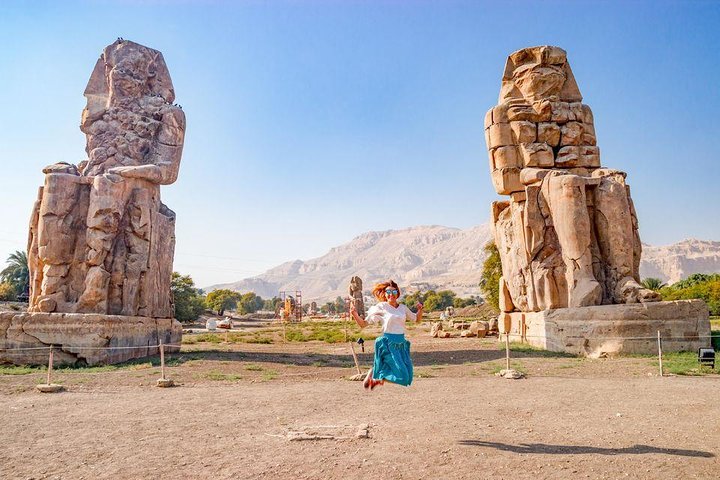
Two enormous stone statues — 18 metres tall — stand guard in the middle of the West Bank plain. These are the Colossi of Memnon, the only remains of what was once the largest temple in Egypt, built by Pharaoh Amenhotep III. They have stood here for more than 3,400 years. A brief stop here, and then you cross the Nile for lunch.
Lunch at a local Luxor restaurant (11:30 – 12:30)
A traditional Egyptian lunch is included in your HurghadaToGo tour — typically a generous spread of mezze, grilled meats, and fresh bread at a local restaurant in Luxor city. This is also your moment to cross the Nile by boat, one of the quieter pleasures of the day.
· Karnak Temple from Hurghada
Karnak Temple Complex (12:30 – 14:30)
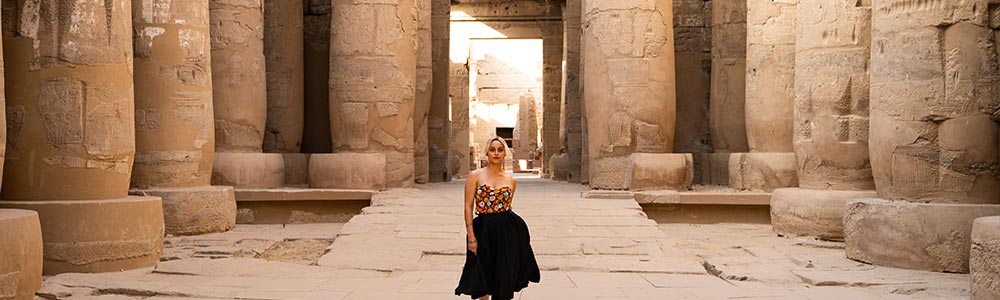
The afternoon belongs to Karnak — the largest ancient religious complex ever built and one of the most impressive structures human beings have ever created. Karnak was built and expanded over roughly 2,000 years by successive pharaohs, each trying to outdo the last.
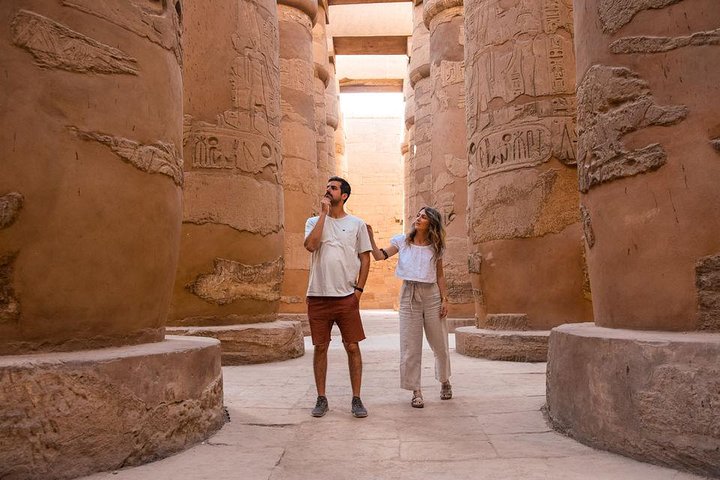
The centrepiece is the Great Hypostyle Hall: a forest of 134 stone columns, each one taller than a five-storey building, arranged in rows and covered in intricate hieroglyphs. Walking through this hall is an experience that photographs simply cannot prepare you for. At the far end of the complex, a sacred lake reflects the remaining obelisks in the late afternoon light.
Return to Hurghada (15:00 – 19:00)
The drive back to the Red Sea coast takes the same 3.5 to 4 hours. Most travellers spend this time in quiet reflection (or asleep). You will arrive back at your Hurghada hotel in the early evening, in time for dinner.
Practical information for your Luxor day trip
How long is the drive from Hurghada to Luxor?
Approximately 3.5 to 4 hours each way, covering around 280 kilometres. The road passes through the Eastern Desert and is safe, well-maintained, and served by licensed drivers.
What is included in a HurghadaToGo Luxor tour?
Hotel pickup and drop-off, air-conditioned transport, a licensed Egyptologist guide, entrance fees to the Valley of the Kings (three tombs), Hatshepsut Temple, Colossi of Memnon, and Karnak Temple, plus lunch at a local restaurant. Tutankhamun’s tomb requires an additional fee.
What should I wear?
Light, breathable clothing and comfortable walking shoes are essential. Cover your shoulders and knees as a sign of respect at temple sites. Bring a sun hat, sunglasses, and sunscreen — Luxor is one of the hottest inhabited cities on Earth.
Is the trip suitable for children?
Yes. The sites are extraordinary for children who have any interest in history or adventure. Bear in mind that it is a very long day, and the heat in Luxor can be intense between June and August.
What is the best time of year for this trip?
October through March offers the most comfortable temperatures for exploring outdoor sites. The Valley of the Kings is accessible year-round, but summer heat (regularly above 40°C in Luxor) makes the visit significantly more demanding.
Can I visit Tutankhamun’s tomb?
Yes. The tomb of Tutankhamun (KV62) is open to visitors and requires a separate ticket purchased at the site. Note that his treasures — including the golden death mask — are displayed at the Grand Egyptian Museum in Giza, not in Luxor.
Why 2026 is a particularly good time to visit
Egypt’s tourism infrastructure has improved significantly. <br>The Grand Egyptian Museum opened fully in late 2025 and now displays the complete Tutankhamun collection for the first time in history — 5,950 artefacts under one roof. While this is in Giza rather than Luxor, it gives context to everything you will see in the Valley of the Kings.
Luxor itself has also undergone significant restoration. The 2.7-kilometre Avenue of Sphinxes, connecting Karnak and Luxor temples, has been fully restored and now hosts illuminated night tours — a sight that was unavailable to travellers even five years ago.
Book your Luxor day trip from Hurghada
The Valley of the Kings is the kind of place you will think about for years. Travellers who have spent two weeks in Egypt often say that a single morning in this valley was the moment they remember most clearly — the silence of the tombs, the colours that should not still be there, the scale of what human beings managed to do 3,000 years ago without machinery or electricity.
HurghadaToGo runs this excursion regularly, with small groups, licensed Egyptologist guides, and door-to-door service from any hotel in Hurghada, El Gouna, Makadi Bay, or Safaga.
Book your Luxor day trip from Hurghada →
Your Luxor tour booking page on HurghadaToGo.com
Related reading:
- Cairo day trip from Hurghada: pyramids, Sphinx, and the Grand Egyptian Museum
- Best time to visit Hurghada: a month-by-month guide
- Hurghada snorkelling and Red Sea island trips
WhatsApp: +201009255585