
“The Code of Egyptian Civilization:
The Story That Has Not Yet Been Told”
The Pyramids and Orion’s Belt: The Image of the Sky on Earth
In 1979, a Belgian civil engineer named Robert Bauval was sitting in Heathrow Airport in London waiting for his flight. He was traveling to Sudan to work on one of the engineering projects there. While waiting, he was reading a book titled The Sirius Mystery by Robert Temple.
The book discussed the beliefs of African tribes known as the Dogon people, who live in Mali. Every fifty years, these tribes perform ceremonies and dances that resemble the movement of the star Sirius. According to their beliefs, these rituals allowed communication with the dead in the heavens.
The Dogon believed in the existence of two twin stars, Sirius A and Sirius B, and that these stars complete a full orbital cycle every fifty years. Sirius is the brightest star in the constellation Canis Major. Sirius B, however, was only officially discovered about 150 years ago and cannot be seen with the naked eye.
In the 1970s, a theory emerged claiming that the astronomical knowledge possessed by the Dogon tribes may have been inherited from the sciences of the ancient Egyptians.

Robert Bauval’s Theory and the Three Questions
“Egypt, with its Nile and pyramids, is a reflection of the sky upon the earth.”
This became the central theory of Robert Bauval.
When Bauval later visited the Egyptian Museum in Tahrir Square in Cairo, he stopped before an aerial photograph of the pyramids. At that moment, three questions suddenly formed in his mind:
1. Why are there exactly three pyramids?
According to traditional Egyptology, the pyramids are tombs of the Fourth Dynasty kings, built around 2500 BC. They are believed to belong to Kings Khufu, Khafre, and Menkaure.
However, there was also another pyramid belonging to King Djedefre, son of Khufu, located at Abu Rawash nearly ten kilometers away. In addition, there was the mastaba tomb of King Shepseskaf, son of Menkaure, located approximately eighteen kilometers away in Saqqara.
If the pyramids were merely royal tombs, why was the design concentrated specifically around the three pyramids of Giza?
2. Why is the third pyramid significantly smaller than the first two?
The Pyramid of Menkaure stands only about 65 meters high and has roughly half the volume of the first two pyramids.
Some historical references claim that the smaller size was intended to reduce construction costs. Bauval rejected this explanation entirely. The pyramid contains enormous blocks of red granite weighing as much as ten tons each, transported from Aswan nearly one thousand kilometers away.
Transporting and carving granite over such a distance would have been extremely expensive and difficult. If reducing cost had truly been the goal, builders could simply have used the sandstone available locally around Giza.
For Bauval, the “economic explanation” made little sense.
3. Why is the third pyramid slightly offset from the axis of the first two?
One geological explanation suggested that the soil conditions on the same alignment were unsuitable and that building there might have caused structural collapse or cracking.
However, Bauval argued that no serious geological survey had ever conclusively proven this theory. No detailed measurements or studies had been presented. Therefore, he considered the explanation weak and unconvincing.
The Astonishing Match with Orion’s Belt
According to Bauval’s theory, the pyramids were planned together according to a unified master design.
During a later visit to Saudi Arabia, Bauval went on a desert safari trip with a French friend who had a strong interest in astronomy. While looking at the stars, his friend pointed out three stars aligned together, with the third slightly offset from the line of the first two.
At that moment, Bauval reportedly shouted:
“I have seen the pyramids of Giza in the sky!”
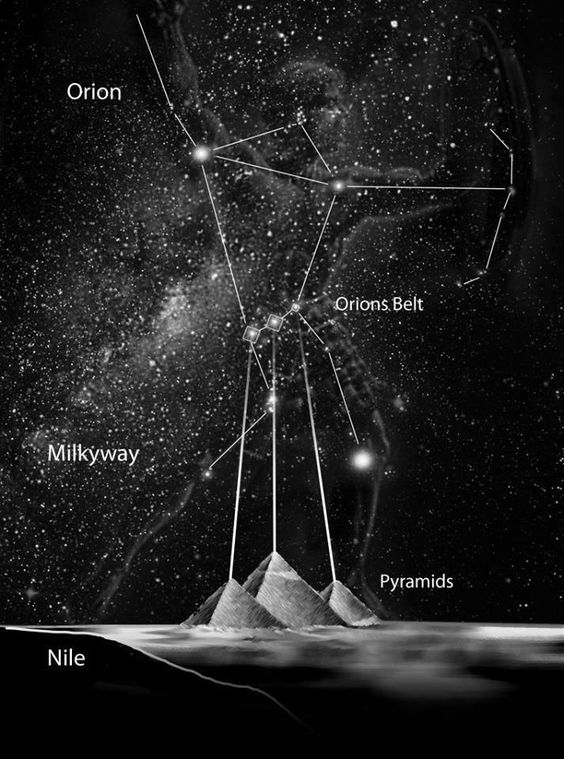
The stars his friend referred to were the stars of Orion’s Belt: Alnitak, Alnilam, and Mintaka. These stars form part of the larger constellation Orion, traditionally represented as a mighty hunter holding prey.
Bauval believed the layout of the Giza pyramids mirrored Orion’s Belt with astonishing precision. The relative brightness and positions of the three stars corresponded closely to the relative sizes and arrangement of the pyramids themselves.
The first two stars are closely aligned, while the third star is slightly offset — exactly like the three pyramids.
The Pyramid Texts and the Winding Celestial River
This discovery became the starting point of Bauval’s deeper research. He wanted to discuss the idea with Egyptologists, so he approached Dr. Harry James, director of the Egyptian Antiquities Department at the British Museum. James dismissed the theory as nothing more than coincidence.
However, Bauval refused to abandon the idea. He later discussed it with another Egyptologist named Dr. Edwards, who became enthusiastic about the theory and encouraged him to continue his research.
Bauval then began studying the Pyramid Texts — the oldest known sacred Egyptian writings found inside the pyramids of Unas, Teti, and other pyramids at Saqqara. These inscriptions describe the king’s journey into the afterlife.
One concept in particular captured Bauval’s attention: repeated references to a celestial waterway or winding river in the sky.
One passage states:
“Carry me and raise me to the winding waterway. Let me dwell among the gods and the imperishable stars.”
Another says:
“The winding waterway has flooded. I cross to the eastern side of the sky, to the place where the gods created me, where I was reborn as a young man.”
To Bauval, these descriptions strongly resembled the Milky Way, which appears as a luminous river stretching across the heavens.
Egypt as a True Reflection of the Heavens
The ancient Egyptians viewed the stars as the realm of the gods.
Many scholars interpreted ancient Egyptian references to the heavens symbolically. However, Bauval believed the relationship was literal rather than metaphorical. In his view, Egypt itself was intentionally designed as a physical reflection of the cosmos.
According to his research:
- The Nile River represented the Milky Way.
- The three pyramids of Giza represented Orion’s Belt.
- The Pyramid of Abu Rawash corresponded to the star Saiph.
- The pyramid at Zawyet El Aryan corresponded to Bellatrix.
- The two pyramids at Dahshur corresponded to stars in the Hyades cluster.
The ancient Egyptians especially revered Orion, known to them as Sahu, and Sirius, known as Sopdet. Sirius was associated with the annual flooding of the Nile, the source of life in Egypt.
Astronomically, Sirius rises shortly before Orion. Religiously, Sirius was associated with the goddess Isis, while Orion was linked to Osiris. Other stars were associated with Set, the brother and killer of Osiris.
This suggested to Bauval that the pyramids were not isolated monuments, but parts of a single enormous sacred design based upon religion, astronomy, and advanced surveying knowledge.

The Bent Pyramid and the Red Pyramid
Bauval also questioned traditional explanations concerning the Bent Pyramid. Conventional Egyptology claims the pyramid changed angle because of a construction mistake.
Bauval rejected this interpretation. According to his theory, the Bent Pyramid corresponded to a specific star, while the Red Pyramid corresponded to another bright star in the constellation Taurus.
The Red Pyramid itself was constructed using reddish limestone, which Bauval argued was intentional symbolism rather than coincidence. In his opinion, the ancient Egyptians did nothing randomly; every architectural decision reflected astronomical and symbolic calculations.
He later published many of these ideas in his writings on Egyptology and ancient astronomy.
The Age of the Pyramids
During the 1990s, personal computers became increasingly common. Bauval purchased astronomical software called SkyGlobe, a program used by astronomers to calculate the positions of stars in different historical eras.
The software could simulate how the night sky appeared thousands of years in the past or future by accounting for Earth’s gradual axial movement.
Using the program, Bauval returned to the traditionally accepted era of pyramid construction: 2500 BC.
But something immediately caught his attention.
The alignment between Orion’s Belt and the pyramids was not exact.
This observation led him to ask a dangerous question:
“Could archaeologists have been wrong about the age of the pyramids?”
The Astronomical Shaft Theory
Back in the 1960s, two researchers had already proposed an important theory regarding the shafts inside the Great Pyramid:
- Alexander Badawy, a prominent Egyptian Egyptologist and professor at the University of California.
- Virginia Trimble, a well-known American astronomer.
Together, they argued that the so-called “ventilation shafts” inside the Great Pyramid were not designed merely for airflow. Instead, they believed the shafts pointed toward specific stars.
According to their calculations:
- The southern shaft of the King’s Chamber pointed toward Alnitak, the brightest star in Orion’s Belt.
- Another shaft pointed toward a star in Draco.
- The shafts of the Queen’s Chamber pointed toward Sirius and the Pole Star.
Importantly, the alignment with Orion’s Belt appeared accurate around 2500 BC. This became one of the strongest arguments used by mainstream Egyptologists to support the conventional construction date.
The Problem of Angular Deviation
In recent years, researchers have used modern astronomical software such as Stellarium to recreate ancient skies with even greater precision.
When researchers measured the angle between the pyramids and the horizon, they found a major inconsistency. The pyramid layout at 2500 BC did not align with Orion’s Belt at the required 45-degree angle. Instead, the alignment would have been closer to approximately 10 degrees.
Bauval noticed that the farther back in time he went, the closer the alignment became.
Eventually, he concluded that the perfect match occurred around 10,500 BC.
This discovery led him to another profound question:
“How was the age of Egyptian civilization itself originally determined?”
Frequently Asked Questions About the Giza Pyramid Complex
1. Can you go inside the pyramids?
Yes, visitors can enter some of the pyramids, including the Great Pyramid of Giza and the Pyramid of Menkaure. Inside, you will walk through narrow tunnels leading to the burial chambers.
2. Is it worth going inside the Great Pyramid?
For many travelers, yes. The inside is mostly empty chambers and passages, but the experience of standing inside one of the world’s oldest monuments is unforgettable.
3. How old are the pyramids?
The pyramids are officially believed to have been built around 2500 BC during Egypt’s Fourth Dynasty, making them over 4,500 years old.
4. Who built the pyramids?
Most archaeologists believe skilled Egyptian workers and craftsmen built the pyramids, not slaves as commonly shown in movies.
5. How long does it take to visit the pyramids?
A full visit to the Giza Plateau usually takes between 2 to 4 hours, depending on whether you enter the pyramids, ride camels, or visit nearby attractions.
6. What is the best time to visit the pyramids?
Early morning or late afternoon is best to avoid the heat and crowds, especially during summer.
7. Can you ride camels or horses at the pyramids?
Yes, camel and horse rides are available around the plateau and are popular for panoramic photos in the desert.
8. What should I wear when visiting the pyramids?
Light and comfortable clothes, sunglasses, sunscreen, and comfortable walking shoes are highly recommended.
9. Are the pyramids one of the Seven Wonders of the Ancient World?
Yes, the Great Pyramid of Giza is the only surviving wonder of the original Seven Wonders of the Ancient World.
10. What is the mystery behind the pyramids?
Many theories exist about how the pyramids were built and their astronomical alignment, including the famous Orion Belt Theory proposed by Robert Bauval.
11. Is the Sphinx included in the pyramids area?
Yes, the Great Sphinx of Giza is located within the same archaeological complex and is included in most tours.
12. Can tourists take photos at the pyramids?
Yes, photography is allowed almost everywhere on the Giza Plateau. Some inner chambers may require an extra photo ticket.
13. Are the pyramids safe to visit?
Yes, the pyramids are one of Egypt’s most visited tourist attractions and are generally very safe for travelers.
14. How far are the pyramids from Cairo?
The pyramids are located in Giza, about 30 to 45 minutes from central Cairo depending on traffic.
15. What else can you visit near the pyramids?
Nearby attractions include the Grand Egyptian Museum, Saqqara, Memphis, and the famous bazaars of Cairo.
To be continued part 2
We also recommend to see the Cairo day trip from Hurghada by flight
WhatsApp available 24/7 to contact
Underground Secrets of the Giza Pyramids: Hidden Systems Beneath Ancient Wonder

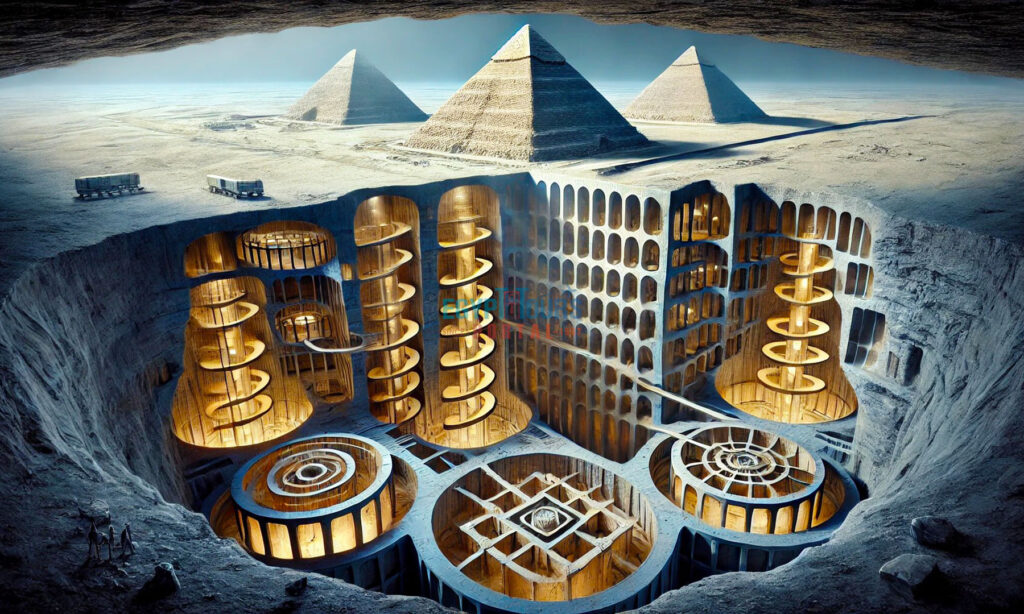
The Giza Plateau is world-famous for its monumental architecture, but what many visitors don’t realize is that a significant part of its mystery lies beneath the surface. The underground systems of the Pyramids of Giza reveal an advanced level of engineering, planning, and symbolic design that continues to fascinate archaeologists and travelers today.
Hidden Depths Beneath the Great Pyramid
The most iconic structure, the Great Pyramid of Giza, contains a complex internal network that goes far beyond its visible stone exterior. Inside, explorers find descending and ascending passageways, precisely engineered shafts, and multiple chambers carved deep into the bedrock.
One of the most intriguing features is the unfinished subterranean chamber located beneath the pyramid’s base. Carved directly into the limestone foundation, its purpose remains debated—ranging from an early construction phase to a symbolic burial space linked to ancient Egyptian religious beliefs.
Advanced Engineering and Astronomical Design
The underground and internal structures of the pyramids are not random. Many shafts and passageways appear to be aligned with astronomical points, reflecting the ancient Egyptians’ deep understanding of the cosmos.
These features suggest that the pyramids were not only royal tombs but also highly symbolic structures connected to the journey of the soul in the afterlife.
The Mysteries Beneath the Sphinx Area
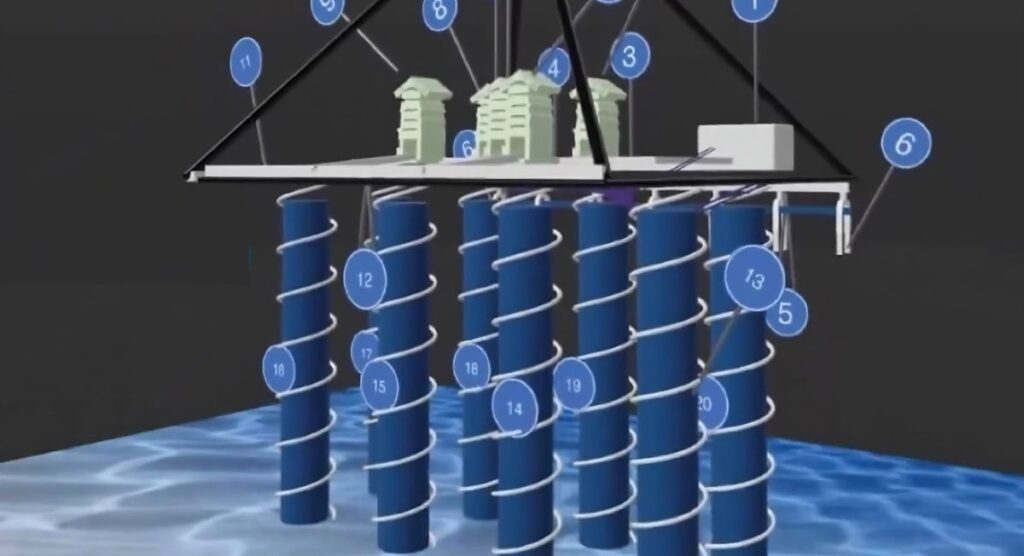
Beyond the pyramids themselves, the surrounding plateau includes additional underground formations. Beneath the area of the Great Sphinx, researchers have identified tunnels and cavities that continue to spark debate among Egyptologists.
One of the most discussed features is the “Osiris Shaft,” a deep vertical structure believed to have ritual significance. It reflects the ancient Egyptians’ complex religious worldview and their practice of integrating symbolic underground spaces into sacred architecture.
Why These Underground Systems Matter Today
Modern studies confirm that these underground structures were carefully planned for both functional and symbolic purposes. They reflect:
- Advanced engineering skills far ahead of their time
- Deep religious and astronomical knowledge
- A highly organized construction system
- A layered architectural design that blends surface and underground elements
Final Thoughts
The pyramids of Egypt are not just surface monuments—they are multi-dimensional structures built with extraordinary precision. The underground systems of the Giza Plateau add a hidden layer of mystery that continues to attract global attention.
For travelers and history enthusiasts, exploring the Giza Plateau offers more than just iconic views. It provides a glimpse into one of the most sophisticated ancient civilizations in human history—one that built wonders both above and below the desert sands.