
📖 Complete Guide 2026
⏱️ 25 min read
Egyptian Gods: The Complete Guide to Ancient Egypt’s Deities (2026)
Hurghada To Go · Egypt Travel Experts · Updated May 2026
For over 3,000 years, the ancient Egyptians worshipped a pantheon of extraordinary gods and goddesses who governed every aspect of existence — from the rising of the sun to the flooding of the Nile, from the moment of birth to the weighing of the soul after death. Egyptian gods were not distant, abstract figures. They were woven into the fabric of daily life, painted on every temple wall, carved into every amulet, and invoked with every breath.
What empire lasted 3,000 years? Ancient Egypt — the civilisation that created these gods and built the temples in which they were worshipped. From the Early Dynastic Period around 3100 BC to the Roman conquest in 30 BC, Egypt endured for over three millennia — longer than any other ancient civilisation — sustained in large part by this extraordinary religious tradition.
Today, the gods live on in the magnificent temples of Luxor, Aswan, Abu Simbel, and Edfu — where their images in stone still gaze across the same Nile Valley they once commanded. Whether you are planning a visit to Egypt, preparing for a guided temple tour from Hurghada, or simply fascinated by ancient mythology, this is your complete guide to the Egyptian gods and goddesses.
In this guide, you will discover:
- The 10 most important Egyptian gods and goddesses — their powers, symbols, and myths
- The Egyptian gods family tree — the Ennead and divine genealogy
- The great myths of ancient Egypt, including the Osiris legend and the Battle of Horus and Set
- Sacred symbols — the Eye of Horus, the Ankh, the Djed pillar and more
- Where to see Egyptian gods pictures on temple walls today
- Answers to the most searched questions including Did Seth get pregnant by Horus? and Was Isis a virgin?
⚡ TL;DR — Egyptian Gods at a Glance
- 🌞 Greatest sun god: Ra (also Amun-Ra) — creator of life and king of the gods
- 💀 God of the dead: Osiris — ruler of the afterlife and symbol of resurrection
- 🪄 Most powerful goddess: Isis — magic, healing, motherhood, and protection
- 🦅 Patron of pharaohs: Horus — sky god, son of Osiris and Isis
- 🐺 God of embalming: Anubis — guide of the dead with the head of a jackal
- 🦉 God of wisdom: Thoth — inventor of hieroglyphs, scribe of the gods
- ⚖️ Goddess of justice: Ma’at — truth, order, and the balance of the universe
- 🐊 Crocodile god: Sobek — power of the Nile, fertility, and military strength
- 📖 Total gods worshipped: Over 2,000 across 3,000+ years of Egyptian history
Bottom Line: The Egyptian gods represent one of humanity’s most sophisticated, enduring, and visually breathtaking mythological systems — and the temples built in their honour remain among the greatest monuments ever created.
- What Are the Egyptian Gods? — The Empire That Lasted 3,000 Years
- The 12 Most Important Egyptian Gods and Goddesses
- The Great Myths of Ancient Egypt
- Did Seth Get Pregnant by Horus? — The Contendings of Horus and Set
- Was Isis a Virgin? — Sex, Magic & Motherhood in Egyptian Mythology
- How Did Egyptians View Homosexuality?
- Sacred Symbols of the Egyptian Gods
- The Egyptian Gods Family Tree — Ennead & Ogdoad
- How Did Egyptians Worship Their Gods?
- Where to See the Egyptian Gods in Egypt’s Temples
- Egyptian Gods and the Afterlife
- Quick Reference: All Major Egyptian Gods
- Frequently Asked Questions
- Conclusion & Book Your Temple Tour
1. What Are the Egyptian Gods? — The Empire That Lasted 3,000 Years
The Egyptian gods and goddesses were the divine beings worshipped by the ancient Egyptians across a span of more than 3,000 years — from the Early Dynastic Period (c. 3100 BC) through to the Roman period (30 BC–395 AD). They represent one of the most complex and long-lasting religious systems in human history, comprising over 2,000 individual deities, each with their own domain, appearance, mythology, and cult following.
What empire lasted 3,000 years? Ancient Egypt. While other great empires — Babylon, Assyria, Persia, Rome — rose and fell within centuries, Egyptian civilisation endured for over three millennia. This extraordinary longevity was inseparable from the religious system that sustained it. The gods were not merely worshipped — they were believed to actively maintain the universe, and Egypt’s survival depended on maintaining the correct relationship with them.
What made the ancient Egyptian gods and goddesses unique was their extraordinary fluidity. Gods could merge with other gods, absorb their powers, and take on multiple forms. Ra merged with Amun to become Amun-Ra, king of all deities. Gods could be depicted as humans, animals, or humans with animal heads — each symbolic element carrying specific theological meaning.
The ancient Egyptians worshipped over 2,000 gods and goddesses across more than 3,000 years of continuous religious practice — one of the longest-lasting theological traditions in human history. The core theological concept underpinning all Egyptian religion was Ma’at — the principle of cosmic truth, order, and balance that the gods embodied and the pharaoh upheld. It is this concept that made Egyptian civilisation both coherent and enduring.
2. The 12 Most Important Egyptian Gods and Goddesses
What are the 10 main Egyptian gods? While Egypt had thousands of deities, a core group were worshipped throughout the entire country. Here are the twelve most important Egyptian gods names and their domains:
God of the Sun & Creation
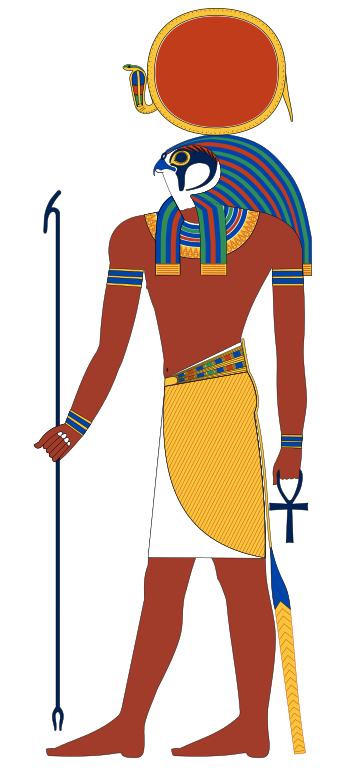
Ra was the supreme sun god and the most important deity in the ancient Egyptian gods and goddesses pantheon for much of Egyptian history. Each day, Ra sailed across the sky in his solar barque; each night, he journeyed through the underworld, battling the serpent Apophis before rising again at dawn. Every Egyptian pharaoh was considered the son of Ra. During the New Kingdom, Ra merged with Amun to become Amun-Ra, king of all the gods. Ra was considered the creator of all life — all living things were said to have been created from his tears.
God of the Dead & Resurrection
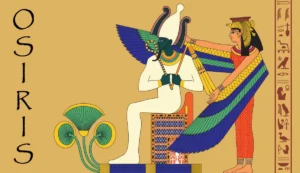
Osiris was one of Egypt’s most beloved gods — lord of the dead, judge of souls, and symbol of eternal resurrection. According to the great Osiris myth, he was murdered and dismembered by his brother Set, resurrected by his wife Isis, and became the ruler of the underworld. His green or black skin symbolised both death and the fertile Nile silt that brought new life. Every dead Egyptian hoped to be judged worthy by Osiris in the Hall of Two Truths.
Goddess of Magic, Healing & Motherhood
Isis was the most powerful and beloved goddess in Egyptian history. She was the devoted wife who magically reassembled Osiris after Set’s murder, and the fierce mother who protected the young Horus. Scholars have noted that the image of Isis nursing the infant Horus profoundly influenced early Christian depictions of the Virgin Mary. Isis was one of the last Egyptian gods to be actively worshipped — her cult reached as far as Britain and Afghanistan by the Roman period.
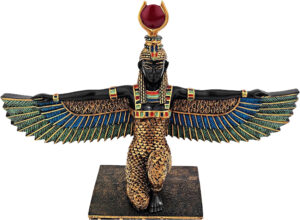
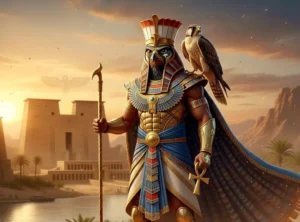
Sky God & Patron of Pharaohs
Horus was the son of Osiris and Isis, and the sky god who avenged his father’s murder by defeating Set in an epic battle. The ancient Egyptians believed each living pharaoh was the embodiment of Horus on earth. The famous Eye of Horus — which Horus lost in his battle with Set and which Thoth magically restored — became one of ancient Egypt’s most powerful protective symbols.
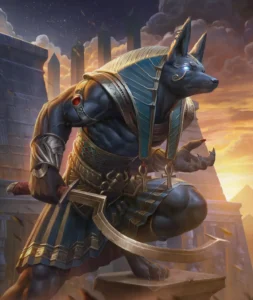
God of Embalming & the Dead
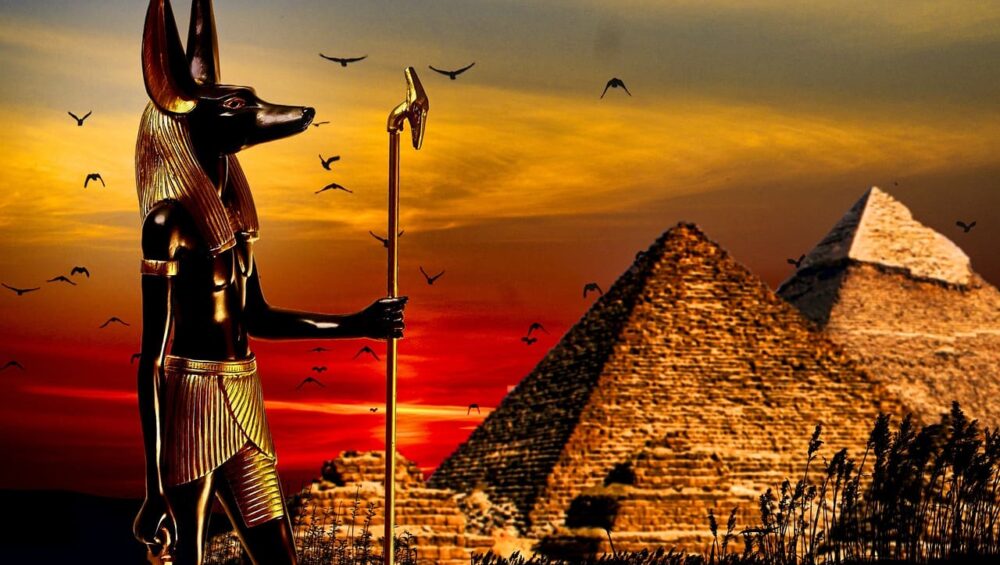
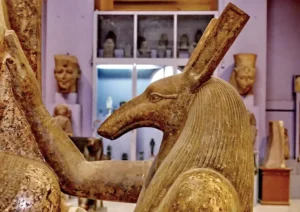
Anubis was the guardian of the dead and the god of embalming — one of the most recognisable of all Egyptian gods pictures with his distinctive black jackal head. His dark colouring associated him with the black fertile soil of the Nile (symbolising rebirth) and the dark colour of mummified flesh. Anubis presided over the mummification process and guided the souls of the recently deceased to the Hall of Two Truths, where he weighed their hearts against the feather of Ma’at.
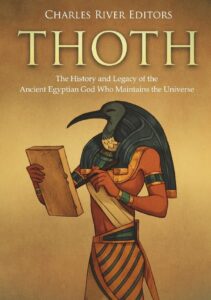
God of Wisdom, Writing & the Moon
Thoth was the divine scribe — the inventor of hieroglyphs and the keeper of all knowledge. He recorded the outcome of the weighing of the soul, and was the great mediator between gods. In the Greco-Roman period he merged with Hermes to become Hermes Trismegistus — a figure whose alchemical and mystical knowledge influenced thought through the Renaissance.
God of Chaos, Storms & the Desert
Set was the most ambivalent of the major Egyptian gods — simultaneously feared as the murderer of Osiris and respected as the defender of Ra against the chaos serpent Apophis each night. Despite his fearsome reputation, Set was not simply evil; he was a necessary force, representing the untamed power that made the world dynamic and ultimately survivable.
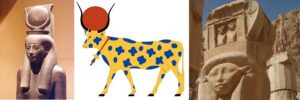
Goddess of Love, Music & Beauty
Hathor was one of Egypt’s most widely worshipped ancient Egyptian goddesses — the embodiment of joy, music, love, and feminine beauty. As one of the manifestations of the Eye of Ra, she had a destructive aspect expressed in her alter-ego Sekhmet, the lioness goddess of war. The Dendera Temple dedicated to Hathor is one of the best-preserved and most colourful temples in Egypt.
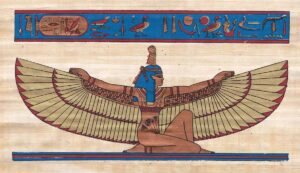
Goddess of Truth, Justice & Cosmic Order
Ma’at was less a personal goddess and more the embodiment of the principle that held the universe together — truth, justice, balance, and cosmic order. In the afterlife, the hearts of the dead were weighed against her single white ostrich feather in the Hall of Two Truths. A heart heavier than the feather would be devoured by the monster Ammit, ending the soul’s existence forever.
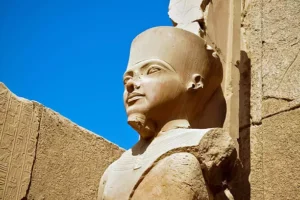
King of the Gods (New Kingdom)
Amun, whose name means “The Hidden One,” rose to become king of all the gods when Karnak Temple in Luxor became Egypt’s most important religious site during the New Kingdom. His merger with the sun god Ra produced Amun-Ra — the supreme deity of the Egyptian state for over 500 years. Karnak Temple, built in Amun’s honour by approximately 30 pharaohs, is the largest religious structure in the world.
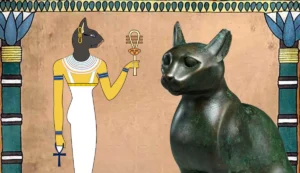
Goddess of Cats, Protection & Fertility
Bastet began as a fierce lioness goddess and gradually became associated with the domestic cat. Her worship drove the widespread veneration of cats in Egypt, where killing a cat was punishable by death. Archaeologists have found hundreds of thousands of mummified cats at her sacred city of Bubastis.
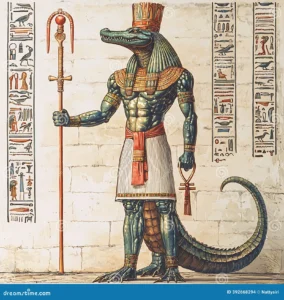
Crocodile God of the Nile
Sobek embodied the raw, fertile power of the Nile. Sacred crocodiles were kept and fed in his temples. The extraordinary Kom Ombo Temple on the Nile between Luxor and Aswan is dedicated jointly to Sobek and Horus — the only surviving double-deity temple in Egypt.
3. The Great Myths of Ancient Egypt
Unlike Greek or Roman myths collected into single narrative texts, ancient Egypt mythology was distributed across thousands of inscriptions, papyri, tomb paintings, and temple reliefs spanning 3,000 years. Nevertheless, several great mythological cycles stand out as the cornerstones of Egyptian religious thought.
💀 The Osiris Myth — Death, Resurrection, and the First Murder
Osiris, the first king of Egypt, was murdered by his jealous brother Set, who tricked him into lying in a coffin, sealed it, and cast it into the Nile. When Osiris’s wife Isis recovered the body, Set dismembered it into 14 pieces and scattered them across Egypt. Isis spent years recovering the pieces and reassembling Osiris — performing the first act of mummification. She revived him long enough to conceive their son Horus, who would grow up to avenge his father. Osiris descended to the underworld to rule as king of the dead.
🦅 The Battle of Horus and Set
The conflict between Horus and Set — nephew and uncle, order and chaos, civilisation and the desert — is one of the oldest stories in ancient Egypt mythology. Over a series of contests judged by the gods, Horus and Set competed for the right to rule Egypt. Set tore out one of Horus’s eyes; Horus castrated Set. Eventually, the gods awarded the kingship to Horus and exiled Set to the desert — where his chaotic energy would continue to serve a purpose as the force that drove away Apophis each night.
🌞 The Solar Journey of Ra
Each day, Ra sailed across the sky in his solar barque, bringing light and life to the world. Each night, he descended into the underworld — the Duat — where his barque was met by the souls of the dead. At the darkest hour, Ra’s barque was attacked by Apophis, the primeval serpent of chaos. It was Set who used his great strength to drive off Apophis and ensure Ra’s sunrise. Without this nightly battle, the sun would never rise again.
The Osiris myth explains why pharaohs were mummified, why they were identified with Horus in life and Osiris in death, and why the weighing of the heart ceremony was performed at death. The myth’s key elements — a dying and rising god, betrayal by kin, a devoted wife’s magical resurrection, and divine justice — parallel themes found in later religious traditions worldwide.
4. Did Seth Get Pregnant by Horus? — The Contendings of Horus and Set
Did Seth get pregnant by Horus? This is one of the most searched questions about Egyptian mythology — and the answer, drawn directly from ancient Egyptian texts, is more complex and fascinating than the question suggests.
The primary source is the Papyrus Chester Beatty I (c. 1150 BC), which contains the most complete version of the Contendings of Horus and Set. In this text, during their extended contest for the throne of Egypt, Set attempted to sexually humiliate Horus in a way that would establish his dominance — in Egyptian culture, the “active” role in such an act conferred power while the “passive” role implied submission.
According to the Papyrus Chester Beatty I, Horus secretly told Isis what Set had attempted. Isis intervened with her magic: she caused Set to ingest Horus’s seed instead of the reverse. When the gods summoned Set to speak before the tribunal, a golden disc — Horus’s seed, transformed — appeared on Set’s head, placed there by Thoth. This was understood as a visible marker of Set’s humiliation. The episode does not describe Set becoming pregnant in a literal sense, but the golden disc appearing on his head was treated as proof that Horus had prevailed in this contest.
What makes this episode so remarkable to modern readers is how frankly ancient Egyptian mythology addressed the sexuality of the gods — including same-sex acts between male deities. These were not portrayed as morally wrong in themselves but as power struggles with theological implications about dominance, order, and chaos.
Egyptologists including John Baines and Geraldine Pinch have noted that this episode reflects the Egyptian theological approach to the body as a locus of power — the gods were not morally sanitised figures but complex beings whose actions encoded cosmological meaning. Set’s attempted dominance represented chaos seeking to overcome order; Horus’s victory (mediated by Isis’s magic) represented the ultimate triumph of legitimate kingship.
5. Was Isis a Virgin? — Sex, Magic & Motherhood in Egyptian Mythology
Was Isis a virgin? No — in the traditional sense of the word, Isis was not a virgin. She was the wife of Osiris and conceived Horus through their union. However, the mythological circumstances of Horus’s conception make this question considerably more theologically interesting than it first appears.
According to the Osiris myth, Isis conceives Horus after Osiris has been murdered and dismembered by Set. In the version recorded by the Greek historian Plutarch (drawing on Egyptian sources), Isis reassembles Osiris’s body but cannot find all the parts — specifically, his phallus, which has been lost in the Nile. Isis creates a golden substitute through magic and uses it to conceive Horus. In this version, the conception is entirely magical and non-biological in the conventional sense.
Many religious historians have noted parallels between the image of Isis magically conceiving Horus and the later Christian tradition of the Virgin Birth. The visual image of Isis nursing the infant Horus — which became widespread across the Mediterranean world — is considered by many scholars to have directly influenced early Christian iconography of Mary nursing the infant Jesus. The parallels include a divine mother, a miraculous conception, and a child destined to restore cosmic order. Whether this constitutes direct influence or parallel development remains a subject of scholarly debate.
The Egyptian texts themselves do not frame Isis as a virgin in the modern sense. What they emphasise is her magical power — her ability to transcend ordinary biology through divine magic (heka). Isis was explicitly described as the most powerful magician in the universe, capable of things that other gods — including Ra himself — could not achieve. The conception of Horus was the supreme expression of this power: she could create life where death had prevailed, order where chaos had struck, and future where the present seemed to have ended.
6. How Did Egyptians View Homosexuality?
How did Egyptians view homosexuality? This is one of the most searched questions about ancient Egyptian social history — and the evidence, while limited, paints a nuanced picture considerably different from what modern readers might expect from an ancient civilisation.
The most celebrated case in Egyptian history is the tomb of Khnumhotep and Niankhkhnum — two high-ranking palace officials who served as royal manicurists to Pharaoh Niuserre during the Fifth Dynasty (c. 2400 BC). Their shared tomb at Saqqara is unique: they are depicted in poses and with epithets normally reserved for married couples, including nose-to-nose touching — the Egyptian equivalent of a kiss. Many Egyptologists interpret this as evidence of a loving relationship between the two men, though a minority argue they may have been twins.
The ancient Egyptian evidence suggests that what mattered was not the gender of the participants in a sexual act but the social role each played. The “active” role was associated with power and dominance; the “passive” role with submission. This is why the Horus–Set episode was theologically charged: it was framed as a contest for dominance, not a moral judgment about same-sex acts as such. No ancient Egyptian legal text explicitly prohibits homosexual behaviour. The evidence overall suggests that ancient Egyptians did not have a category equivalent to the modern concept of “sexual orientation.”
The Book of the Dead contains one negative reference — a declaration that the deceased “has not had sex with another man’s partner” — but this refers to adultery rather than same-sex acts. The evidence overall points to a society where same-sex relationships were possible and not universally condemned, though social power dynamics (active versus passive roles) carried significant cultural weight.
7. Sacred Symbols of the Egyptian Gods
| Symbol | Name | Associated God(s) | Meaning |
|---|---|---|---|
| 𓂀 | Eye of Horus (Wedjat) | Horus, Ra | Protection, healing, royal power |
| ☥ | Ankh | Isis, Osiris, Ra, all gods | Life, immortality, divine protection |
| 𓌀 | Djed Pillar | Osiris, Ptah | Stability, endurance, Osiris’s backbone |
| 🪶 | Feather of Ma’at | Ma’at | Truth, justice, cosmic balance |
| 𓆣 | Scarab (Khepri) | Khepri (Ra at dawn) | Transformation, rebirth, self-creation |
| 🐍 | Uraeus (Cobra) | Wadjet, Ra, pharaoh | Royal authority, divine protection |
| 𓏢 | Crook & Flail | Osiris, pharaoh | Kingship, harvest, divine authority |
| 𓅃 | Falcon / Hawk | Horus, Ra-Horakhty | Sky, kingship, divine vision |
8. The Egyptian Gods Family Tree — Ennead & Divine Genealogy
The Egyptian gods family tree was organised into two key groupings: the Ennead of Heliopolis (nine gods) and the Ogdoad of Hermopolis (eight gods). Who are the 8 Egyptian gods? The Ogdoad consisted of eight primordial deities — Nun and Naunet (water), Heh and Hauhet (infinity), Kek and Kauket (darkness), and Amun and Amaunet (hiddenness) — representing the chaotic forces before creation.
🔟 The Great Ennead of Heliopolis — Who Are the 5 (and 9) Egyptian Gods?
Who are the 5 Egyptian gods most central to Egyptian religion? Ra, Osiris, Isis, Horus, and Set form the dramatic core. But the full Ennead of nine gods emanating from the creator Atum provides the complete divine family structure:
| God | Domain | Relationship in Egyptian Gods Family Tree |
|---|---|---|
| Atum / Ra | Sun, creation | The original creator god |
| Shu | Air, atmosphere | Son of Atum |
| Tefnut | Moisture, rain | Daughter of Atum, sister-wife of Shu |
| Geb | Earth | Son of Shu and Tefnut |
| Nut | Sky | Daughter of Shu and Tefnut, sister-wife of Geb |
| Osiris | Death, resurrection | Son of Geb and Nut |
| Isis | Magic, motherhood | Daughter of Geb and Nut, wife of Osiris |
| Set | Chaos, desert | Son of Geb and Nut, brother of Osiris |
| Nephthys | Funerary rites, mourning | Daughter of Geb and Nut, wife of Set |
9. How Did Ancient Egyptians Worship Their Gods?
Ancient Egyptian religious life was not centred on congregational worship. Instead, the relationship between gods and people was mediated through priests, temples, and the pharaoh. Temples were considered the literal homes of the gods on earth. Each morning, the head priest would enter the innermost sanctuary, break the clay seal on the door, wash and dress the god’s cult statue, present food offerings, recite hymns and prayers, then seal the shrine again.
🏺 How Egyptians Honoured the Gods in Daily Life
- ✅ Household shrines: Small statues of household gods like Bes and Taweret in homes
- ✅ Amulets: Carried at all times — Eye of Horus, scarabs, ankhs for protection
- ✅ Votive offerings: Food, flowers, and statuettes left at temple gates
- ✅ Festival participation: Public celebrations with music, dancing, and processions
- ✅ Personal prayers: Inscribed on stelae placed in temple precincts
- ✅ Dream interpretation: Sleeping near temple sanctuaries to receive divine messages
- ✅ Mummification: Preserving the body under the protection of Anubis and Osiris
10. Where to See the Egyptian Gods in Egypt’s Temples Today
The legacy of the ancient Egyptian gods and goddesses is literally carved in stone. Here are the best temples to visit to experience Egyptian gods pictures with names in their full, ancient glory — exactly as the pharaohs saw them:
Karnak Temple
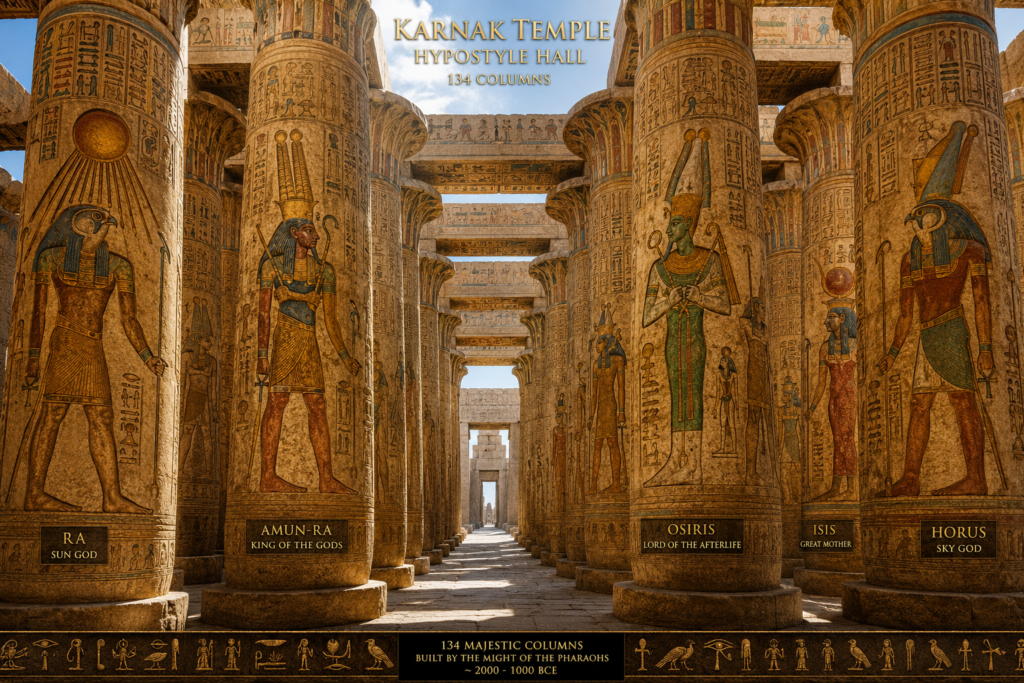
The world’s largest religious complex — 247 acres, built over 1,500 years by 30+ pharaohs. The Hypostyle Hall’s 134 colossal columns are one of the greatest architectural achievements in history. Every major Egyptian god appears somewhere in this complex.
Philae Temple
The last active ancient Egyptian temple — open until the 6th century AD. Sitting on a turquoise island in Aswan, reachable by motorboat. Extraordinary relief carvings of Isis in every aspect of her mythology.
Edfu Temple
The best-preserved temple in Egypt — buried under desert sand until 1860. Walls covered with detailed accounts of the Horus and Set myth. A standard stop on all Nile cruises.
Kom Ombo Temple
The only double temple in Egypt — perfectly symmetrical, right half for Sobek, left for Horus the Elder. Set on a bend of the Nile. Includes an extraordinary crocodile mummy museum.
Dendera Temple
One of Egypt’s most colourful and well-preserved temples — including the famous Dendera Zodiac ceiling (original now in the Louvre). The best place to see pictures of Egyptian gods and goddesses in their original painted glory.
Abu Simbel
Two massive rock-cut temples 280 km south of Aswan. Ramesses II depicted alongside Ra-Horakhty, Amun, and Ptah. Astronomically aligned so the sun illuminates the inner sanctuary twice a year.
11. Egyptian Gods and the Afterlife
No aspect of ancient Egyptian religion was more developed than the afterlife. The journey of the soul after death involved a complex celestial bureaucracy presided over by the Egyptian gods of death.
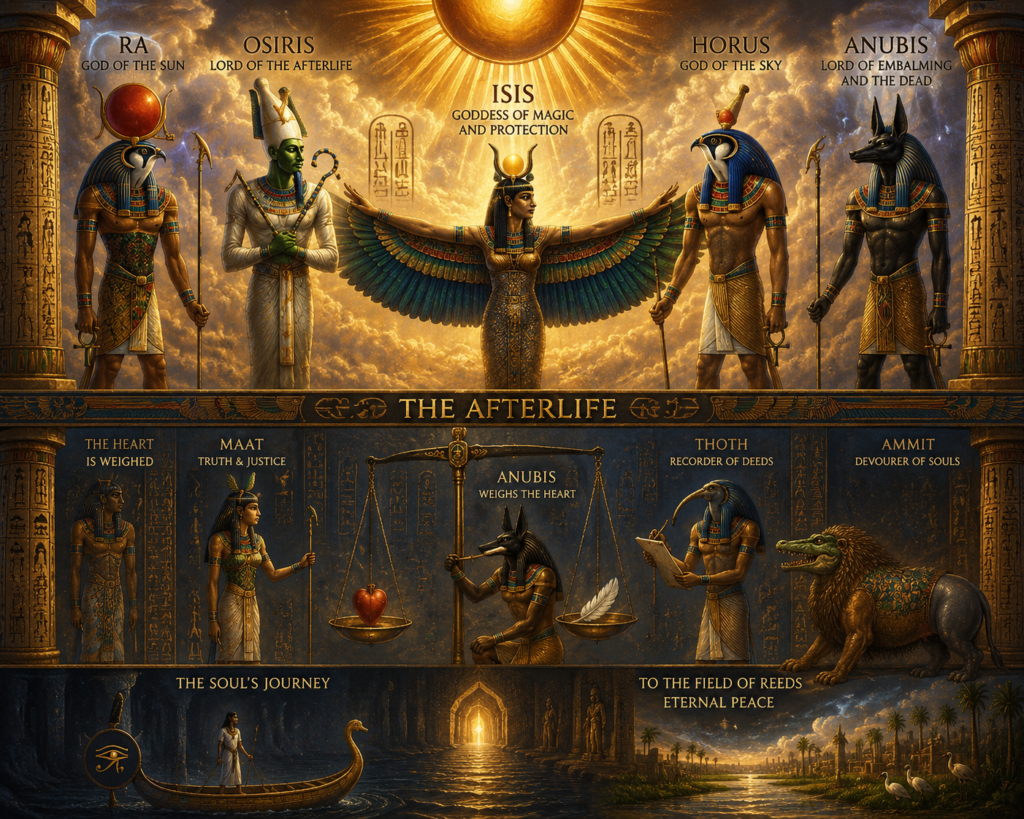
After death, the soul (the ka and ba) had to navigate the underworld, the Duat, guided by the spells in the Book of the Dead. The journey culminated in the Hall of Two Truths, where the heart of the deceased was weighed on scales against the white feather of Ma’at. Anubis operated the scales; Thoth recorded the verdict. If the heart balanced with the feather, the soul was declared worthy and presented to Osiris for entry into the eternal paradise of the Field of Reeds. If the heart was heavier, the monstrous Ammit (part lion, part hippo, part crocodile) would devour it — and the soul would cease to exist.
12. Quick Reference: All Major Egyptian Gods — Complete Names List
The complete Egyptian gods names reference — all major ancient Egyptian gods and goddesses with their domains, appearances, symbols, and where to see their Egyptian gods pictures today:
| God / Goddess | Domain | Appearance | Key Symbol | Where to See |
|---|---|---|---|---|
| Ra (Re) | Sun, creation | Falcon head + sun disc | Sun disc, ankh | All temples; Heliopolis ruins near Cairo |
| Amun-Ra | King of gods | Double-plumed crown | Ram, goose | Karnak Temple, Luxor |
| Osiris | Death, resurrection | Green/black mummified man | Crook & flail, djed | Temple of Abydos, Valley of the Kings |
| Isis | Magic, motherhood | Throne headdress, wings | Ankh, tjet knot | Philae Temple, Aswan |
| Horus | Sky, kingship | Falcon head | Eye of Horus, falcon | Edfu Temple |
| Anubis | Embalming, dead | Black jackal head | Jackal, scales | Valley of the Kings, Cairo Museum |
| Thoth | Wisdom, writing | Ibis head or baboon | Ibis, writing palette | Karnak, Hermopolis ruins |
| Set (Seth) | Chaos, desert | “Set animal” head | Was sceptre | Valley of the Kings, Edfu (as villain) |
| Hathor | Love, music, beauty | Cow horns + sun disc | Sistrum, cow | Dendera Temple, Abu Simbel |
| Ma’at | Truth, cosmic order | Woman with ostrich feather | Feather, scales | All temples (omnipresent) |
| Bastet | Cats, protection | Cat head | Cat, sistrum | Grand Egyptian Museum, Cairo |
| Sobek | Nile, fertility | Crocodile head | Crocodile, was sceptre | Kom Ombo Temple |
| Ptah | Craftsmen, creation | Mummiform man, tight cap | Djed, was sceptre | Abu Simbel inner sanctuary |
| Sekhmet | War, plague, healing | Lioness head | Lioness, solar disc | Karnak (700 statues), Cairo Museum |
| Nephthys | Funerals, mourning | Woman with basket headdress | Basket hieroglyph | Valley of the Kings tombs |
| Khnum | Nile source, creation | Ram head | Potter’s wheel, ankh | Esna Temple |
13. Frequently Asked Questions About Egyptian Gods
The most important Egyptian gods are Ra (sun god and creator), Osiris (god of the dead and resurrection), Isis (goddess of magic and motherhood), Horus (sky god and patron of pharaohs), Anubis (god of embalming), Thoth (god of wisdom and writing), Amun-Ra (king of gods during the New Kingdom), Set (god of chaos), Hathor (goddess of love and music), and Ma’at (goddess of truth and cosmic order).
Ancient Egypt lasted over 3,000 years — from the Early Dynastic Period around 3100 BC to the Roman conquest in 30 BC. This makes it one of the longest-lasting civilisations in human history. Egypt’s extraordinary durability was inseparable from its religious system: the Egyptian gods and goddesses provided a framework of cosmic order (Ma’at) that sustained both the state and the culture across three millennia.
In the Papyrus Chester Beatty I (c. 1150 BC), during the Contendings of Horus and Set, Set attempted to humiliate Horus during their contest for Egypt’s throne. Isis intervened with her magic, causing Set to ingest Horus’s seed instead. Through divine transformation, a golden disc appeared on Set’s head — visible proof before the tribunal of gods that Horus had prevailed. Set did not become pregnant in a literal sense, but this episode reflects how ancient Egyptian mythology used sexuality as a metaphor for power and legitimacy. The full account is in the Papyrus Chester Beatty I, housed in the Chester Beatty Library, Dublin.
Isis was not a virgin in the traditional sense — she was the wife of Osiris and conceived Horus through their union. However, in the version of the myth recorded by Plutarch (drawing on Egyptian sources), Isis conceives Horus after Osiris’s death using magical means — creating a divine substitute through her power of heka (magic). This miraculous, non-biological conception has led many historians to note parallels with the later Christian tradition of the Virgin Birth, particularly as the image of Isis nursing the infant Horus is believed to have influenced early Christian iconography of Mary and the infant Jesus.
The evidence is limited but nuanced. The shared tomb of Khnumhotep and Niankhkhnum at Saqqara (c. 2400 BC) — two palace officials depicted in poses normally reserved for married couples — is widely interpreted by Egyptologists as evidence that same-sex relationships were possible in ancient Egypt. No ancient Egyptian law explicitly prohibits same-sex acts. What mattered in Egyptian social thinking was the power role of each participant (active vs. passive) rather than gender itself. The Horus–Set episode is the most explicit mythological reference and frames same-sex acts as power contests rather than moral violations.
Ancient Egyptians worshipped over 2,000 gods and goddesses across more than 3,000 years of history. However, only a few dozen were truly major deities worshipped throughout all of Egypt. Many deities merged together — such as Amun and Ra becoming Amun-Ra — a process called syncretism. What are the 10 main Egyptian gods? Ra, Osiris, Isis, Horus, Anubis, Thoth, Amun-Ra, Set, Hathor, and Ma’at are consistently ranked as the ten most important.
The Eye of Horus (Wedjat) is one of ancient Egypt’s most powerful symbols, representing protection, royal power, and good health. According to myth, Horus lost his eye in battle with Set, and it was magically restored by Thoth. Today it remains one of the most recognised Egyptian symbols worldwide, appearing in jewellery, tattoos, and popular culture.
Who are the 8 Egyptian gods? The Ogdoad of Hermopolis consisted of eight primordial deities representing the chaotic forces before creation: Nun and Naunet (primordial water), Heh and Hauhet (infinity/boundlessness), Kek and Kauket (darkness), and Amun and Amaunet (hiddenness/air). These eight deities were considered the forces that existed before the gods — the raw material of creation from which the universe emerged.
The Hall of Two Truths was the mythological courtroom of the afterlife where each soul was judged after death. The heart of the deceased was placed on scales and weighed against the white ostrich feather of Ma’at. Anubis operated the scales; Thoth recorded the verdict; Osiris presided as judge. A heart lighter than or equal to the feather indicated a virtuous life. A heavier heart would be devoured by Ammit — ending the soul’s existence permanently.
After Alexander the Great’s conquest of Egypt in 331 BC, deliberate syncretism occurred between Egyptian gods and goddesses and Greek gods. Amun became associated with Zeus, Thoth with Hermes (producing Hermes Trismegistus), Horus with Apollo, Isis with Aphrodite. The Ptolemaic dynasty created the god Serapis — a blend of Osiris and the sacred bull Apis with Greek Zeus — to unite their Greek and Egyptian subjects.
The best places to see Egyptian gods pictures with names in their original temple context: Karnak Temple (Amun-Ra, Luxor), Philae Temple (Isis, Aswan), Edfu Temple (Horus), Kom Ombo (Sobek and Horus), Abu Simbel (Ramesses II with Ra-Horakhty, Amun, Ptah), Dendera Temple (Hathor). All are accessible via Hurghada To Go excursions and Nile cruise packages.
14. Final Thoughts: The Eternal Power of the Egyptian Gods
The gods of ancient Egypt have never really left. They live in the towering columns of Karnak, in the painted walls of the Valley of the Kings, in the island temple of Isis at Philae catching the last of the Aswan sunlight. They live in the Eye of Horus worn as a pendant in London and New York. They live in every museum case displaying a golden funerary mask, every papyrus fragment recording a prayer to Osiris, every carved scarab amulet that passed from hand to hand across three thousand years of faith.
What empire lasted 3,000 years? The civilisation that created these gods. What sustained it? The belief that Ra rose each morning, that Ma’at maintained cosmic order, that Osiris awaited the just soul at the end of life’s journey. These were not abstract philosophical positions — they were the lived reality of millions of people for over a hundred generations.
What makes the Egyptian gods and goddesses so enduringly compelling is not their strangeness but their familiarity. In Ra’s daily battle against darkness, we recognise the human struggle against fear. In Osiris’s death and resurrection, we recognise hope for life beyond death. In Isis’s fierce love, we recognise devotion. In Ma’at’s feather of justice, we recognise the ancient longing for a world where truth is rewarded.
These are not just ancient stories. They are the earliest surviving expressions of the questions that still define us. And in Egypt’s temples, those expressions are still standing — waiting for you.
🏛️ Experience the Egyptian Gods in Person
Book your temple tour from Hurghada with Hurghada To Go and walk in the footsteps of the pharaohs — guided by expert Egyptologists who bring the gods alive through story, symbol, and stone.
✅ Karnak Temple (Amun-Ra) ✅ Philae Temple (Isis) ✅ Edfu Temple (Horus) ✅ Kom Ombo (Sobek) ✅ Abu Simbel
📧 [email protected] | 🌐 hurghadatogo.com | WhatsApp available 24/7
© 2026 Hurghada To Go · hurghadatogo.com