
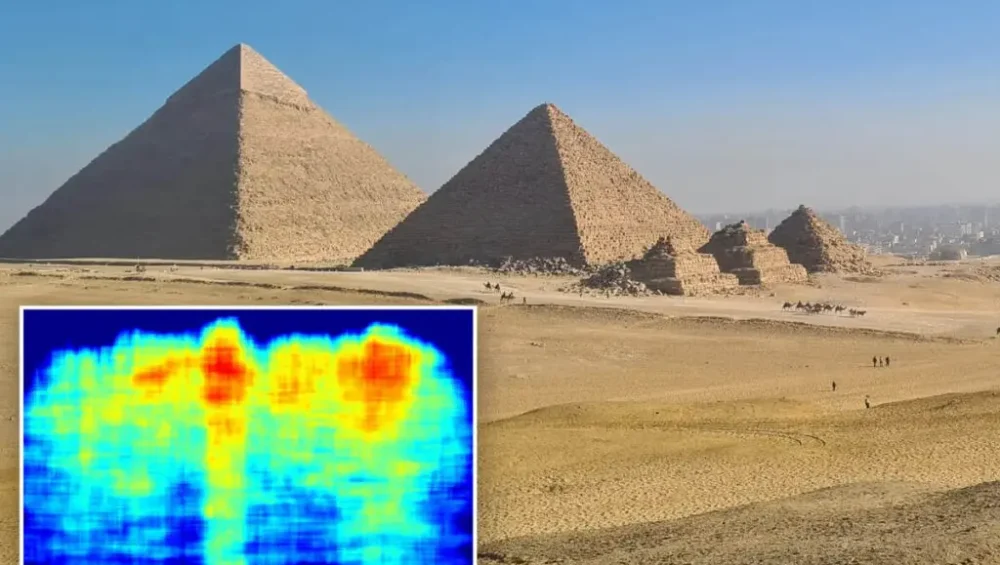
Unveiling the Hidden Heart of the Great Pyramid: Groundbreaking Muon-Imaging Discoveries Rewrite What We Thought We Knew
For over 4,500 years, the Great Pyramid of Giza has stood on the Giza plateau as the ultimate symbol of ancient human ambition. We’ve measured it, photographed it, crawled through its known passages, and argued endlessly about how (and why) it was built. Most Egyptologists believed we had a reasonably complete picture of its internal layout: the King’s Chamber, Queen’s Chamber, Grand Gallery, subterranean chamber, and a handful of narrow shafts. Yet every few decades, the pyramid reminds us that it still keeps secrets.
In late 2025, an international team of physicists, archaeologists, and engineers quietly released one of the most important datasets in the history of pyramid research. Using cutting-edge muon tomography—essentially turning the Earth into a giant X-ray machine powered by cosmic rays—they have mapped previously invisible voids deep inside the limestone core of Khufu’s monument. What they found is breathtaking: a network of hidden cavities that appear deliberate, precisely placed, and utterly unknown to modern scholarship until now.
Cosmic Rays Meet 4,500-Year-Old Stone
If you’re not familiar with muon imaging, here’s the short version. Every second, billions of muons—subatomic particles created when cosmic rays smash into Earth’s atmosphere—rain down on us. These ghostly particles pass effortlessly through empty space but slow down and get absorbed when they hit dense matter like stone. By placing highly sensitive detectors inside and around the pyramid for months (sometimes years), researchers can count how many muons arrive from different angles. Fewer muons = denser material. More muons = something hollow behind the stone.
This isn’t new science—the ScanPyramids project used muon tomography back in 2015–2017 to discover the famous “Big Void” above the Grand Gallery. But the new campaign, conducted between 2022 and 2025, deployed detectors with dramatically higher resolution and coverage. Think of it as the difference between a 1990s ultrasound and a modern 8K medical scanner. The results are three-dimensional density maps so sharp that researchers can now spot cavities only a few meters across, buried hundreds of feet inside solid limestone.
What the New Scans Actually Show
The headline finding: at least six major previously unknown voids, plus dozens of smaller anomalies, scattered throughout the pyramid’s core. These aren’t random cracks or erosion pockets. They have crisp, straight boundaries. Some are rectangular, others form long, narrow corridors that run parallel to known passages. One void sits almost perfectly centered above the King’s Chamber, aligned with the pyramid’s north-south axis to within a fraction of a degree.
Even more intriguing are the traces left inside the cavities. The scans picked up thin, uniform layers that the team interprets as ancient mortar residues—exactly the kind of gypsum mortar the Egyptians used to level and bed their blocks. In several places, the density patterns suggest tool marks: the faint, regular scratches left by copper chisels or wooden mallets. These are not natural features. Someone built these spaces on purpose, then carefully sealed them behind millions of tons of masonry.
Echoes of Lost Architectural Plans
Here’s where it gets really exciting for pyramid nerds (and yes, I count myself among them). When the team overlaid the new void map onto some of the rare surviving architectural sketches from ancient Egypt—fragments preserved on papyrus and ostraca from the Middle Kingdom and later—they found startling correspondences.
For decades, a minority of researchers have argued that the Great Pyramid contained internal ramps or spiral passageways used during construction and then sealed up. Others proposed elaborate systems of counterweight shafts or “relieving chambers” far more complex than the five narrow compartments we already know above the King’s Chamber. The new voids line up almost perfectly with several of these hypothetical layouts. One cavity follows the exact path predicted in 1984 by French architect Jean-Pierre Houdin for his famous internal-ramp theory. Another matches a void proposed (but never proven) by German engineer Rudolf Gantenbrink based on his 1993 robot exploration of the Queen’s Chamber shafts.
Suddenly, ideas that were once dismissed as fringe are looking a lot more respectable.
So What Were These Voids For?
That, of course, is the million-dollar question. The researchers are rightly cautious, but they’ve floated several plausible explanations:
- Construction logistics – Hidden ramps, lifting shafts, or staging chambers that allowed workers to move two-ton blocks far inside the growing pyramid before sealing everything up.
- Structural engineering – Additional relieving chambers to distribute the enormous weight of stone above the King’s Chamber, preventing the kind of collapse that damaged the Bent Pyramid and Meidum pyramid earlier in the Fourth Dynasty.
- Symbolic or ritual function – The ancient Egyptians were obsessed with symmetry, cosmology, and the journey of the pharaoh’s soul. Hidden chambers aligned with cardinal directions or star positions would fit perfectly with their worldview.
- A combination of all three – The Egyptians were practical people. Why not design spaces that serve multiple purposes—practical, structural, and sacred—all at once?
Whatever the answer, the precision of these hidden voids forces us to rethink the technological sophistication of Fourth-Dynasty builders. We already knew they could move 2.3 million blocks with astonishing accuracy, but embedding an entire unseen architecture inside the monument—perfectly aligned, perfectly executed, and perfectly hidden—takes organizational skill and engineering foresight to another level.
Why This Changes Everything
For most of the 20th century, the standard model of pyramid evolution was fairly linear: simple mastabas → step pyramids → failed experiments (Bent and Meidum) → the “true” pyramid perfected at Giza. The internal design was assumed to be relatively straightforward, with a few chambers and corridors carved as the structure rose.
These new discoveries blow that model apart. The Great Pyramid wasn’t just bigger than its predecessors—it was fundamentally more complex in ways that were completely invisible from the outside. Khufu’s architects didn’t merely scale up earlier designs; they invented an entirely new kind of internal architecture that no later pyramid ever matched.
The Long Road Ahead
Before anyone starts dreaming of hidden burial chambers filled with golden treasures (sorry, that’s almost certainly not what we’re looking at), the team stresses that much more work is needed. The current scans give us location and approximate shape, but not fine detail. Next steps include:
- Deploying even higher-resolution detectors for targeted follow-up campaigns.
- Using acoustic or micro-gravimetry methods to cross-check the muon data.
- Drilling tiny (5–10 mm) exploratory holes—something Egyptian authorities have historically been reluctant to allow—in carefully chosen locations to insert endoscopes.
Even if physical exploration never happens, the existing dataset will keep researchers busy for years. Computer modeling can now test how these voids affect stress distribution throughout the pyramid. Historians can re-examine ancient texts for clues we previously overlooked. And architects can study one of the most sophisticated load-bearing designs in human history—built without computers, steel, or even the wheel.
A Monument That Refuses to Stay Solved
The Great Pyramid has humbled generations of explorers. Flinders Petrie thought he’d measured everything worth measuring in the 1880s. Howard Vyse blasted his way into relieving chambers in the 1830s and declared the interior “fully explored.” The ScanPyramids Big Void in 2017 reminded us how wrong that confidence was.
Now, in 2025, the pyramid has done it again. Just when we thought the age of major discoveries was over, cosmic rays have peeled back another layer of mystery.
Khufu’s great monument is not a static relic. It is a living puzzle—one that keeps revealing new pieces long after we thought the box was empty. And if history is any guide, these newly discovered voids are probably just the beginning.
The Great Pyramid still has secrets. And thanks to 21st-century physics meeting 26th-century-BC engineering, we’re finally getting a glimpse of what it’s been hiding all along.
Jean-Pierre Houdin’s Internal Ramp Theory: A Revolutionary Idea for Building the Great Pyramid
The Great Pyramid of Giza, built around 2580–2560 BCE for Pharaoh Khufu, remains one of humanity’s most enduring enigmas. How did ancient Egyptians, without modern machinery, stack 2.3 million stone blocks—some weighing up to 80 tons—to create a 481-foot-tall structure with astonishing precision? Over the centuries, theories have ranged from massive external ramps to lever systems and even wild speculation about alien assistance. In 2000, French architect Jean-Pierre Houdin introduced a groundbreaking hypothesis: an internal spiral ramp hidden within the pyramid itself. This theory, refined over decades with computer modeling and collaborations, aims to explain the construction logically while addressing flaws in earlier ideas. Below, I’ll break it down step by step, including how it works, the evidence supporting it, and the ongoing debates.
The Core Mechanism: Building from the Inside Out
Houdin’s theory combines practicality with ingenuity, drawing on his background in architecture and 3D modeling. He argues that a single massive external ramp (as some traditional theories suggest) would have been impractical—it would require as much material as the pyramid itself and leave behind enormous debris. Instead, the process unfolds in phases:
-
The External Ramp Phase (Lower Third): For the bottom 30–40% of the pyramid (up to about 141–200 feet high), workers used a straight external ramp made of mudbrick and limestone chips. This ramp, sloping at around 7–8 degrees, allowed teams to drag blocks up using ropes, sleds, and lubricants like water or oil. As the pyramid grew, the external ramp was extended and eventually dismantled, with its materials recycled into the structure’s upper levels. This explains why no massive ramp remnants have been found archaeologically.
-
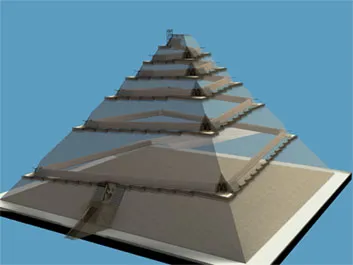
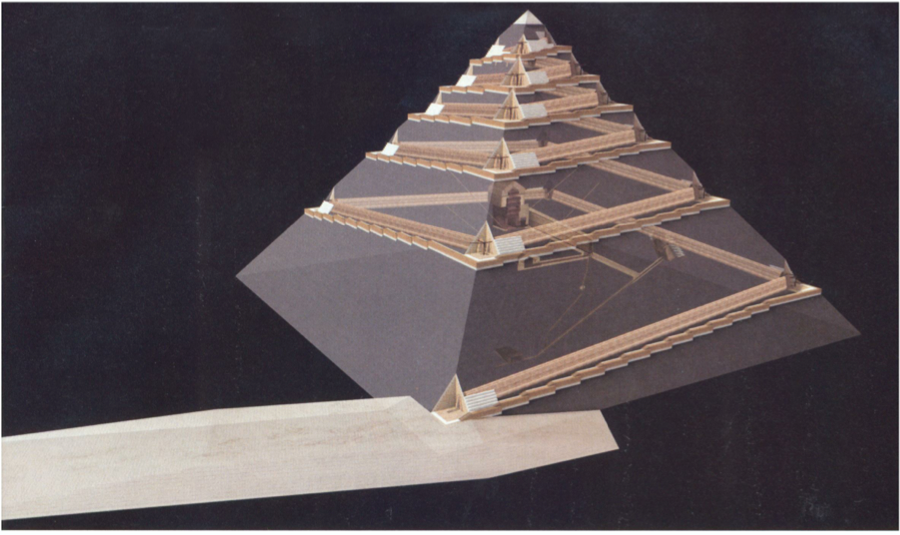
The Internal Spiral Ramp (Upper Two-Thirds): Here’s the innovative part. Once the lower section was complete, construction shifted inward. Houdin proposes a spiral ramp built inside the pyramid, running parallel to the outer faces about 20–30 feet beneath the surface. This tunnel-like ramp, roughly 7–10 feet wide and with a gentle 7% incline, spirals upward in a counterclockwise direction, hugging the pyramid’s edges. It turns 90 degrees at each corner through temporary open “notches” in the exterior—gaps left in the stonework where wooden cranes or hoists could pivot the 2–3-ton limestone blocks around the bend.
As layers were added, the ramp was extended upward, and blocks were hauled along it by teams of workers (possibly 20–50 per block). Once a section was finished, the notches were filled in from the top down, sealing the ramp inside. This internal system allowed the pyramid to be built “from the inside out,” with the outer casing stones (the smooth limestone facing, mostly stripped away in medieval times) placed as construction progressed.
-
Special Features for Heavy Lifting: Houdin also integrates known internal elements. The Grand Gallery—a long, corbelled corridor inside the pyramid—serves as a counterweight system. Heavy granite beams (up to 60 tons) for the King’s Chamber were lifted using a trolley-and-pulley setup, with counterweights (filled with sand or stones) sliding down the gallery to provide the necessary force. This echoes ancient Greek historian Herodotus’s accounts of “machines made of short wooden planks” used in pyramid building.
Houdin developed this using CAD software, partnering with Dassault Systèmes (a French engineering firm) to simulate the process. Their models show it could have been done with about 4,000 workers over 20–23 years, aligning with historical estimates.
To visualize this, here’s a diagram illustrating the spiral path of the internal ramp:
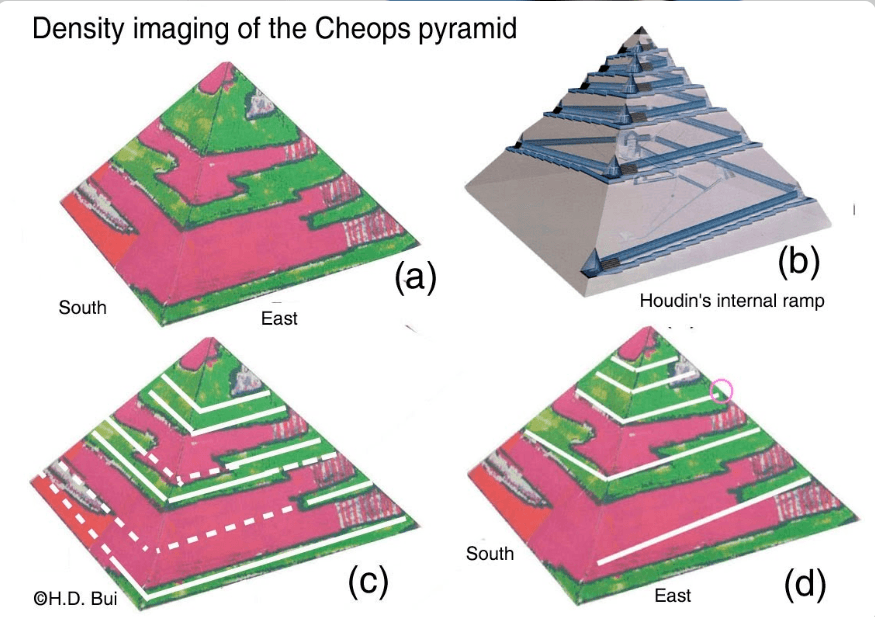
Another view highlights the density variations that might indicate the ramp’s path:
Supporting Evidence: From Scans to On-Site Discoveries
Houdin’s theory isn’t just speculation—it’s backed by indirect evidence from modern technology and explorations:
- Microgravimetric Surveys (1980s): A French team’s density scans revealed anomalies: lower-density areas spiraling inside the pyramid, parallel to the faces, with turns at the corners. These could be remnants of unfilled ramp spaces or construction voids.
- The Northeast Notch (1986–2008): A visible notch on the pyramid’s northeast edge, about 270 feet up, matches where a corner turn would occur. In 1986, a researcher spotted a desert fox disappearing into it, hinting at an internal space. In 2008, Egyptologist Bob Brier and a National Geographic team entered a small L-shaped chamber behind it (11 feet long, 5 feet wide), with arched supports and mortar residue suggesting it was a turning point for blocks. This chamber aligns perfectly with Houdin’s predictions.
- Muon Tomography and ScanPyramids Project (2015–2022): Recent muon-imaging (using cosmic rays to map voids) by the ScanPyramids team detected cavities that correlate with Houdin’s ramp path. In 2022, Houdin updated his theory to incorporate these findings, refining the ramp’s layout to match new density maps.
- Feasibility Modeling: Dassault’s simulations confirm the ramp’s slope and turns are workable with ancient tools like copper chisels, wooden levers, and ropes. It also explains why the pyramid’s core has rougher stones while the exterior was precise.
This cross-section diagram shows how the ramp might integrate with known chambers:
Criticisms and Alternatives: Not Without Controversy
While intriguing, Houdin’s theory has faced pushback from Egyptologists and engineers, who argue it’s overly complex and lacks direct proof:
- Complexity and Practicality Issues: Critics like David Jeffreys call it “far-fetched and horribly complicated,” questioning how workers navigated dark, enclosed ramps (potentially leading to carbon monoxide buildup from torches) or maneuvered blocks around 24 right-angle turns. Placing the smooth outer casing stones amid construction would be tricky, and the required wooden cranes at corners are seen as speculative.
- Lack of Direct Evidence: Despite explorations (including Brier and Houdin’s own 2008 expedition documented in a National Geographic special), no clear internal ramp tunnel has been found. Scans show voids, but they could be structural relieving chambers or natural flaws, not ramps.
- Scope Limitations: Some, like John Baines, note it focuses solely on the Great Pyramid, ignoring how similar methods might apply (or not) to other pyramids. The initial external ramp is still massive (670 yards long), raising the same debris issues as purely external theories.
Alternatives include:
- External Wrapping Ramp: A ramp spiraling around the outside, but this would obscure alignment and require vast material.
- Straight External Ramp with Levers: Building in stages with smaller ramps and levering blocks up, though this struggles with the upper heights.
- Movable Ramp Theory: Proposed by critics like Franz Löhner, using adjustable external ramps that avoid internal complexity.
Despite debates, Houdin’s idea has gained traction, especially with muon scans providing new data. As of 2025, ongoing non-invasive studies (like further imaging) could confirm or refute it. Published in books like The Secret of the Great Pyramid (2008, co-authored with Brier), it represents a shift toward interdisciplinary approaches—blending architecture, engineering, and archaeology—to unlock ancient secrets.
In essence, Houdin’s theory portrays the Egyptians as master planners who embedded their construction infrastructure within the monument itself, turning the pyramid into a self-contained building machine. Whether it’s the definitive answer or not, it challenges us to appreciate the ingenuity of the past.
Comparing Jean-Pierre Houdin’s Internal Ramp Theory to Other Great Pyramid Construction Theories
The construction of the Great Pyramid of Giza has puzzled scholars for millennia, with no definitive ancient records explaining the exact methods used by Fourth Dynasty Egyptians around 2580–2560 BCE. Jean-Pierre Houdin’s internal spiral ramp theory, which posits a hidden ramp system built within the pyramid’s structure, has gained attention for its elegance and alignment with modern scans. However, it competes with several other hypotheses, each attempting to explain how 2.3 million blocks were precisely placed without modern machinery. Below, I’ll outline the major alternative theories, drawing from archaeological evidence, engineering analyses, and recent studies. I’ll then provide a direct comparison, highlighting strengths, weaknesses, and how they stack up against Houdin’s idea.
To visualize these concepts, here are some illustrative diagrams from various sources:
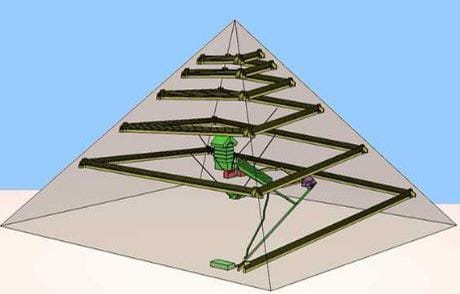
Major Alternative Theories
- Straight External Ramp Theory This classic idea suggests a single, massive ramp extending from the Nile quarry to the pyramid’s base, gradually lengthened and heightened as construction progressed. Workers would drag blocks up the ramp using sleds, ropes, and lubricants like water. Proposed by early Egyptologists like Flinders Petrie in the 19th century, it’s based on remnants of smaller ramps found at other pyramid sites.
- Wrapping (or Spiral) External Ramp Theory Here, a ramp spirals around the pyramid’s exterior, wrapping like a corkscrew as layers are added. This allows continuous access to the working face without a single enormous structure. Variants include a ramp that zigzags up one or more sides. Advocated by researchers like Mark Lehner, it’s inspired by quarry evidence and smaller pyramid constructions.
- Levering or Zigzag Side Ramp Theory Instead of full ramps, this involves using wooden levers, rollers, and short, switchback ramps on the pyramid’s steps or sides to lift blocks layer by layer. It’s often combined with other methods for the upper sections. This draws from ancient texts like Herodotus’s descriptions of “machines made of short wooden planks” and experimental archaeology.
- Pulley-Like Systems Theory A more recent proposal from a 2025 study suggests using rope-based pulley systems with counterweights to hoist blocks vertically or along inclined paths. This could involve temporary wooden frames or the pyramid’s own structure for leverage, minimizing ramp needs. It’s grounded in engineering simulations and comparisons to ancient lifting techniques in other cultures.
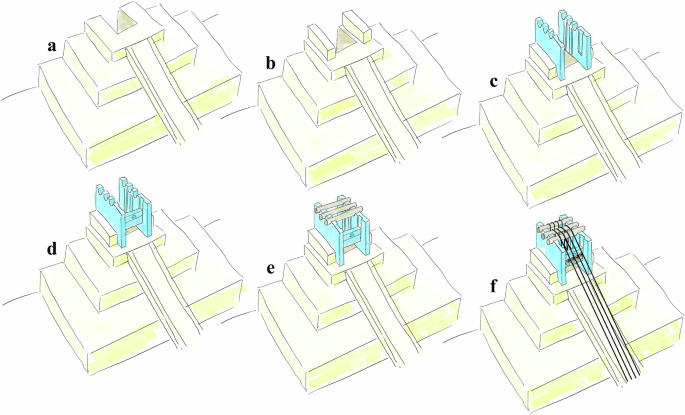
- Counterweight and Internal Features Theory This focuses on the pyramid’s known internal elements, like the Grand Gallery, as part of a counterweight system where sand-filled sleds or weights helped lift heavy granite beams. Often integrated with ramps, it’s supported by Houdin himself for specific parts but emphasized more by others like Bob Brier.
Other fringe ideas, like water flotation via canals or acoustic levitation, lack substantial evidence and are generally dismissed by experts.
Comparison Table
To make the contrasts clearer, here’s a table summarizing key aspects of Houdin’s theory alongside the main alternatives. Ratings for feasibility are based on modern consensus from engineering and archaeological sources, where Houdin’s scores highly due to scan correlations but isn’t universally accepted.
| Theory | Brief Description | Pros | Cons | Evidence/Support | Comparison to Houdin |
|---|---|---|---|---|---|
| Houdin’s Internal Spiral Ramp | Hidden spiral ramp inside the pyramid, transitioning from an external base ramp; sealed after use. | Efficient material use; explains internal voids from scans; allows precise alignment. | Complex to build in dark, enclosed spaces; unproven by direct exploration. | Microgravimetry scans (1980s), muon tomography (2010s–2020s), northeast notch chamber. | N/A – Baseline for comparison. It’s unique in hiding the ramp internally, addressing visibility and debris issues in external theories. |
| Straight External Ramp | Long, straight ramp extended upward from the base. | Simple design; workable for lower levels with large workforce. | Requires massive earthworks (ramp volume could exceed pyramid’s); too steep for top (~50% incline needed). | Ramp remnants at other sites (e.g., Sinki pyramid); quarry evidence. | Less sophisticated than Houdin; doesn’t explain internal anomalies but avoids enclosed-space risks. Houdin critiques it for impracticality at height. |
| Wrapping External Ramp | Spiral or zigzag ramp around the exterior. | Reuses ramp material; provides all-around access. | Obscures pyramid faces during building, complicating surveying; no clear remnants. | Theoretical models; similar ramps in Middle Kingdom tombs. | Similar spiral concept but external vs. internal; Houdin’s version hides the ramp, preserving aesthetics and explaining why no external traces remain. Critics say wrapping would leave visible scars, unlike Houdin’s sealed approach. |
| Levering/Zigzag Side Ramps | Short ramps and levers for layer-by-layer lifting. | Minimal infrastructure; flexible for upper tiers. | Labor-intensive; risky for heavy blocks; doesn’t scale well for precision. | Herodotus’s accounts; experimental recreations with small blocks. | Complementary to Houdin (he incorporates levers); less comprehensive for the whole structure. Houdin adds ramps for efficiency, while this emphasizes manual tools over built pathways. |
| Pulley-Like Systems | Rope pulleys with counterweights for vertical lifts. | Reduces friction; feasible with ancient materials like copper ropes. | Requires advanced knowledge of mechanics; potential for breakage. | 2025 engineering simulations; parallels in Roman cranes. | Could integrate with Houdin (e.g., for Grand Gallery); differs by focusing on lifting tech over ramps. Houdin’s ramp handles horizontal movement better, but pulleys might explain heavy beam placement where ramps falter. |
| Counterweight Systems | Using internal gallery for weighted sleds to lift blocks. | Explains Grand Gallery’s purpose; efficient for heavy loads. | Limited to specific sections; needs ramps for initial placement. | Gallery architecture; Houdin’s own models. | Often blended with Houdin; enhances his theory rather than competing. It addresses vertical lifts that a pure ramp might struggle with. |
Key Insights from the Comparisons
Houdin’s theory stands out for its integration of modern imaging data, like muon scans revealing internal voids that align with his predicted ramp path—something external theories can’t explain without additional hypotheses. External ramp ideas are simpler but logistically flawed for a structure as tall as Giza’s, often requiring ramps longer than the Nile’s width. Mechanical theories like pulleys or counterweights offer innovative alternatives but lack the comprehensive scope of Houdin’s model, which covers the entire build process.
Critics argue Houdin’s is “overly complicated” and untestable without invasive exploration, while supporters point to non-destructive evidence like the 2008 notch discovery. No single theory is proven, and many experts favor hybrids (e.g., external ramps for the base, internal or mechanical for the top). Ongoing muon tomography and simulations may tip the scales, but for now, Houdin’s remains one of the most substantiated due to its predictive power with 21st-century tech.
Easy & Secure Booking
🌐Official Website: hurghadatogo.com
📧 Email: [email protected]
📱 WhatsApp: +201009255585
We also recommend you :
Luxor Overnight Nile-Side Stay from Hurghada – Karnak, Valley of the Kings
Luxor Day Tour by Air from Hurghada – Quick Dive into Ancient Egypt 2026
Luxor Private 2-Day Adventure from Safaga & Red Sea Coast 2026
Cairo Day Trip + Red Sea Evening from Hurghada 2026
Cairo Overnight Tour from Makadi Bay – Pyramids, Museum & Old Town 2026
Cairo Private Charter Day from Soma Bay – Giza Pyramids & Sphinx
Cairo Shopping & Sightseeing Day Tour from Safaga – Giza, Khan El Khalili