

The Nubian Egg: An Ancient Artifact and Its Mysteries
The Nubian Egg, found in a 7000 year old
The “Nubian Egg” refers to a remarkable archaeological find: an engraved ostrich eggshell discovered in 1907 by British archaeologist Mallaby Cecil Firth in a tomb near Aswan, Egypt, associated with the Naqada I culture (also known as Amratian period). This pre-dynastic Egyptian culture dates the artifact to approximately 5000–4000 BCE, making it roughly 7,000 years old. Today, it is housed in the Nubian Museum in Aswan, where it serves as a symbol of ancient Nubian heritage, which historically encompassed southern Egypt and northern Sudan along the Nile.
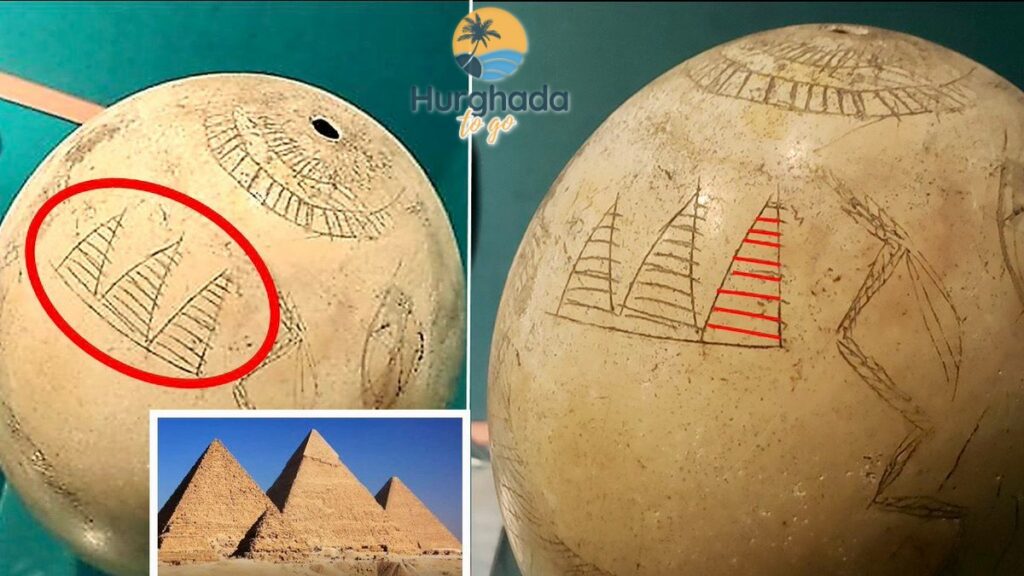
Description and Significance
- Physical Details: The egg is a complete ostrich eggshell, about the size of a large chicken egg but thicker and more durable. Ostrich eggs were commonly used in ancient cultures for burials, rituals, and as containers due to their symbolic association with fertility, rebirth, and the cosmos (the egg shape evoking creation myths).
- Engravings: The shell features intricate etchings, including:
- Three triangular shapes with horizontal lines across them, positioned side by side.
- A zigzag or snake-like line on one side (often interpreted as a river).
- A rounded “globule” or blob on the opposite side.
- Concentric circles near the top, possibly indicating a calendar, astronomical markers, or a portal-like motif.
- Cultural Context: In Nubian and early Egyptian traditions, eggshells like this were often placed in graves as grave goods, possibly containing offerings or serving as amulets. The engravings may represent symbolic elements like mountains, fertility symbols, or ritual patterns rather than literal depictions.
The Pyramid Controversy
The Nubian Egg has sparked widespread debate, particularly online, due to claims that the three triangles depict the Pyramids of Giza (Khufu, Khafre, and Menkaure). This theory gained traction through social media, YouTube videos, and articles suggesting it “proves” the pyramids are far older than the established date of ~2580–2500 BCE (about 4,500–4,600 years old). Proponents argue:
- The triangles align from largest to smallest, mirroring the Giza layout.
- The zigzag resembles the Nile River flowing eastward of the pyramids.
- This would imply knowledge of the pyramids 2,500+ years before their construction, hinting at lost civilizations like Atlantis.
However, this interpretation is widely regarded as a modern misconception by archaeologists and skeptics. Key rebuttals include:
- Chronological Mismatch: The Giza pyramids were built during the 4th Dynasty, millennia after the egg’s tomb. Nubian pyramids in Sudan (from the Kingdom of Kush, ~751 BCE onward) are steeper and more numerous but still post-date the egg by thousands of years.
- Alternative Explanations: The triangles likely symbolize stylized mountains or hills in the Western Desert near the Nile, common in pre-dynastic art. The “zigzag” could represent a river or serpent (a protective symbol like Wadjet), and the whole may be a map of local geography or a fertility/rebirth motif. Ostrich eggs are notoriously hard to carbon-date precisely without destructive testing, but the tomb’s stratigraphy firmly places it in the Naqada I era.
- No Scientific Support for Rewriting History: Carbon-14 dating has been applied to pyramid-related materials (e.g., mortar and wood), confirming the 4th Dynasty timeline. The egg’s engravings predate pyramid-building technology, and similar motifs appear in other Naqada artifacts without pyramidal intent.
The buzz largely stems from viral posts (e.g., on Reddit and TikTok) that ignore archaeological context, often linking to fringe theories about ancient Egypt’s “true” age.
Where to See It
If you’re in Egypt, visit the Nubian Museum in Aswan—it’s a highlight of their collection on Nubian history. Photos and 3D models (like on Sketchfab) offer virtual views, but nothing beats the real thing.

Comparison of Nubian and Giza Pyramids
The Nubian pyramids (primarily in Sudan) and the Giza pyramids (in Egypt) are iconic structures from ancient African civilizations, but they differ significantly in historical context, purpose, design, and cultural significance. Below is a detailed comparison based on available archaeological evidence and historical records.
1. Location and Cultural Context
- Nubian Pyramids:
- Location: Found in ancient Nubia, modern-day northern Sudan, at sites like Meroë, Napata, and Nuri.
- Culture: Built by the Kingdom of Kush, a powerful Nubian civilization (c. 1070 BCE–350 CE) that interacted closely with ancient Egypt, often adopting and adapting Egyptian traditions.
- Historical Period: Constructed primarily between the 8th century BCE and 4th century CE, with the bulk from ~751 BCE onward during the Meroitic period.
- Purpose: Served as royal tombs for Kushite kings, queens (Kandakes), and nobles, reflecting a funerary tradition influenced by Egyptian practices but with distinct Nubian elements.
- Giza Pyramids:
- Location: Located on the Giza Plateau near Cairo, Egypt.
- Culture: Built by the ancient Egyptians during the Old Kingdom, specifically the 4th Dynasty (c. 2580–2500 BCE).
- Historical Period: Constructed around 4,500–4,600 years ago, predating the Nubian pyramids by over 1,500 years.
- Purpose: Royal tombs for pharaohs (Khufu, Khafre, Menkaure), symbolizing divine kingship and the afterlife journey, aligned with Egyptian cosmology and solar worship.
2. Design and Architecture
- Nubian Pyramids:
- Size: Smaller, typically 6–30 meters (20–100 feet) tall, with bases rarely exceeding 18 meters wide.
- Shape: Steeper, with angles of 68–70 degrees, giving a more pointed appearance compared to Egyptian pyramids.
- Materials: Built with sandstone and local stone, often covered with white plaster or painted. Some had capped tops or decorative elements.
- Construction: Simpler techniques, using smaller blocks and rubble fill, reflecting less centralized labor compared to Giza. Many have small attached chapels for offerings.
- Number: Over 250 pyramids across Nubian sites, far more numerous than Egypt’s major pyramids, reflecting a broader tradition of royal burials.
- Giza Pyramids:
- Size: Much larger, with the Great Pyramid (Khufu) originally 146.5 meters (481 feet) tall and a base of 230 meters (755 feet) per side.
- Shape: Shallower angles (51–53 degrees), creating a broader, more gradual profile.
- Materials: Constructed with limestone (outer casing, mostly gone) and granite for internal chambers, sourced from distant quarries (e.g., Aswan for granite).
- Construction: Highly precise engineering, using massive stone blocks (some weighing 15–80 tons), with advanced surveying and labor organization (tens of thousands of workers).
- Number: Only three major pyramids (Khufu, Khafre, Menkaure) plus smaller satellite pyramids and the Great Sphinx.
3. Chronology and Historical Overlap
- Nubian Pyramids: Built much later, starting around the 8th century BCE, during the Kushite 25th Dynasty of Egypt (when Nubians ruled Egypt, c. 744–656 BCE) and continuing into the Meroitic period. They reflect a revival of pyramid-building inspired by earlier Egyptian models.
- Giza Pyramids: Built c. 2580–2500 BCE, during Egypt’s Old Kingdom, a peak of centralized power and monumental architecture. By the time Nubian pyramids were built, Giza’s pyramids were already ancient landmarks.
- Interaction: The Kushites were influenced by Egyptian architecture, likely visiting Giza during their rule over Egypt. However, Nubian pyramids adapted the form to local resources and cultural priorities.
4. Cultural and Symbolic Significance
- Nubian Pyramids:
- Reflected Kushite beliefs in the afterlife, blending Egyptian influences (e.g., mummification) with local traditions.
- Often accompanied by Meroitic script inscriptions (unique to Nubia) and offerings like jewelry, pottery, and animal sacrifices.
- Symbolized royal power in a decentralized society, with pyramids spread across multiple sites rather than a single necropolis.
- Many were looted in the 19th century by treasure hunters like Giuseppe Ferlini, damaging their preservation.
- Giza Pyramids:
- Embodied Egyptian cosmology, aligned with celestial bodies (e.g., Orion’s Belt) and the sun god Ra, symbolizing the pharaoh’s divine ascent.
- Part of a larger complex with temples, causeways, and the Sphinx, emphasizing ritual and state power.
- Contained minimal internal inscriptions but elaborate burial chambers (e.g., Khufu’s Grand Gallery).
- Preserved as global icons, though their casing stones were stripped for medieval Cairo’s construction.
5. Current State and Recognition
- Nubian Pyramids:
- Less famous globally, often overshadowed by Egypt’s pyramids, but recognized as a UNESCO World Heritage Site (Meroë).
- Many are in poor condition due to looting, erosion, and lack of early preservation efforts.
- Growing tourism interest, especially at Meroë, accessible from Khartoum, Sudan.
- Giza Pyramids:
- Among the Seven Wonders of the Ancient World, with the Great Pyramid as the last surviving wonder.
- Well-preserved despite casing loss, heavily studied, and a major global tourist attraction.
- Extensively documented through archaeology, with ongoing discoveries (e.g., workers’ villages).
6. Misconceptions (e.g., Nubian Egg Connection)
- The “Nubian Egg” (a 7,000-year-old engraved ostrich eggshell from Naqada I, ~5000–4000 BCE) has been falsely linked to the Giza pyramids in fringe theories claiming it depicts them. This is chronologically impossible:
- The egg predates Giza’s pyramids by ~1,500–2,000 years and Nubian pyramids by over 3,000 years.
- Its triangular motifs likely represent local geography (e.g., mountains) or symbolic patterns, not pyramids.
- Nubian pyramids have no direct connection to the egg, as they belong to a much later Kushite culture.
Exploring the Kushite 25th Dynasty of Egypt
The 25th Dynasty of Egypt, often called the Kushite Dynasty or Nubian Dynasty, represents a fascinating period (c. 744–656 BCE) when rulers from the Kingdom of Kush, a powerful Nubian civilization centered in modern-day Sudan, governed Egypt. This dynasty is notable for its cultural synthesis, military achievements, and contributions to Egyptian art and religion, blending Nubian and Egyptian traditions. Below is an in-depth exploration of its historical context, key figures, achievements, and legacy, with connections to the Nubian pyramids and broader cultural dynamics.

1. Historical Context
- Origins in Kush: The Kingdom of Kush, located along the Nile in Nubia (southern Egypt and northern Sudan), was a major African power with its capital initially at Napata (near modern Karima, Sudan). Kush had long interacted with Egypt through trade, warfare, and cultural exchange, adopting elements like hieroglyphs and pyramid-building while maintaining distinct traditions.
- Egypt’s Third Intermediate Period: By the 8th century BCE, Egypt was fragmented, with rival dynasties (22nd, 23rd, and 24th) ruling in the north (Lower Egypt) and Thebes in the south (Upper Egypt). This political instability created an opportunity for Kushite intervention.
- Rise to Power: The Kushite king Piye (or Piankhi) capitalized on Egypt’s disunity, launching a campaign around 744 BCE to conquer Upper Egypt and later the Delta, establishing the 25th Dynasty. This marked the first time Nubians ruled Egypt, reversing centuries of Egyptian dominance over Nubia.
2. Key Figures of the 25th Dynasty
The 25th Dynasty rulers, known for their piety and military prowess, included:
- Piye (c. 744–714 BCE):
- Founder of the dynasty, Piye unified Egypt through a campaign recorded on the Victory Stele (found at Gebel Barkal, now in the Nubian Museum, Aswan). He defeated northern rivals, including Tefnakht of Sais, and established control over Thebes and Memphis.
- Emphasized devotion to the Egyptian god Amun, presenting himself as a restorer of traditional Egyptian religion.
- Ruled from Napata but maintained Egyptian administrative structures.
- Shabaka (c. 714–705 BCE):
- Consolidated Kushite rule, moving the capital to Memphis to strengthen control over Lower Egypt.
- Credited with the Shabaka Stone (now in the British Museum), a text preserving the Memphite Theology, a creation myth emphasizing Ptah’s role, showing Kushite reverence for Egyptian traditions.
- Strengthened trade and cultural ties between Nubia and Egypt.
- Shebitku (c. 705–690 BCE):
- Continued military campaigns to secure Egypt’s borders, particularly against Assyrian threats in the Levant.
- His reign saw growing tensions with Assyria, a rising superpower.
- Taharqa (c. 690–664 BCE):
- The most prominent 25th Dynasty ruler, known for military campaigns, monumental construction, and cultural patronage.
- Led campaigns in the Levant to counter Assyrian expansion, briefly regaining influence in Palestine and Phoenicia (e.g., supporting Hezekiah of Judah against Sennacherib, c. 701 BCE).
- Built extensively, including temples at Karnak, Thebes, and the Gebel Barkal sacred site in Nubia. His pyramid at Nuri is one of the largest Kushite pyramids.
- Faced Assyrian invasions led by Esarhaddon (671 BCE) and Ashurbanipal (666 BCE), which ultimately drove the Kushites from Egypt.
- Tanutamani (c. 664–656 BCE):
- The last 25th Dynasty ruler, he briefly retook Memphis but was defeated by Assyrian forces, who sacked Thebes in 663 BCE.
- Retreated to Napata, marking the end of Kushite rule in Egypt, though the Kingdom of Kush continued independently.
3. Achievements and Contributions
- Cultural Synthesis:
- The Kushites blended Egyptian and Nubian traditions, adopting Egyptian art styles, hieroglyphs, and religious practices while introducing Nubian elements like distinctive royal attire (e.g., the Kushite cap-crown with double uraeus) and burial customs.
- They revitalized Egyptian religion, particularly the cult of Amun, restoring temples neglected during Egypt’s decline.
- Monumental Architecture:
- In Egypt, they built or restored temples, notably at Karnak (Taharqa’s colonnades) and Thebes.
- In Nubia, they constructed pyramids at Napata and Nuri, smaller and steeper than Giza’s but numerous (over 80 at Nuri alone). These tombs, used for royals and nobles, featured Meroitic script and Nubian-style offerings.
- Military and Diplomacy:
- The Kushites maintained Egypt’s influence in the Levant, clashing with Assyria to protect trade routes and allies.
- Their rule unified Egypt temporarily, restoring stability after the Third Intermediate Period’s fragmentation.
- Art and Iconography:
- Kushite art emphasized idealized, muscular figures with Nubian features (e.g., broader noses, fuller lips), distinct from Egyptian norms.
- Statues and reliefs, like those of Taharqa at Gebel Barkal, depict Kushite kings as powerful yet pious rulers.
4. Connection to Nubian Pyramids
- The 25th Dynasty marks the early phase of Nubian pyramid construction, inspired by Egyptian models but adapted to Kushite needs:
- Sites: Napata (Gebel Barkal) and Nuri were key royal cemeteries. Piye, Shabaka, and Taharqa were buried in pyramids at these sites, with Taharqa’s at Nuri being particularly grand (c. 51 meters tall).
- Design: Nubian pyramids were smaller (6–30 meters tall), with steeper angles (68–70°) and simpler construction (sandstone, rubble fill) compared to Giza’s massive limestone structures. They often included small chapels for offerings.
- Purpose: Like Giza’s pyramids, they were royal tombs symbolizing the ruler’s afterlife journey, but they reflected Kushite beliefs, incorporating local deities and Meroitic inscriptions in later periods.
- Chronology: Unlike the Giza pyramids (c. 2580–2500 BCE), Nubian pyramids began during or after the 25th Dynasty (8th century BCE) and continued into the Meroitic period (up to 350 CE). The “Nubian Egg” (c. 5000–4000 BCE) predates both, ruling out any direct connection.
5. Decline and Legacy
- Assyrian Invasions: The 25th Dynasty ended with Assyrian conquests under Esarhaddon and Ashurbanipal, who expelled the Kushites from Egypt by 656 BCE. The sack of Thebes (663 BCE) was a devastating blow.
- Retreat to Nubia: The Kushites retreated to Napata and later Meroë, where the Kingdom of Kush thrived until the 4th century CE, developing a distinct Meroitic culture with its own script and ironworking expertise.
- Legacy:
- The 25th Dynasty demonstrated Nubia’s political and cultural strength, challenging Eurocentric views of ancient African civilizations.
- Their pyramids and temples, though less famous than Giza’s, are UNESCO World Heritage Sites (e.g., Gebel Barkal and Meroë).
- Their rule influenced later Egyptian dynasties (e.g., the 26th Dynasty adopted some Kushite artistic styles) and highlighted the deep interconnections between Egypt and Nubia.
6. Archaeological Evidence and Modern Interest
- Key Artifacts:
- Victory Stele of Piye: Details his conquest of Egypt, emphasizing his piety and military strategy.
- Shabaka Stone: Preserves ancient Egyptian theology, showing Kushite efforts to legitimize their rule.
- Taharqa’s Statues and Reliefs: Found at Karnak and Gebel Barkal, blending Nubian and Egyptian styles.
- Sites:
- Gebel Barkal: A sacred mountain and royal cemetery, home to early Kushite pyramids.
- Nuri: Taharqa’s pyramid and others, showcasing the dynasty’s architectural legacy.
- Meroë: Later Kushite capital with over 200 pyramids, continuing the 25th Dynasty’s traditions.
- Modern Context: The Nubian pyramids and 25th Dynasty artifacts are less visited than Giza due to Sudan’s political challenges, but archaeological work (e.g., by the University of Khartoum and international teams) continues to uncover their significance. The Nubian Museum in Aswan and Sudan’s National Museum in Khartoum house key relics.
7. Debunking Misconceptions
- Nubian Egg Myth: The “Nubian Egg” (c. 5000–4000 BCE) has been falsely linked to the Giza pyramids in fringe theories. It predates the 25th Dynasty and Nubian pyramids by millennia, and its triangular motifs likely represent local geography or symbols, not pyramids.
- Kushite Origins: Some outdated narratives downplay Kushite sophistication, but archaeological evidence (e.g., Meroitic script, iron smelting) confirms their advanced culture, equal to Egypt’s in many respects.
8. Visiting and Learning More
- Travel: The Nubian pyramids at Meroë and Gebel Barkal are accessible from Khartoum, though Sudan’s infrastructure and security challenges require careful planning. Giza’s pyramids, by contrast, are a major tourist hub near Cairo.
- Resources: Visit the Nubian Museum (Aswan) for 25th Dynasty artifacts or explore virtual tours of Meroë on platforms like Sketchfab. Academic sources, like those from the Sudan Archaeological Research Society, offer detailed insights.
Conclusion
The 25th Dynasty represents a high point of Nubian influence, uniting Egypt and Kush in a cultural and political renaissance. Its rulers, from Piye to Taharqa, left a legacy of pyramids, temples, and art that bridged two civilizations. While overshadowed by Giza’s fame, the Nubian pyramids and 25th Dynasty’s achievements highlight Africa’s deep historical richness.
.
Easy & Secure Booking
Reserve your unforgettable Nubian village visit by boat from Aswan 2026 now through:
🌐 Official Website: hurghadatogo.com
📧 Email: [email protected]
📱 WhatsApp: +201009255585
We also recommend you :
Philae Temple and High Dam 2 days tour in Aswan from Hurghada
6-Day Nile Cruise: Luxor to Aswan with Felucca Ride