
Introduction: Welcome to the Land of Eternal Wonder
Ancient Egypt Red Sea Awaits
Egypt. A name that stirs the soul, evokes golden sands, and conjures up images of colossal pyramids silhouetted against fiery sunsets. But Egypt is more than a postcard-perfect destination — it is the beating heart of one of the world’s oldest and most fascinating civilizations: Ancient Egypt.
For over 3,000 years, from the unification of Upper and Lower Egypt around 3100 BCE to the conquest by Alexander the Great in 332 BCE, Ancient Egypt stood as a beacon of architectural mastery, religious depth, and imperial grandeur. And today, its legacy continues to attract travelers, scholars, and dreamers from around the globe. Ancient Egypt awaits you — not just in books and museums, but in every step you take from Luxor to Giza, from Aswan to Saqqara.
In this comprehensive guide, we journey through time to explore:
- The mysterious roots of the Lost Egyptian Civilization
- The population growth that powered empires along the Nile
- Daily life, beliefs, and royal dynasties
- The temples of Karnak and Luxor, still echoing with ancient chants
- The secrets of the Great Pyramids, including tips for the Ultimate Pyramids Tour from Hurghada
- Pyramids Tour from Hurghada
Whether you’re planning your first visit to Egypt or looking to deepen your understanding of its ancient legacy, this guide is your ultimate companion. So pack your imagination and let’s cross the threshold into history — Ancient Egypt Awaits.

Chapter 1: The Lost Egyptian Civilization – Before the Pharaohs
Pyramids Tour from Hurghada
Long before the grandeur of Ramses or the mystery of Tutankhamun, the Nile Valley was home to a people whose cultural sophistication challenges everything we thought we knew. The pre-dynastic inhabitants of Ancient Egypt — those who lived as far back as 10,000 BCE — were more than simple farmers or hunter-gatherers. They were astronomers, architects, and artists, leaving behind clues that modern science is only beginning to decode.
Forgotten Masters of Stone and Sky
Pyramids Tour from Hurghada
Some of the most controversial yet compelling theories about the Lost Egyptian Civilization suggest that the true origins of Egypt’s pyramid builders predate the pharaohs by thousands of years. Evidence such as erosion patterns on the Great Sphinx, enigmatic megaliths, and advanced astronomical alignments indicate a people with knowledge that rivals — or surpasses — our own.
Were the Old Kingdom Egyptians the inheritors of an even older, lost legacy? Many researchers believe so. The question is not just who built the pyramids — but who taught them how?
This mystery alone makes Egypt a magnet for seekers and travelers. Exploring these sites isn’t just about sightseeing — it’s about entering a story still being written.
Chapter 2: Ancient Egypt’s Population and Growth – From Villages to Empires
Egypt’s greatness was built not only by pharaohs and priests, but by a vibrant and growing population whose daily lives and communal efforts transformed the Nile Valley into the cradle of civilization. Understanding the population and its development is key to understanding the rise of Ancient Egypt.
Ancient Egypt Red Sea
The Nile: Lifeblood of the People
The lifeline of Ancient Egypt was the Nile River. Its dependable floods deposited rich silt that allowed agriculture to flourish. Early settlements clustered along its banks as early as 6000 BCE, giving rise to some of the earliest forms of communal organization in human history. These Nile-side villages evolved from simple huts into complex, organized societies.
With time, a pattern emerged: agriculture yielded surplus, surplus allowed for specialization, and specialization led to social stratification. This created the conditions for urban centers to emerge and for the population to grow exponentially.
Unification and Urban Expansion
By around 3100 BCE, Egypt was unified under a single ruler — Narmer, also known as Menes. This unification triggered a massive transformation: the construction of cities, the establishment of a bureaucratic state, and the coordination of large-scale irrigation and food distribution systems. Populations began clustering around political and religious centers like Memphis, Thebes, and later, Akhetaten.
From an estimated few hundred thousand people during the pre-dynastic period, Egypt’s population is believed to have reached over 1 million by the Middle Kingdom (c. 2000 BCE), and up to 4–5 million by the New Kingdom era (c. 1550–1070 BCE). This made Egypt one of the most populous and urbanized societies in the ancient world.
Demographics of a Divine Society
The structure of Ancient Egyptian society resembled a pyramid: at the top was the divine pharaoh, considered a living god. Below him were priests, nobles, and administrators. Skilled workers like scribes and artisans formed the middle class, while the vast majority of people were farmers, laborers, and servants.
Population growth was fueled by steady agricultural productivity, relatively low internal warfare, and a culture that emphasized stability and continuity. Children were valued not only for carrying on family lineage but as crucial contributors to agricultural and household work.
Marriage and childbirth were socially encouraged, and extended families often lived together in multigenerational homes. This family-centric structure, alongside favorable environmental conditions, explains the sustained population growth that underpinned the building of temples, tombs, and pyramids.
Labor and Legacy
While enslaved people did exist, much of Ancient Egypt’s infrastructure — including its most iconic monuments — was built by well-fed, paid laborers, many of whom were recruited seasonally from farming communities during the flood months when agricultural work paused.
The power of this growing population enabled unprecedented achievements in engineering, religious architecture, and statecraft. Without the millions of hands that worked the land, carved the stone, and recorded the history, there would be no pyramids, no temples, and no legacy as vast as that of Ancient Egypt.
As we continue our journey, we’ll explore how this population lived day-to-day — how they dressed, what they ate, and what they believed.
Chapter 3: Daily Life in Ancient Egypt – A Civilization in Motion
While kings and gods fill the history books, it was the daily rhythms of ordinary people that gave life to Ancient Egypt. From sunrise rituals to communal meals, from family life to funerary customs, the daily experiences of Egyptians created a dynamic and enduring society that still fascinates the modern world.
Homes Along the Nile
Most Egyptians lived in modest homes made of mudbrick, clustered in villages near the Nile. Houses were built to be cool in the daytime heat and often included flat roofs where people could sleep under the stars. Wealthier citizens and nobles had larger dwellings with more rooms, interior courtyards, and sometimes even gardens.
Life was centered around the Nile and the sun. The annual flooding of the Nile dictated the agricultural calendar and the daily rhythm of life. Markets, festivals, and religious rites were intertwined with the seasonal cycle.
Work, Craft, and Agriculture
Agriculture was the foundation of life. Most people worked the land, growing wheat, barley, flax, and vegetables. Men typically worked in the fields, while women managed the home and helped during harvest. Fishermen plied the Nile, and herders raised cattle, goats, and geese.
Craftsmen were highly respected and vital to Egypt’s economy. Potters, weavers, carpenters, and stonemasons produced everything from furniture and jewelry to temple carvings. Scribes held especially high status, as literacy was rare and valuable.
Food and Dining
A typical diet included bread, beer, onions, garlic, fish, and dates. Wealthier families enjoyed more meat, wine, and fruit. Meals were often communal and simple, with food cooked over open fires or in clay ovens.
Beer, made from barley and flavored with herbs or dates, was the staple beverage — consumed daily by all classes. Wine was reserved for the upper classes and for religious offerings.
Family and Social Life
Family was the core of Egyptian society. Marriage was the norm, and households included extended family. Women had more rights in Egypt than in many other ancient cultures — they could own property, initiate divorce, and manage businesses.
Children were cherished, and parenting involved teaching moral values (ma’at — truth, balance, order), skills, and religious beliefs. Games, toys, and music played important roles in childhood, along with participation in festivals and rituals.
Religion in Everyday Life
The gods were ever-present. Shrines could be found in homes, and people made daily offerings for health, protection, and good harvests. Ordinary Egyptians also participated in temple festivals and pilgrimages, celebrating deities such as Isis, Osiris, Horus, and Hathor.
Death and the afterlife were central themes. Mummification was not reserved only for royalty — many citizens took steps to prepare for the journey to the next world, believing they would need their bodies and possessions in the afterlife.
Daily life in Ancient Egypt was a tapestry of practicality, spirituality, and tradition — a dynamic civilization in constant motion, both earthly and eternal.
Chapter 4: Pharaohs of Power – The Rulers Who Shaped the Nile
The story of Ancient Egypt is inseparable from the grandeur and mystique of its pharaohs. These kings and queens were not just political leaders; they were considered gods on Earth, intermediaries between the divine and mortal realms. Their deeds, dreams, and dynasties shaped the course of Egyptian history for more than three millennia.
The Divine Kingship
To understand the power of the pharaoh, one must first understand the concept of divine kingship. Unlike modern rulers, pharaohs were seen as living deities — the earthly embodiment of Horus and the son of Ra, the sun god. This divine status gave them supreme authority over religious, legal, and military matters.
Pharaohs were guardians of ma’at — the ancient Egyptian principle of cosmic order, truth, and justice. Their primary responsibility was to maintain harmony across the kingdom. Their success was measured not only in conquests or wealth but in the fertility of the land, the favor of the gods, and the legacy they left behind.
Legendary Pharaohs
Narmer (Menes) – Often credited with unifying Upper and Lower Egypt around 3100 BCE, Narmer established the first dynasty and laid the foundations of the Egyptian state.
Djoser – Known for commissioning the Step Pyramid of Saqqara, the first monumental stone building in history, under the guidance of his architect Imhotep.
Sneferu – A master builder who perfected pyramid construction, Sneferu built the Bent Pyramid and the Red Pyramid, setting the stage for Giza.
Khufu (Cheops) – The builder of the Great Pyramid of Giza, one of the Seven Wonders of the Ancient World, still standing tall over 4,500 years later.
Hatshepsut – One of the most successful female pharaohs, Hatshepsut ruled as king, donned the ceremonial beard, and launched ambitious trade expeditions and building projects, including her stunning temple at Deir el-Bahari.
Akhenaten – A radical reformer, he temporarily abandoned Egypt’s polytheistic religion in favor of the worship of a single god, Aten. He built a new capital, Akhetaten (modern Amarna), and changed the course of art and theology.
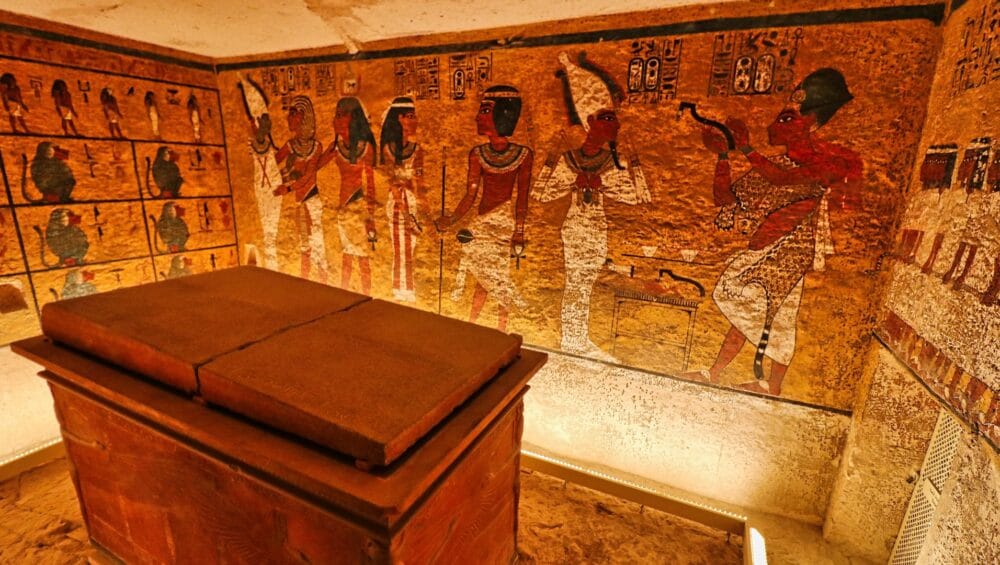
Tutankhamun – Though his reign was short and relatively uneventful, the discovery of his intact tomb in 1922 by Howard Carter brought him eternal fame and offered unparalleled insight into royal life and death.
Ramses II (Ramses the Great) – Perhaps the most celebrated pharaoh, Ramses II ruled for over 66 years, expanded Egypt’s borders, and built more statues, temples, and obelisks than any other ruler. His Abu Simbel temples remain one of Egypt’s most awe-inspiring sights.
Cleopatra VII – The last pharaoh of Ancient Egypt, Cleopatra was a shrewd politician and passionate lover of Julius Caesar and Mark Antony. Her dramatic life and death marked the end of the Pharaonic era and the beginning of Roman rule.
Symbols of Sovereignty
Pharaohs were recognized by their regalia: the crook and flail (symbols of kingship and fertility), the double crown of Upper and Lower Egypt, the uraeus cobra on their forehead, and the ceremonial beard. Statues, reliefs, and tomb paintings often depicted them larger than life, flanked by gods and goddesses.
Their names were enclosed in cartouches, oval shapes representing royal protection. Many had five names, each reflecting divine roles and earthly duties.
Death and Legacy
In death, pharaohs were buried in elaborate tombs filled with treasures, amulets, and sacred texts. These tombs — whether hidden in the Valley of the Kings, or standing as monumental pyramids — were designed to ensure a safe journey to the afterlife and eternal divinity.
Their enduring legacies live on not only in stone but in the national identity of modern Egypt. Every traveler who gazes upon the colossal statues of Ramses or walks beneath the towering pylons of Karnak follows in the footsteps of divine kings.
Chapter 5: Temples of Eternity – Explore the Temples of Luxor & Karnak
Ancient Egypt Red Sea Awaits
Temples of Luxor and Karnak
The temples of Ancient Egypt were more than just places of worship; they were cosmic gateways, ceremonial theaters, and eternal monuments that connected the human world with the divine. Among these, the Temples of Luxor and Karnak stand out as the spiritual and architectural heart of Egypt — majestic, mysterious, and magnetic to all who visit.
The City of a Hundred Gates
Thebes — modern-day Luxor — was once the grand capital of Egypt during the New Kingdom. Homer called it “the City of a Hundred Gates,” and rightly so. The sheer scale of its temples and the sophistication of its layout continue to astonish historians and tourists alike.
Two great temple complexes dominate this ancient landscape:
- Karnak Temple, the largest religious building ever constructed
- Luxor Temple, a ceremonial center intimately tied to divine kingship
Though separated by about 3 kilometers, these temples were once joined by a majestic Avenue of Sphinxes, lined with hundreds of guardian statues, recently restored and reopened to the public.
Temples of Luxor and Karnak
Karnak: The Sacred Precinct of Amun-Ra
Karnak was not a single temple but a sprawling complex built over 2,000 years by generations of pharaohs. It was primarily dedicated to Amun-Ra, the chief deity of Thebes, and included sanctuaries for Mut (his wife) and Khonsu (his son).
Key highlights:
- The Hypostyle Hall, with 134 giant columns towering up to 21 meters
- The Sacred Lake, used for ritual purification
- Obelisks of Hatshepsut and Thutmose I, monuments of imperial ambition
Karnak was a living temple — ceremonies, offerings, oracles, and festivals like the Opet Festival animated its sacred courtyards. High priests wielded great power here, and its architecture mirrored the Egyptian view of the cosmos.
Temples of Luxor and Karnak
Luxor Temple: The Temple of Kingship
Luxor Temple was not dedicated to a single god but to the rejuvenation of kingship itself. It played a central role in the Opet Festival, during which statues of the gods were carried from Karnak to Luxor to bless the pharaoh and renew his divine power.
Highlights include:
- The monumental First Pylon, flanked by colossal statues of Ramses II
- An original obelisk still standing tall (its twin now resides in Paris)
- Intricately carved scenes of coronation and divine birth
One of Luxor Temple’s most fascinating features is that it was continuously used for religious worship — from Ancient Egyptian times through Coptic Christianity and into the Islamic era, as shown by a mosque still standing within its ancient walls.
A Journey for the Modern Traveler
Visiting these temples is like stepping into the pages of a living epic. Travelers today can walk the Avenue of Sphinxes, explore Karnak’s echoing hypostyle halls, or watch the sunset cast golden light on Luxor Temple’s colonnades.
Whether you’re a history enthusiast, a spiritual seeker, or a casual tourist, the temples of Luxor and Karnak offer an experience that transcends time. Consider booking a guided tour from Hurghada, El Gouna, or Makadi Bay to fully immerse yourself in their secrets.
These are not ruins — they are eternal.

Chapter 6: Pyramids of Mystery – The Ultimate Pyramids Tour from Hurghada
Ancient Egypt Red Sea Awaits
No journey to Egypt is complete without a visit to its most iconic landmarks — the Pyramids of Giza. Towering above the golden sands just outside modern Cairo, these colossal structures are the last remaining Seven Wonders of the Ancient World, and they continue to astonish with their size, precision, and mystery.
If you’re staying in Hurghada, a city on Egypt’s Red Sea coast known for its beaches and resorts, you can experience the pyramids on a one-day Ultimate Pyramids Tour — a time-travel adventure that starts by the sea and ends among the stars of ancient history.
From Hurghada to Giza: The Modern Pilgrimage
There are three popular travel options for the journey:
- By Flight – The fastest way. A morning flight from Hurghada to Cairo gets you to the pyramids early, with time for a full tour and return in the evening.
- By Private Car – Ideal for flexibility and comfort. Your personal guide and driver take you directly from your hotel to Giza and Cairo’s highlights.
- Group Tours by Mini-Van or Coach – A budget-friendly option with social interaction. Perfect for families or travelers looking to share the experience.
Booking through HurghadaToGo ensures a smooth and informative trip with expert Egyptologists, air-conditioned vehicles, and customizable itineraries.
The Pyramids of Giza
Built during the Fourth Dynasty (c. 2600–2500 BCE), the pyramids served as tombs for three great pharaohs:
- Khufu (Cheops) – The Great Pyramid, standing 146 meters tall in its prime, was the tallest man-made structure for over 3,800 years.
- Khafre (Chephren) – Slightly smaller but appears taller due to its elevated position. It retains some original casing stones.
- Menkaure – The smallest, but still awe-inspiring. Known for its refined architecture.
Surrounding the pyramids are smaller satellite pyramids, mastaba tombs, temples, and one of Egypt’s greatest enigmas:
The Great Sphinx
Guarding the plateau is the Great Sphinx of Giza, with the body of a lion and the head of a king — possibly Khafre. Carved from a single block of limestone, it stretches 73 meters in length and has inspired endless speculation. What does it guard? What lies beneath?
Some theories suggest hidden chambers, secret texts, or connections to a civilization older than Ancient Egypt — tying back to theories discussed in Chapter 1 about the Lost Egyptian Civilization.
Inside the Pyramids
Visitors can enter the Great Pyramid (limited access daily) and climb narrow passageways into the King’s Chamber. It’s a humbling experience — standing in silence inside a 4,500-year-old marvel, surrounded by stone that has endured millennia.
Guides explain the pyramid’s alignment with celestial bodies, its construction theories, and the funerary rites of pharaohs. Whether you believe in aliens, Atlanteans, or purely human genius, the engineering feat is indisputable.
Museum and Cairo Highlights
Your Ultimate Pyramids Tour can also include:
- The Egyptian Museum in Tahrir Square — home to King Tutankhamun’s treasures
- The Grand Egyptian Museum (GEM) – a new state-of-the-art facility near Giza
- Shopping at Khan el-Khalili Bazaar – for papyrus, spices, gold, and souvenirs
Travel Tips for the Tour
- Bring sunscreen, water, and comfortable shoes
- Camera fees may apply in some tombs
- Ask about camel rides for iconic photos
- Dress respectfully, especially when visiting religious sites en route
A journey from Hurghada to the pyramids is more than a tour — it’s a pilgrimage into the past, a face-to-face meeting with the grandeur of human ambition.
With HurghadaToGo, you’re not just visiting; you’re stepping into one of the greatest stories ever built.

Chapter 7: Religion, Myths, and the Afterlife
To truly understand Ancient Egypt is to understand its gods, myths, and profound belief in the afterlife. For the ancient Egyptians, religion was not a part of life — it was life. Their temples, tombs, festivals, and daily rituals all centered on a divine cosmos ruled by powerful deities and eternal truths.
The Pantheon of Gods
Ancient Egypt had a rich and complex pantheon of gods, each representing aspects of nature, society, and the human condition. These gods were not distant — they walked among the people, intervened in daily life, and required offerings, prayers, and temples.
Key deities included:
- Ra – The sun god, creator, and king of the gods. He sailed across the sky by day and the underworld by night.
- Osiris – God of the afterlife and resurrection, ruler of the underworld.
- Isis – Goddess of magic, motherhood, and healing. Wife of Osiris and mother of Horus.
- Horus – Falcon-headed god of kingship and the sky. Protector of the pharaoh.
- Anubis – Jackal-headed god of embalming and guardian of tombs.
- Thoth – Ibis-headed god of wisdom, writing, and time.
- Ma’at – Goddess of truth, balance, and cosmic order. Her feather was used to weigh the souls of the dead.
Each region of Egypt had local gods and cults, but national deities like Amun-Ra, Osiris, and Isis united the country spiritually.
Creation Myths and Cosmic Order
Egyptian religion included multiple creation myths, often based on local traditions:
- In Heliopolis, creation began with Atum, who emerged from the primordial waters and created gods through self-generation.
- In Hermopolis, eight deities represented chaos and balance before the emergence of the sun.
- In Memphis, Ptah created the world through thought and speech — a philosophical view of divine manifestation.
Central to all myths was Ma’at, the ideal of harmony and order. The pharaoh’s role was to uphold Ma’at, and every ritual reinforced this cosmic balance.
Temples as Sacred Engines
Temples were not places for congregational worship like modern churches or mosques. Instead, they were sacred engines — microcosms of the universe — where priests conducted daily rituals to sustain the gods and keep the world running.
Each day, the temple god’s statue was awakened, washed, clothed, perfumed, and offered food. These rites were precise and deeply symbolic. Only the highest-ranking priests (and the pharaoh) could enter the innermost sanctuaries.
The Afterlife: An Eternal Journey
The ancient Egyptians believed in an afterlife that mirrored earthly life, but better. To enter it, one had to pass several trials:
- Mummification – Preserved the body so the soul (ba and ka) could recognize it.
- The Book of the Dead – A guide of spells and instructions for navigating the underworld.
- Judgment by Osiris – The deceased’s heart was weighed against the feather of Ma’at. If lighter, they entered paradise (the Field of Reeds). If heavier, it was devoured by the monster Ammut.
Tombs were stocked with food, furniture, clothing, and amulets. Scenes on tomb walls depicted joyous afterlife scenes — farming, feasting, and music. It was a continuation of the best parts of life, free from pain or injustice.
Festivals and Public Worship
Major festivals like the Opet Festival, Wepet-Renpet (New Year), and Feast of the Valley allowed the public to interact with the divine. These events included processions, music, dancing, offerings, and moments when the statues of gods left the temples to bless the people.
Religion was inclusive, participatory, and deeply emotional. It bound together every class of society — from pharaohs to peasants — in shared rituals and cosmic purpose.
Echoes in Modern Faiths
Many scholars note that Egyptian beliefs influenced later religions. Concepts like divine judgment, resurrection, heaven, and moral codes echo in Judaism, Christianity, and Islam. Even today, the symbolism of the ankh (life), scarabs (rebirth), and the Eye of Horus (protection) endures.
To visit Egypt is not just to see statues and temples — it is to enter a spiritual continuum that still hums with ancient power.

Chapter 8: Ancient Art, Writing, and Science
Beyond the colossal monuments and divine rituals, Ancient Egypt was a civilization of immense creativity and intellect. Their art, writing, and scientific achievements not only served religious and political functions but also revealed a people deeply attuned to the world around them. Through vivid murals, precise hieroglyphs, and remarkable innovations, the Egyptians etched their legacy into time.
Art as Eternal Expression
Egyptian art was not merely decorative — it was a sacred language designed to preserve order (Ma’at) and reflect divine truth. Every line, color, and posture followed strict rules to communicate meaning across generations.
- Wall paintings in tombs depicted scenes of daily life, festivals, and the afterlife, showing not just what Egyptians did, but how they hoped to be remembered.
- Statues of pharaohs, gods, and animals conveyed power, divinity, and protection. The size of figures denoted status: kings were largest, then nobles, then servants.
- Color symbolism was precise: green for rebirth, red for chaos or vitality, gold for divinity, and black for fertility and resurrection.
From the vibrant columns of Karnak to the serene statues of Hatshepsut, Egyptian art continues to awe and inspire — not only in museums but in the living temples of the Nile Valley.
The Gift of Writing: Hieroglyphs
The ancient Egyptians called their script “Medu Netjer” — the “words of the gods.” Hieroglyphs were a sacred writing system combining phonetic sounds, logograms, and determinatives.
- Used for inscriptions in temples, tombs, and monuments
- Contained over 700 symbols
- Required years of training to master — scribes were among Egypt’s elite
Hieroglyphs were complemented by two cursive scripts:
- Hieratic – A simplified form used by priests and officials
- Demotic – An even more abbreviated script used in the later periods for daily administration
The Rosetta Stone, discovered in 1799, featured the same text in Greek, Demotic, and hieroglyphs. Its decipherment by Jean-François Champollion in 1822 opened the doors to modern Egyptology.
Science in Stone and Stars
The scientific prowess of Ancient Egypt can be seen in their buildings, medicines, tools, and calendars:
1. Astronomy & Calendars
- Egyptians tracked celestial bodies for agricultural and religious timing.
- They divided the year into 12 months of 30 days, plus 5 festival days.
- The heliacal rising of Sirius marked the coming Nile flood — a cornerstone of their calendar.
2. Mathematics
- Used for architecture, land measurement, and trade
- Mastered basic geometry, fractions, and arithmetic
- Developed a decimal system with symbols for units, tens, hundreds
3. Medicine
- Practiced surgery, dentistry, and healing with herbs
- Medical papyri like the Ebers Papyrus recorded hundreds of remedies
- Believed in a balance between physical and spiritual health
4. Engineering
- Constructed pyramids, temples, canals, and dams with astounding precision
- Employed levers, ramps, copper tools, and early surveying techniques
- Their alignment of monuments with stars and cardinal points remains a marvel
Education and Innovation
Children of the elite were educated in writing, math, history, and religion. Scribes trained from a young age in specialized schools attached to temples and government buildings.
Artists and craftsmen learned through apprenticeships, and knowledge was passed down within families. Innovation was not accidental — it was cultivated through discipline, tradition, and spiritual purpose.
Legacy in Modern Times
Many Egyptian innovations influenced later civilizations — the Greeks, Romans, and beyond. Today, their legacy endures:
- In modern architecture inspired by pyramid forms
- In scientific methods rooted in observation and record-keeping
- In the admiration for their beauty, precision, and mystery
To visit Egypt is to walk among the minds of genius — to witness a culture that turned science into sacred art and writing into immortal voice.
Chapter 9: Exploring Egypt Today — From Ancient Sites to Modern Wonders
Egypt is not a relic frozen in time — it is a vibrant, living destination where the past and present intertwine. For travelers seeking both ancient splendor and modern comfort, Egypt offers a unique blend: from the timeless mysteries of the pyramids to luxury Nile cruises, desert adventures, and Red Sea resorts. This chapter will guide you through how to experience Ancient Egypt today — in the footsteps of pharaohs, but with Wi-Fi, comfort, and curated tours.
Cairo: Capital of Contrasts
Start in Cairo, where modern skyscrapers tower over bustling bazaars and ancient mosques. Key attractions include:
- Giza Plateau – Home to the Pyramids and the Sphinx
- The Grand Egyptian Museum (GEM) – A world-class showcase of Ancient Egyptian artifacts near the pyramids
- The Egyptian Museum in Tahrir Square – Still housing many original treasures
- Khan el-Khalili Bazaar – A labyrinth of alleys selling spices, gold, perfumes, and souvenirs
- Islamic and Coptic Cairo – Offering insight into Egypt’s layered religious history
Cairo is your gateway to Egypt’s wonders, and you can access all major sites from here with ease.
Luxor: The Open-Air Museum
Fly or drive south to Luxor, once Thebes, the capital of the New Kingdom. You’ll walk where Ramses, Hatshepsut, and Tutankhamun ruled. Don’t miss:
- Karnak Temple Complex
- Luxor Temple
- Valley of the Kings and Queens – Tombs of pharaohs including Tutankhamun
- Hatshepsut’s Mortuary Temple
- Nile River Cruises – A scenic, luxurious way to connect Luxor to Aswan
-
Ancient Egypt Red Sea
Luxor is one of the best places in the world to experience ancient history in an immersive, tangible way.
Aswan: Tranquility and Grandeur
In Aswan, the Nile flows calmly, surrounded by granite cliffs and Nubian villages. Top experiences include:
- Philae Temple – Dedicated to Isis, accessible only by boat
- Unfinished Obelisk – Revealing ancient quarrying techniques
- Abu Simbel Temples – A marvel relocated to avoid flooding from the Aswan High Dam
- Nubian Culture Tours – Offering colorful art, food, and music
Aswan is a quieter, more serene complement to Cairo and Luxor — ideal for reflection.
Red Sea Resorts: Ancient Egypt red sea Meets Paradise
After exploring tombs and temples, unwind along the Red Sea coast. Cities like Hurghada, El Gouna, and Makadi Bay are perfect bases for relaxation and exploration:
- Snorkeling and Diving – Coral reefs rivaling the Caribbean
- Luxury Hotels and Spas – World-class resorts with sea views
- Desert Safari & Bedouin Nights – 4×4 rides, camel treks, and stargazing
- Excursions to Cairo and Luxor – Day trips by flight or car
- Pyramids Tour from Hurghada
Companies like HurghadaToGo make these combinations easy, providing well-reviewed excursions to ancient wonders directly from the beach.
Egypt for Every Traveler
Whether you’re a solo backpacker, a family on vacation, a retired couple, or a honeymooner — Egypt welcomes all with open arms and ancient secrets. Here are a few tailored ideas:
- Families – Combine pyramids with beach fun and educational museum tours
- History Lovers – Dive deep with multi-day Nile cruises and private guides
- Luxury Seekers – Five-star resorts, balloon rides over Luxor, and fine dining in Cairo
- Adventure Enthusiasts – Sandboarding, quad biking, diving, and hiking in the Sinai
- Pyramids Tour from Hurghada
Practical Tips for Your Egyptian Journey
- Best Time to Visit: October to April (cooler weather)
- Currency: Egyptian Pound (EGP)
- Language: Arabic (English widely spoken in tourist areas)
- Safety: Egypt is safe in major tourist areas; travel with registered agencies
- Dress Code: Modest dress is appreciated, especially in religious sites
- Pyramids Tour from Hurghada
Ancient Egypt Red Sea
Final Thoughts: The Journey is Eternal
Egypt is more than a destination — it’s a dialogue with the past. It’s standing where gods were worshipped, kings crowned, and humanity took its earliest steps toward greatness. Today, it’s also a land of smiles, spices, sunsets, and stories waiting to be told.
From Ancient Egypt’s population growth to its pharaohs and pyramids, from sacred art to temple tours from Hurghada — your journey doesn’t end here.
Because Ancient Egypt Red Sea Awaits, always.
Book your tours to Egypt’s timeless wonders now with HurghadaToGo.com
WhatsApp: +201009255585
Email: [email protected]