🏺 Private Tour · West Bank Luxor · Egyptologist Guide · No Crowds
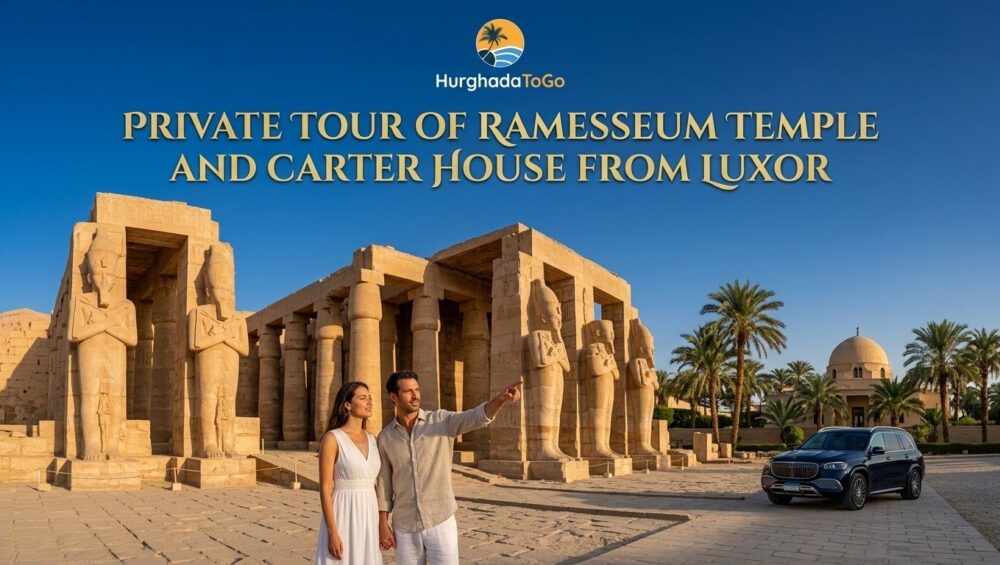
Private Tour of Ramesseum Temple and Carter House from Luxor
📅 Updated: April 2026 | ⏱️ 12 min read | 💷 From €85 / person | ⭐ 4.9/5 | 🏺 Half-Day · West Bank Luxor
A private tour of the Ramesseum Temple and Carter House from Luxor is one of the most rewarding half-day experiences available on the West Bank — combining two sites that most visitors completely miss. The Ramesseum is the mortuary temple of Ramesses II, dominated by the fallen colossus that inspired Shelley’s Ozymandias, featuring extraordinary Battle of Qadesh reliefs and an intact astronomical ceiling. Carter House is the modest stone building where Howard Carter lived during his decade-long search for Tutankhamun’s tomb — a site that brings the greatest archaeological discovery in history alive with remarkable personal detail.
Together, these two sites on the southern West Bank offer something genuinely rare in Luxor: near-complete solitude, extraordinary historical depth, and the kind of unhurried, personal exploration that is simply impossible on a group tour. This 2026 guide covers the complete itinerary, everything you need to know about both sites, opening hours, ticket prices, and tips from experienced Egyptologist guides.
💡 Why these two sites together: The Ramesseum and Carter House sit within 10 minutes of each other on the West Bank — and they represent two of the greatest detective stories in Egyptology. Ramesses II spent his reign projecting immortality through stone. Howard Carter spent a decade searching for the one pharaoh who had achieved it. Visiting both in sequence with a private Egyptologist creates one of the most intellectually layered experiences available in Luxor.
Why Choose a Private Tour of Ramesseum Temple and Carter House from Luxor?
The West Bank of Luxor is divided into two very different tourism experiences. The northern half — the Valley of the Kings, Hatshepsut’s Temple — draws the majority of group tours and can feel crowded by mid-morning. The southern half, where the Ramesseum and Carter House sit, is where the West Bank becomes genuinely exploratory. On most mornings, you will share the Ramesseum with fewer than a dozen other visitors. Carter House is often completely empty.
For guests already staying in Luxor — on a Nile cruise, at a hotel, or after arriving from Hurghada — this private half-day tour from Luxor is the perfect way to see two extraordinary sites without the time commitment of a full-day excursion. It pairs naturally with an afternoon visit to Luxor Temple or Karnak on the East Bank, making for a rich full day without the exhaustion of trying to cover everything at once.
🇬🇧 UK Traveller Tip
This tour works perfectly as an add-on morning for guests on a Nile cruise stopping in Luxor. Ships typically dock from early morning — your private Egyptologist meets you at the dock and has you back aboard for lunch. It also works as a standalone half-day for Luxor hotel guests who want a slower, deeper experience than the standard Valley of the Kings rush.
Private Tour Itinerary — Ramesseum Temple & Carter House, Hour by Hour
This is a focused half-day private tour from Luxor, running approximately 4–5 hours. All times are adjustable — early morning departure is recommended for cooler temperatures and the best light at both sites.
07:00 – 07:30 AM
Hotel or Cruise Ship Pickup in Luxor — Nile Crossing to the West Bank
Your Egyptologist guide meets you at your Luxor hotel, Nile cruise dock, or a designated meeting point on the East Bank. A short motorboat crossing of the Nile brings you to the West Bank — one of the most evocative moments of any Luxor visit. Morning light turns the river silver-gold and the Theban Hills glow ahead. Your guide briefs you on the day’s itinerary during the crossing. First stop on the West Bank: the Antiquities Inspectorate Ticket Office to collect all site tickets.
07:30 – 07:45 AM
Colossi of Memnon — The Two Guardians of the West Bank
A brief photo stop at the iconic Colossi of Memnon — two 18-metre quartzite statues of Pharaoh Amenhotep III, standing guard at the entrance to the West Bank for 3,400 years. Your guide explains the mysterious “singing” phenomenon reported by ancient Greek and Roman travellers at dawn, and the role of these statues as gateways to the Theban necropolis. Morning light here produces exceptional photographs.
08:00 – 09:30 AM
The Ramesseum Temple — Mortuary Temple of Ramesses II: Fallen Colossus, Battle Reliefs & Astronomical Ceiling
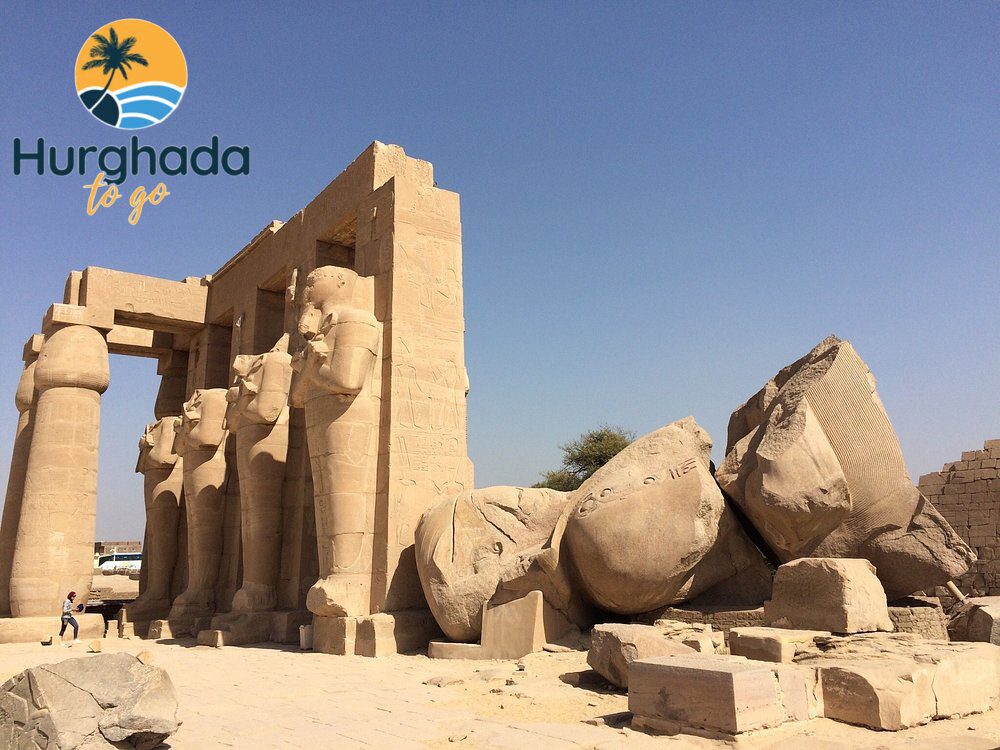
Your main stop of the morning and one of the most atmospherically charged sites on the entire West Bank. Arriving at 08:00 AM, you explore the Ramesseum with near-total privacy — most group tours have not yet arrived. Your Egyptologist leads a thorough 90-minute tour covering: the towering First Pylon and its Battle of Qadesh reliefs (the earliest documented peace treaty in history); the First Court and the fallen granite colossus of Ramesses II — once 17 metres tall, now shattered in the sand, its upturned face one of the most haunting images in Egyptology; the Second Court and Osiride pillars showing Ramesses II in his divine form; the Second Hypostyle Hall with 48 papyrus columns and the extraordinary astronomical ceiling mapping the ancient Egyptian calendar and constellations; the inner sanctuary and offering chambers; and the vast mud-brick granary complex — barrel-vaulted storehouses running behind the temple, almost always completely deserted by other visitors.
09:45 – 11:00 AM
Howard Carter’s House — Spirit of Discovery, Tutankhamun’s Story & the Greatest Find in Archaeology
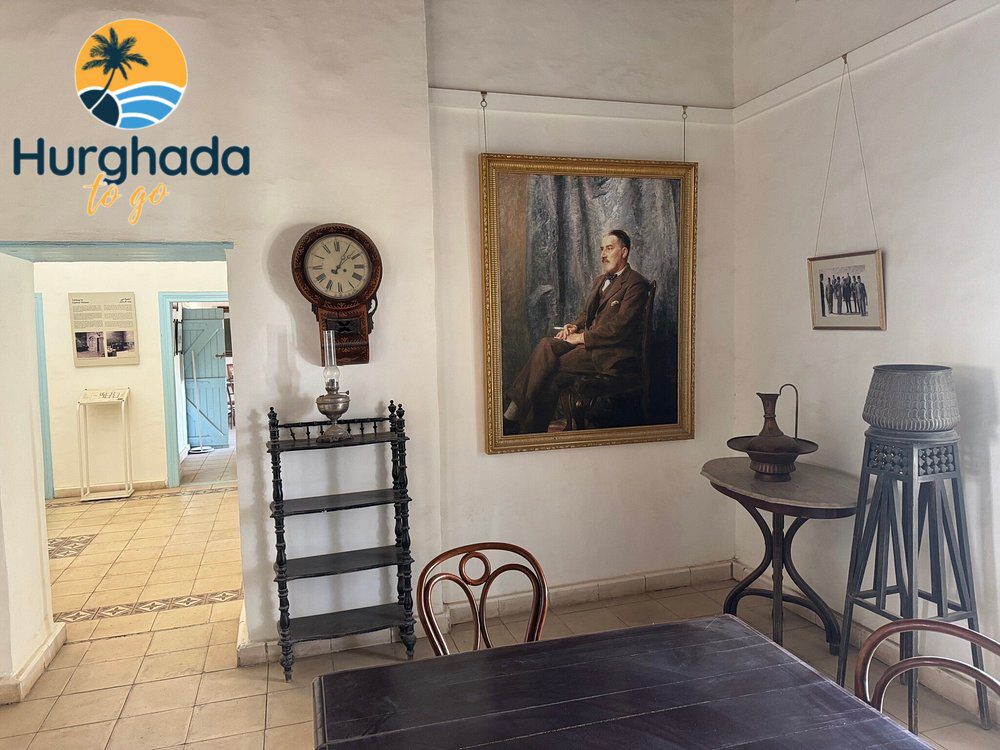
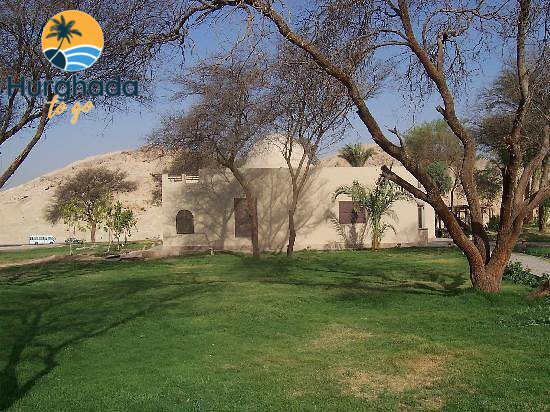
A 15-minute drive from the Ramesseum brings you to Carter House — the modest stone building on the hillside above the Valley of the Kings where British Egyptologist Howard Carter lived during his extraordinary decade-long search for Tutankhamun’s tomb. Preserved as a small but richly atmospheric museum, Carter House contains original photographs, personal objects, replicas of excavation tools, and the full story of the 1922 discovery — from Lord Carnarvon’s impatient arrival in Cairo to the moment Carter made the hole in the sealed doorway and Lord Carnarvon asked “Can you see anything?” and Carter replied: “Yes, wonderful things.” Your guide narrates the complete discovery story inside Carter’s own home, in the valley where it all happened.
11:00 – 11:15 AM
Valley of the Kings Viewpoint — Panoramic Overview of the Royal Necropolis
Carter House sits on the ridge directly above the Valley of the Kings. From the terrace, your guide points out the valley below — the numbered tomb entrances, the path Carter walked every morning for 31 seasons, and the limestone cliff peak that the ancient Egyptians revered as a natural pyramid. A powerful geographical and historical orientation that gives the entire West Bank landscape new meaning.
11:30 AM — Return
Return to East Bank — Hotel, Cruise Ship, or Optional Afternoon Extension
Your guide accompanies you back across the Nile to your hotel or cruise ship by approximately 11:30–12:00 noon — leaving the full afternoon free. Optional afternoon extension: add Luxor Temple (East Bank, 5 minutes from most hotels) for the full day experience. Can I visit Luxor Temple at night? Yes — Luxor Temple stays open until 21:00 and is magnificently illuminated after dark, making it one of the finest evening experiences in Egypt. Ask your guide about timing.
The Ramesseum Temple — Can You Visit the Ramesseum & What Will You See?
Can you visit the Ramesseum? Yes — the Ramesseum is fully open to visitors year-round and is one of the most rewarding and least crowded sites on Luxor’s West Bank. Built by Ramesses II around 1255 BCE as his mortuary temple, it was described by the ancient Greek historian Diodorus Siculus as the “Tomb of Ozymandias” — the name that inspired Shelley’s famous 1818 sonnet after European travellers rediscovered the fallen colossus in the 19th century.
What Time Does the Ramesseum Temple Open? — Hours & Ticket Price 2026
| Detail |
Information |
| Opening hours |
06:00 AM – 05:00 PM (Oct–Apr) · 06:00 AM – 06:00 PM (May–Sep) |
| Best visiting time |
07:00 – 10:00 AM — coolest, emptiest, best light for photography |
| Ticket price 2026 |
EGP 220 (foreign adult) · EGP 110 (student with valid ID) |
| Where to buy |
Antiquities Inspectorate Ticket Office, West Bank — NOT at the temple itself |
| Recommended time on site |
90 minutes minimum · 2 hours for a thorough visit |
| Crowd level |
Very low — typically fewer than 20 visitors at any time |
What to See at the Ramesseum — Six Key Highlights with Your Private Egyptologist
🗿
The Fallen Colossus of Ramesses II
Once the largest monolithic statue ever carved — 17 metres tall, over 1,000 tonnes of Aswan granite. Now lying in magnificent ruin in the first court, its face upturned toward the Egyptian sky. This is the “Ozymandias” colossus. Your guide positions you for the exact photograph that makes it all click.
⚔️
First Pylon — Battle of Qadesh & the World’s First Peace Treaty
The entrance pylon is covered with the most detailed account of Ramesses II’s battle against the Hittites at Qadesh (1274 BCE) — a battle the Egyptians considered a victory but historians call a draw. The subsequent Hittite–Egyptian peace treaty (1259 BCE) is the oldest surviving international treaty in history, and a copy hangs at the UN in New York.
🌟
Astronomical Ceiling — Ancient Egyptian Calendar & Constellations
The ceiling of the second hypostyle hall is one of the finest surviving astronomical ceilings in Egypt — depicting the Egyptian lunar calendar, the 12 months, the rising of Sirius (which marked the Egyptian New Year), and the ancient constellations. Your guide explains each section in context with ancient Egyptian cosmology.
🏛️
Second Hypostyle Hall — 48 Papyrus Columns Still Standing
48 of the original papyrus columns remain standing in the second hypostyle hall — their capitals still intact, their shafts bearing carved reliefs. Walking between them creates the immersive sensation of moving through a petrified forest of ancient stone. Traces of original paint survive on several column faces.
🧱
Mud-Brick Granaries — The Administrative Heart of Ancient Thebes
Behind the stone temple, dozens of barrel-vaulted mud-brick storerooms survive from the original administrative complex. These granaries held grain, oil, and goods redistributed to temple workers and craftsmen across Thebes. Walking through these ancient vaults — completely deserted by other tourists — is one of the most unexpectedly evocative experiences on the West Bank.
📜
Ozymandias Connection — Shelley’s Poem & the Romantic Discovery
In 1818, Percy Bysshe Shelley wrote Ozymandias after reading descriptions of the Ramesseum colossus: “Look on my works, ye Mighty, and despair!” Your guide recites the poem beside the actual fallen head that inspired it — one of the most genuinely literary moments available in Egypt.
Howard Carter’s House — Where Did Howard Carter Stay in Luxor & What Is There to See?
Where did Howard Carter stay in Luxor? Howard Carter lived in a modest stone house he built himself on the hillside of Sheikh Abd el-Qurna on the West Bank of Luxor — directly above the Valley of the Kings. He first occupied it in 1910 and continued to use it during his excavation seasons until 1922, when the discovery of Tutankhamun’s tomb (KV62) changed archaeological history forever. The house is now preserved as a small museum and is one of the most personally evocative sites in Egyptology.
Carter was a self-taught Egyptologist — he began his career in Egypt at 17 as an artist and illustrator for the Egypt Exploration Fund. He rose through the ranks of the Egyptian Antiquities Service, surviving political controversies and professional setbacks, before being hired by Lord Carnarvon in 1907 to search for the one undiscovered royal tomb he was convinced remained in the Valley of the Kings. He was right. After 31 seasons of excavation and six years of systematic searching under Carnarvon’s sponsorship, on 4 November 1922, Carter’s team uncovered the first step of the staircase leading to Tutankhamun’s tomb.
What to See at Carter House — Inside the Museum
📸
Original Photographs of the Discovery
Period photographs documenting the excavation — the sealed doorway, the first view inside the antechamber (“wonderful things”), the unwrapping of the mummies, and Lord Carnarvon’s presence at the moment of discovery. Many of these photographs are rarely reproduced.
🏺
Excavation Tools & Personal Objects
The tools Carter used — brushes, picks, recording equipment, and preservation materials — displayed in the rooms where he worked. Personal objects including his watercolour sketches of Egyptian sites and antiquities he painted before photography became the standard documentation method.
🗺️
Maps & Excavation Plans of the Valley of the Kings
The systematic grid maps Carter used to plan his excavation season by season — dividing the Valley floor into sections and working methodically through each one. The plan that finally led to Tutankhamun’s staircase in the last untested area of the Valley.
🌅
Valley of the Kings Viewpoint from the Terrace
Carter’s house terrace overlooks the Valley of the Kings directly below. Your guide points out the visible tomb entrances, the path Carter walked every morning, and the natural limestone peak the ancient Egyptians worshipped as a pyramid-shaped holy mountain. A panorama that places the entire discovery story in its physical context.
📜 “Can you see anything?” — The Greatest Moment in Archaeology: When Lord Carnarvon asked Carter what he could see through the small hole made in the sealed inner doorway on 26 November 1922, Carter replied: “Yes, wonderful things.” At Carter House, your Egyptologist recreates the full sequence of events — from the discovery of the first step on 4 November to the formal opening of the tomb on 29 November — with a narrative depth that transforms the bare facts of the discovery into one of the great human stories of the 20th century.
2026 Pricing — What Is Included & What Is Not
From (2 people)
€85
per adult · ~£73 per person · Half-day (4–5 hours)
✓ Licensed Egyptologist · ✓ All Entrance Fees · ✓ Nile Boat Crossing · ✓ Private Vehicle
Children (0–12): 50% · Solo traveller supplement applies
Included
✓ Licensed English-speaking Egyptologist guide (dedicated to your group)
✓ Private vehicle on the West Bank between all sites
✓ Entrance fees: Ramesseum (EGP 220) + Carter House (EGP 50) + Colossi of Memnon (free)
✓ Nile motorboat crossing (East Bank ↔ West Bank)
✓ Bottled water throughout · Free cancellation up to 24 hours before
Not Included
✕ Lunch (this is a half-day tour — returns before midday)
✕ Tips for guide (optional — EGP 50–100 pp appreciated)
✕ Hotel-to-hotel transport from Hurghada (Luxor-based guests only — Hurghada guests see our
full day Luxor tours)
All Site Ticket Prices 2026
| Site |
EGP (Adult) |
Approx. £ |
| Ramesseum |
EGP 220 |
~£3.40 |
| Howard Carter’s House |
EGP 50 |
~£0.75 |
| Colossi of Memnon |
Free |
Free |
| Total per person |
EGP 270 |
~£4.15 |
💷 Money Tip
Tickets must be purchased at the Antiquities Inspectorate Ticket Office on the West Bank — not at the sites themselves. Carry EGP cash as a backup as card machines occasionally have connectivity issues. As of April 2026: £1 ≈ 65 EGP. All entrance fees are included in your tour price — your guide handles all ticketing.
Insider Tips & Practical Advice for Your Visit
Tip 1 — Ask your guide to stand behind the fallen Ramesseum colossus and look up. The view from directly behind the fallen granite head — sky framed by ruined pylons — is one of the most extraordinary photographic moments on the West Bank, and virtually unknown to standard tour visitors.
Tip 2 — Visit the mud-brick granaries. Behind the stone temple, the vast mud-brick storehouse complex is almost never visited. These barrel-vaulted storerooms are some of the best-preserved New Kingdom administrative structures in Egypt — and completely deserted. Ask your guide to take you through.
Tip 3 — Bring a small torch for the Ramesseum’s inner chambers. The innermost sanctuary rooms can be dimly lit. Your phone torch reveals painted details on the ceiling and upper walls that are invisible in available light.
Tip 4 — At Carter House, ask about the “Mummy’s Curse.” The death of Lord Carnarvon five months after the tomb opening in 1923 sparked the famous “Pharaoh’s Curse” rumour. Your guide’s explanation — the real scientific analysis of what happened and why the “curse” was a media invention — is one of the most entertaining parts of the Carter House visit.
Tip 5 — Is it safe to walk from Luxor at night? The East Bank of Luxor city centre is very safe for walking at night — the Corniche promenade along the Nile is pleasant and well-lit. The West Bank, however, is best accessed by motorboat or arranged transport after dark rather than on foot. The Nile crossing by motorboat runs until approximately 22:00 and costs only a few EGP.
Tip 6 — Can I visit Luxor Temple at night? Yes — Luxor Temple stays open until 21:00 and is illuminated after dark, creating one of the finest evening experiences in Egypt. After returning from the West Bank by noon, you have the full afternoon to rest and the early evening to visit Luxor Temple. The combination of a morning at the Ramesseum and Carter House followed by an evening at Luxor Temple creates a genuinely extraordinary full day in ancient Thebes.
🎒 What to Pack:
Closed-toe walking shoes (uneven stone surfaces at the Ramesseum) · SPF 50 sunscreen + wide-brimmed hat + UV sunglasses · Light scarf or shawl (modest dress for sacred sites) · Camera + power bank · EGP small notes for tips and bathroom attendants (EGP 50–100 pp for guide) · Small torch for inner chambers
Frequently Asked Questions
Can you visit the Ramesseum? Is it open to the public?
Yes. The Ramesseum is fully open to visitors every day. Opening hours are 06:00 AM to 05:00 PM (October–April) and 06:00 AM to 06:00 PM (May–September). The ticket price in 2026 is EGP 220 for foreign adults (approximately £3.40). Tickets must be purchased at the Antiquities Inspectorate Ticket Office on the West Bank — not at the temple itself. On this private tour, your guide handles all ticketing in advance.
What time does the Ramesseum temple open?
The Ramesseum opens at 06:00 AM year-round. The best time to visit is between 07:00 and 10:00 AM — temperatures are lower, light is better for photography, and crowd levels are at their minimum. This private tour arrives at the Ramesseum at approximately 08:00 AM to take maximum advantage of the morning window.
Where did Howard Carter stay in Luxor during his excavations?
Howard Carter built and lived in a modest stone house on the hillside of Sheikh Abd el-Qurna on the West Bank of Luxor — directly above the Valley of the Kings. He occupied it from approximately 1910 and used it as his base during excavation seasons until and beyond the discovery of Tutankhamun’s tomb in 1922. The house is now preserved as a museum and is included as the second main stop on this private tour. Carter chose the location deliberately — a short walk from the Valley of the Kings, with a direct view down into the valley from his terrace.
Can I visit Luxor Temple at night?
Yes — Luxor Temple on the East Bank opens at 06:00 AM and stays open until 21:00 (last entry). It is magnificently illuminated after dark, with warm amber lights transforming the columns and statues into something genuinely extraordinary. Visiting Luxor Temple at night after returning from the West Bank in the early afternoon creates a natural and deeply satisfying full day in ancient Thebes. Ticket price: EGP 500 (foreign adult) — purchased at the Luxor Temple ticket office on the East Bank.
Is it safe to walk from Luxor at night?
Walking on the East Bank of Luxor city centre at night is very safe — the Corniche promenade along the Nile is well-lit, lively, and pleasant for evening walks between the temple and the local restaurants. The West Bank is best accessed after dark by motorboat (running until approximately 22:00, very inexpensive) or arranged transport rather than on foot. Your guide can arrange evening transport if needed.
Can this tour be extended to include other West Bank sites?
Yes. This tour can be extended to include Medinet Habu (Ramesses III’s mortuary temple), the Valley of the Nobles (4 painted tombs of ancient officials), or the Valley of the Queens. Adding any of these transforms the half-day into a full-day West Bank experience. Discuss your preferences when booking — there is no extra planning charge, only additional entrance fees where applicable. See our full
Luxor tours from Hurghada for the complete West Bank day tour.
Book Your Private Tour of Ramesseum Temple & Carter House
Licensed Egyptologist · Private vehicle · All entrance fees included · Nile crossing included · From €85 per person · Free cancellation 24 hours before departure.
🏺 BOOK NOW — FROM €85 PER PERSON
A private tour of the Ramesseum Temple and Carter House from Luxor offers something that the Valley of the Kings and Karnak Temple — for all their magnificence — cannot: intimacy, solitude, and the sense of genuine discovery. The fallen colossus of Ramesses II, the astronomical ceiling of his hypostyle hall, the barrel-vaulted granaries behind the temple, and the quiet stone house where Howard Carter spent a decade searching for the greatest buried treasure in history — these are experiences that reward the curious traveller with memories that outlast any photograph.