
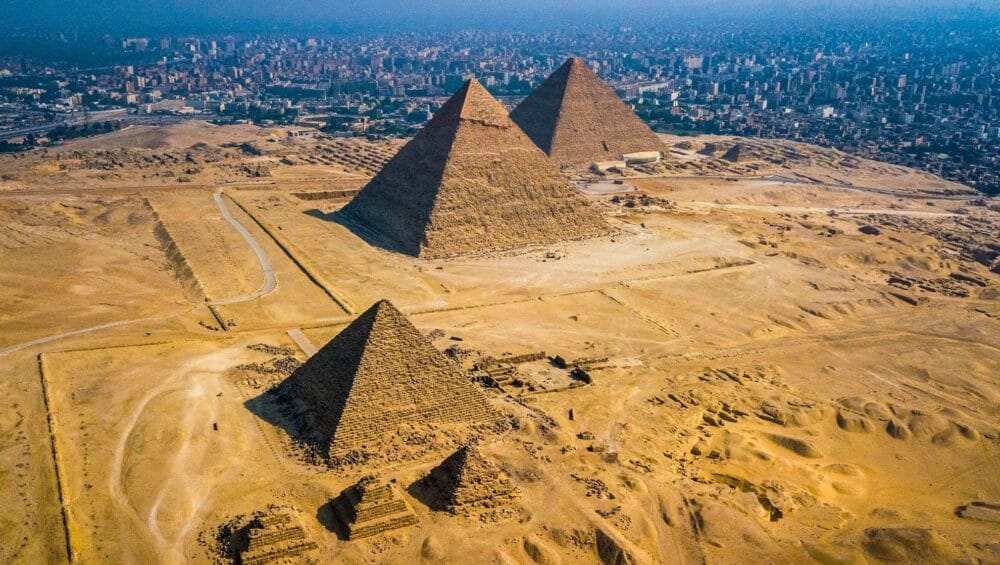
Pyramids Secrets Revealed | 22 Astonishing Facts & the Latest Scientific Discoveries
For centuries, the Egyptian pyramids have stirred the human imagination. Towering above the golden sands of the Giza Plateau, these massive stone monuments have come to symbolize not only Egypt’s enduring legacy but also the brilliance of human ambition. More than 4,500 years after their construction, they continue to inspire awe, fuel debates, and invite new discoveries that reshape what we know about the ancient world.
While millions visit the pyramids every year, very few realize just how much mystery still surrounds them. Who exactly built them? How did ancient engineers manage to move colossal stones weighing tens of tons? Why are the pyramids aligned with celestial constellations? And most recently—what role did the long-lost Nile branch known as the Ahramat River play in their construction?
In 2024, scientists revealed breakthrough evidence that may finally answer one of the greatest riddles in history: how the pyramids were built. This discovery sheds light not only on engineering but also on the very landscape of ancient Egypt.
At HurghadaToGo, we believe that visiting the pyramids is more than just a sightseeing activity—it’s a once-in-a-lifetime journey into the heart of human history. Whether you take a pyramids tour from Hurghada, Cairo day trip from Hurghada by flight, a private minivan tour, or a budget-friendly bus excursion, standing in front of these timeless structures changes the way you see the world.
In this long-form guide, you will discover:
-
The groundbreaking scientific discovery about the Ahramat River.
-
10 hidden secrets of the pyramids that most people don’t know.
-
12 surprising facts about the Great Pyramid and its surrounding complex.
-
Insights into why the pyramids matter for modern travelers.
-
How to plan your own journey with HurghadaToGo tours.
Prepare to dive into the mysteries of the pyramids—where science, history, and adventure meet.
Pyramids Secrets Revealed: 5 Astonishing Facts You Never Learned in School
Forget everything you think you know. The Egyptian pyramids are more than just tombs; they are encrypted messages from a brilliantly advanced ancient world. Pyramids Secrets Revealed by modern science are rewriting history books. Here are the most jaw-dropping discoveries.
1. The Secret River Highway
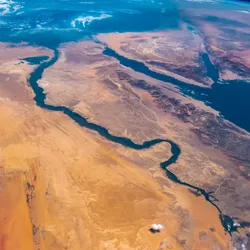
The greatest of the Pyramids Secrets Revealed in 2024 was the discovery of the Ahramat Branch, a lost Nile river buried under the desert sand. This 64-km-long waterway was the ancient superhighway that ran directly past the Giza plateau. Pyramids Secrets Revealed by satellite radar show this is how millions of multi-ton stone blocks were floated to the construction site, solving a mystery that has puzzled humanity for millennia.
2. They Were Built by Honored Laborers, Not Slaves
One of the most important Pyramids Secrets Revealed by archaeology debunks a long-held myth. Excavations of workers’ villages show they were skilled, well-fed artisans who received medical care and were buried with honor near the pharaohs. This wasn’t slave labor; it was a national project of pride. These Pyramids Secrets Revealed change them from symbols of oppression to monuments of unity.
3. The Original Shining Marvels
When we think of pyramids, we see rough, stepped brown stones. But Pyramids Secrets Revealed by historians tell a different story. They were originally covered in highly polished, gleaming white Tura limestone, capped with a gold or electrum pyramidion. They reflected the sun so brilliantly they could be seen from miles away, acting as “jewels of the sun.” This is one of the most visually stunning Pyramids Secrets Revealed.
4. Hidden Chambers & Cosmic Alignments
Pyramids Secrets Revealed by muon tomography and thermal scanning show there are still unexplored voids and chambers inside the Great Pyramid, like the mysterious “Big Void” above the Grand Gallery. Furthermore, Pyramids Secrets Revealed through astronomy show their shafts align with stars like those in Orion’s Belt, turning them from mere tombs into celestial gateways for the pharaoh’s soul.
5. Mathematical Codes Embedded in Stone
Perhaps the most mind-bending of the Pyramids Secrets Revealed is their mathematical precision. The Great Pyramid’s perimeter to height ratio equals 2π (Pi), it’s aligned to true north with minimal error, and its dimensions encode the Earth’s measurements. These Pyramids Secrets Revealed suggest a lost knowledge of astronomy and mathematics that seems almost impossible for its time.
The journey to uncover all Pyramids Secrets Revealed is far from over. With every technological advance, we peel back another layer, getting closer to understanding the true genius of the ancient world.
The New Ahramat River Discovery – Unlocking an Ancient Secret
For centuries, the question of how the ancient Egyptians built the pyramids has been one of history’s greatest puzzles. Millions of visitors gaze at these monumental structures every year, marveling at their sheer size and wondering: How did people 4,500 years ago move stones weighing up to 50 tons without modern technology?
From ramps and pulleys to alien theories, explanations have been wide-ranging—yet incomplete. But in 2024, a groundbreaking scientific discovery may have solved one of the greatest mysteries of all time. Researchers revealed evidence of a long-lost branch of the River Nile, now buried under the desert sands, which may have been the ancient superhighway that made pyramid construction possible.
This hidden river, known today as the Ahramat Branch (from the Arabic word Ahramat, meaning pyramids), offers a fresh perspective not only on pyramid engineering but also on why the structures were built where they are.
pyramids tour from Hurghada
A Discovery Thousands of Years in the Making Pyramids Secrets Revealed
The research, led by Professor Eman Ghoneim of the University of North Carolina Wilmington, combined multiple cutting-edge methods:
-
Radar satellite imagery – to see beneath desert sands.
-
Historical maps – showing ancient topographical features.
-
Geophysical surveys – measuring the underground composition.
-
Sediment coring – drilling deep samples to confirm the existence of buried waterways.
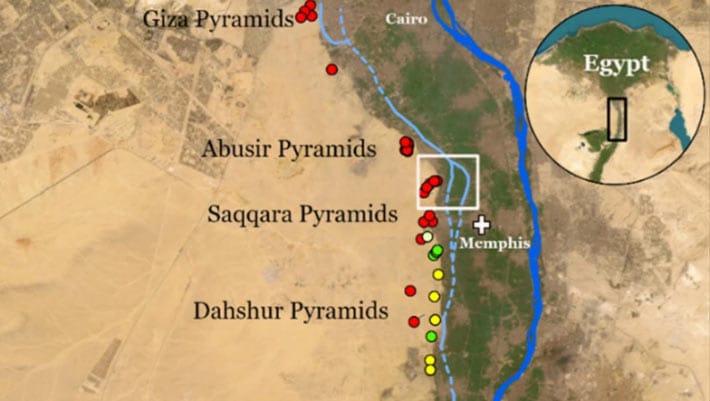
Through these techniques, the team was able to map a hidden Nile branch stretching roughly 64 kilometers (39 miles), with a width of 200 to 700 meters—large enough to have been a vital transportation artery in ancient times.
This was not just a small canal or irrigation offshoot. It was a major river system, running directly alongside the pyramid fields of Giza, Saqqara, Dahshur, and Lisht—where 31 pyramids were constructed between 4,700 and 3,700 years ago.
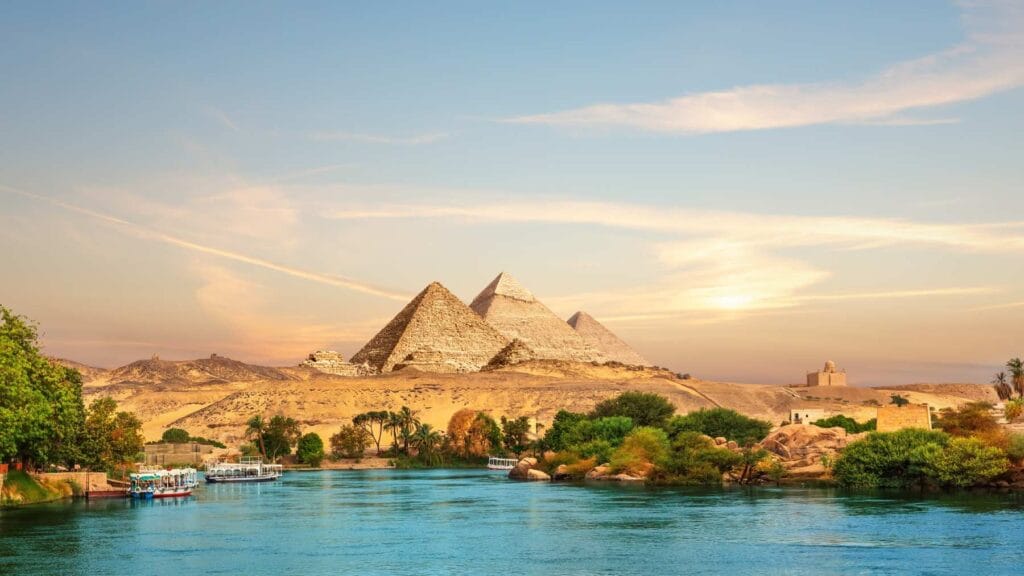
In other words, the pyramids were not isolated monuments in a barren desert, as we see today. They once rose dramatically beside a wide river, connected to Egypt’s lifeline, the Nile.
pyramids tour from Hurghada
Why the Ahramat River Matters Pyramids Secrets Revealed
To understand the importance of this discovery, we must step back into the world of the Old Kingdom of Egypt.
-
Transportation of Heavy Stones
-
The Great Pyramid of Khufu alone required an estimated 2.3 million limestone blocks.
-
Granite blocks from Aswan (almost 1,000 km south of Giza) weighed up to 50 tons each.
-
Without access to waterways, moving these blocks across land would have been nearly impossible.
-
The Ahramat River explains how such massive loads could be floated close to the construction sites before being dragged short distances.
-
-
Religious & Symbolic Importance
-
The Nile was central to Egyptian life, seen as the pathway between life and the afterlife.
-
Building pyramids alongside a sacred river reinforced their role as cosmic gateways for pharaohs’ souls.
-
It also explains why pyramids cluster so densely along this ancient riverbed.
-
-
Urban & Worker Settlements
-
Archaeologists have uncovered entire worker villages near pyramid sites.
-
Access to the river would have provided fresh water, food supplies, and transport for thousands of laborers.
-
The Ahramat Branch likely supported flourishing communities that sustained these massive projects.
-
-
Geographical Puzzle Solved
-
For years, scholars wondered why so many pyramids were located in what now looks like desert wasteland.
-
The answer: it wasn’t desert at all back then—it was prime riverfront real estate.
- pyramids tour from Hurghada
-
The Science Behind the Discovery Pyramids Secrets Revealed
What makes the Ahramat River discovery remarkable is the way it combined modern technology with ancient history.
-
Radar satellite imagery: Unlike visible light, radar can penetrate through layers of sand. This allowed researchers to trace faint outlines of riverbeds buried under millennia of desert drift.
-
Sediment cores: By drilling into the ground, scientists retrieved soil layers containing ancient river sediments. These confirmed the presence of Nile deposits where no water flows today.
-
Cross-disciplinary research: Experts from the U.S., Egypt, and Australia worked together, merging geology, archaeology, and environmental science.
The results were published in Communications Earth & Environment in 2024, making headlines worldwide.
Voices of the Researchers Pyramids Secrets Revealed
The findings were not just about geology—they had direct historical implications.
-
Professor Eman Ghoneim explained:
“Nobody was certain of the location, the shape, the size, or the proximity of this mega waterway to the actual pyramids site. Now we can show it was active and operational during the construction phase.”
-
Dr Suzanne Onstine, co-author of the study, told the BBC:
“Locating the actual river branch and having data that shows there was a waterway that could be used for transportation of heavier blocks, equipment, people—everything—really helps us explain pyramid construction.”
A New Vision of Ancient Egypt Pyramids Secrets Revealed
Imagine standing on the Giza Plateau 4,500 years ago. The air is filled with the shouts of workers, the creak of ropes, and the splash of oars.
Instead of endless desert stretching into the horizon, you would see a wide Nile branch glistening in the sun, filled with boats transporting limestone blocks from quarries, granite slabs from Aswan, cedar wood from Lebanon, and food supplies for workers.
The pyramids, freshly covered in shining white limestone casing stones, would have reflected brilliantly against the water, almost like giant mirrors for the sun.
It is a vision that transforms how we understand these monuments—not as remote desert tombs, but as vibrant riverside temples of eternity.
The Ahramat River and Pyramid Alignment
Another fascinating aspect is the alignment of pyramids with celestial and religious landmarks.
-
The Great Pyramids of Giza are famously aligned with Orion’s Belt.
-
But they are also aligned diagonally so that their southeastern corners point to the Temple of Ra at Heliopolis.
-
With the Ahramat River running alongside, these alignments may have been even more intentional—uniting sky, land, and water in one grand cosmic plan.
- pyramids tour from Hurghada
This interplay of astronomy, geography, and religion underscores the sophistication of ancient Egyptian civilization.
Why Was the River Lost?
If the Ahramat River was so important, why did it disappear?
The answer lies in climate change—ancient climate change.
-
Around 4,000 years ago, a period of severe drought struck Egypt.
-
Combined with sandstorms and desertification, the river branch gradually silted up and vanished beneath layers of sand and farmland.
-
Over centuries, people forgot it even existed.
- pyramids tour from Hurghada
Today, what was once a wide, bustling waterway is invisible to the naked eye. Only the most advanced technology has revealed its ghostly traces.
Tourism & the Rediscovery of the Ahramat River
For modern travelers, this discovery adds a new dimension to pyramid tourism.
When you book a Cairo day trip from Hurghada with HurghadaToGo, you’re not just visiting ancient tombs—you’re stepping into a landscape reshaped by science.
Imagine your guide pointing out:
-
“Here, 4,500 years ago, the Nile flowed directly beside these stones. Workers floated massive granite blocks from Aswan to this very spot.”
This brings history alive in a way that pure imagination cannot. With every new discovery, a tour to the pyramids becomes not just a visit, but a journey through layers of time.
Key Takeaways from the Ahramat River Discovery
-
The pyramids were built beside a long-lost Nile branch, not in isolated desert.
-
This river, the Ahramat Branch, stretched 64 km and served as a natural highway.
-
It explains how massive stones could be transported efficiently.
-
It solves the puzzle of why pyramids are so densely clustered between Giza and Lisht.
-
It paints a picture of ancient pyramids as riverside monuments, gleaming in the sun.
10 Secrets of the Egyptian Pyramids That Few People Know
The Egyptian pyramids have fascinated travelers, scholars, and adventurers for thousands of years. They are more than stone monuments — they are timeless puzzles holding within their walls the mysteries of human ambition, engineering genius, and spiritual belief.
While most visitors know the basics — that they were built as tombs for pharaohs — there are countless lesser-known facts that make them even more intriguing. From astronomical alignments to hidden chambers, the pyramids hold secrets that continue to astonish us.
Here are 10 pyramid secrets that will change the way you look at these monuments forever.
1. The Pyramids Weren’t Built by Slaves
pyramids tour from Hurghada
For decades, popular culture (and even Hollywood movies) suggested that the pyramids were built by slaves, forced into back-breaking labor under the whip. This myth traces back to ancient Greek historian Herodotus and was reinforced in later storytelling.
But modern archaeology paints a very different picture. Excavations near Giza uncovered workers’ villages complete with bakeries, breweries, and medical facilities. Skeletal remains of workers show evidence of medical treatment, meaning injured laborers were cared for rather than discarded.
These discoveries reveal that the builders were skilled laborers, artisans, and farmers, who worked in rotation when the Nile flooded their fields. They were well-fed, respected, and even buried with honor near the pyramids.
👉 This changes our perspective of the pyramids from monuments of oppression to symbols of national unity and pride.
2. The Great Pyramid Can Predict the Equinox
The Great Pyramid of Khufu at Giza is not only an architectural wonder but also an astronomical marvel.
-
It aligns perfectly with the four cardinal directions: north, south, east, and west.
-
During the spring and autumn equinoxes, the pyramid casts no shadow at noon, due to its precise alignment.
This suggests that the ancient Egyptians had advanced knowledge of astronomy and mathematics, enabling them to integrate cosmic patterns into their monuments.
The Great Pyramid may have functioned not only as a tomb but also as a giant calendar or observatory, marking celestial events that governed Egyptian religion and agriculture.
3. The Original Pyramids Were Smooth and Shiny
When people think of pyramids today, they imagine weathered, stepped structures made of rough limestone. But in their prime, the pyramids looked dramatically different.
-
The Great Pyramid was once covered in highly polished white Tura limestone casing stones.
-
These stones fit together so perfectly that the pyramid gleamed like a giant mirror in the desert, reflecting sunlight so brightly that it could be seen from miles away.
-
Some ancient texts even describe the pyramids as “jewels of the sun.”
Unfortunately, most of these casing stones were removed during the Middle Ages for building projects in Cairo, while earthquakes loosened others. But if you look closely at the Great Pyramid’s base, you can still see traces of these smooth stones today.
4. The Pyramid’s Interior Maintains a Constant Temperature
Step inside the Great Pyramid, and you’ll notice something fascinating: the temperature is always the same.
-
Regardless of scorching heat outside or cool desert nights, the interior stays at around 20°C (68°F).
-
This phenomenon is due to the thermal mass of the pyramid’s massive stone blocks, which absorb and release heat slowly.
This natural air-conditioning effect showcases the Egyptians’ ingenious architectural skills. It also made the pyramid an ideal resting place for preserving the pharaoh’s body and treasures.
pyramids tour from Hurghada
5. Secret Chambers Still Remain Unexplored
Modern technology has given us a peek inside the pyramids without damaging them. Tools like thermal imaging and muon radiography (which uses cosmic rays to detect voids in stone) have revealed hidden chambers inside the Great Pyramid.
One such chamber, dubbed the “Big Void,” was discovered above the Grand Gallery in 2017. It’s at least 30 meters long and has never been entered.
What lies inside remains a mystery:
-
Could it contain hidden treasures?
-
Was it part of a construction system?
-
Or did it have a symbolic purpose for the pharaoh’s journey to the afterlife?
The fact that even today, we have not fully explored the pyramids shows how much there is still to discover.
pyramids tour from Hurghada
6. The Pyramids Were More Than Tombs
Yes, the pyramids were built as tombs for kings, but their function may have been more complex than that.
-
No intact mummy has ever been found inside the Great Pyramid.
-
Some researchers believe the pyramids also functioned as ceremonial centers, initiation sites, or even repositories of lost knowledge.
-
Others point to their energy-focused design, with theories ranging from natural acoustics to the possibility of harnessing earth’s vibrations.
While mainstream Egyptology emphasizes their role as tombs, the lack of definitive evidence leaves room for exciting debate.
pyramids tour from Hurghada
7. The Pyramid Complex Is Much Larger Than You Think
Visitors often focus on the three main pyramids at Giza, but the complex is much more extensive.
-
There are smaller satellite pyramids, built for queens and royal family members.
-
Mortuary temples and causeways connected the pyramids to the Nile.
-
Villages of workers, cemeteries, and quarries surrounded the area.
-
The Great Sphinx, carved from limestone, stands guard over the entire necropolis.
This reveals that the pyramids were not just isolated structures, but part of a grand urban and religious landscape.
pyramids tour from Hurghada
8. Mathematical Precision Beyond Its Time
The Great Pyramid of Khufu is one of the most mathematically precise buildings ever created.
-
Its base covers 13 acres and is almost perfectly square.
-
Each side measures about 230 meters, with only a few centimeters of difference between them.
-
The ratio of the pyramid’s perimeter to its height approximates pi (π = 3.1416).
-
Its dimensions also reflect the golden ratio (1.618), found in art, nature, and sacred architecture worldwide.
How did the Egyptians achieve this accuracy without modern instruments? This remains one of the greatest puzzles of ancient engineering.
pyramids tour from Hurghada
9. The Pyramids Align with Orion’s Belt
The three pyramids of Giza are not randomly placed—they are aligned with the three stars of Orion’s Belt.
In Egyptian mythology, Orion was associated with the god Osiris, ruler of the underworld. The alignment symbolized the pharaoh’s soul ascending to the heavens to join Osiris.
This cosmic connection suggests the pyramids were not just physical monuments but also celestial gateways, linking earth and sky in a divine plan.
pyramids tour from Hurghada
10. The Pyramid Stones Are Enormous
It’s hard to appreciate the sheer size of pyramid stones until you stand next to one.
-
Most limestone blocks weigh between 2 and 3 tons each.
-
Granite slabs used in the King’s Chamber of the Great Pyramid weigh up to 80 tons.
-
These stones came from quarries located miles away, with the granite transported over 900 km from Aswan.
How were they moved? Theories include:
-
Wooden sledges dragged over lubricated sand.
-
Barges floating down the Nile and Ahramat River.
-
Or even lost techniques unknown to us today.
Regardless of the method, the logistics remain mind-blowing. Even with modern cranes, moving such massive stones would be a challenge.
pyramids tour from Hurghada
Why These Secrets Matter Pyramids Secrets Revealed
Each of these secrets reshapes our understanding of the pyramids:
-
They were built by a proud, organized workforce — not slaves.
-
They reflected the Egyptians’ mastery of astronomy, mathematics, and engineering.
-
They were part of a larger cosmic and religious vision.
-
And even today, they guard mysteries we have yet to solve.
For visitors standing in front of these monuments, knowing these hidden truths transforms the experience. You’re not just seeing stone blocks stacked in the desert. You’re witnessing a story of human ambition, spirituality, and genius that continues to inspire the world.
12 Surprising Facts About the Great Pyramids of Egypt
The Great Pyramids of Giza are the last standing wonder of the Seven Wonders of the Ancient World, and their story is far more fascinating than the postcards and travel brochures suggest. Beyond their sheer size and majesty, the pyramids conceal quirky, surprising, and lesser-known facts that make them even more remarkable.
Whether you’re planning a Cairo tour from Hurghada, already standing in front of Khufu’s masterpiece, or simply dreaming of ancient Egypt, these 12 facts will make you look at the pyramids with fresh eyes.
1. The Great Pyramid Was the Tallest Building in the World for 3,800 Years
Standing originally at 146.6 meters (481 feet), the Great Pyramid held the record as the tallest human-made structure until the construction of the Lincoln Cathedral in England in 1311 CE. Even today, it towers above most buildings in Cairo.
Imagine — a monument built over 4,500 years ago remained unsurpassed until the Middle Ages.
2. The Step Pyramid of Djoser Was the First
Before Khufu’s Great Pyramid, there was Djoser’s Step Pyramid at Saqqara. Built around 2670 BCE by the brilliant architect Imhotep, it was the first monumental stone building in history.
The Step Pyramid introduced the concept of stacking mastabas (flat-roofed tombs), which evolved into the smooth-sided pyramids at Giza. Without Imhotep’s vision, the Great Pyramid might never have existed.
3. The Bent Pyramid Was a Mistake Turned Marvel
At Dahshur, south of Giza, stands the Bent Pyramid of Sneferu (Khufu’s father). Its lower angle rises steeply at 54°, but halfway up, it changes to a shallower 43°.
Why? Engineers realized the steep angle risked collapse, so they adjusted the design mid-construction. The result: the world’s first “dual-slope” pyramid. Sneferu went on to build the Red Pyramid, considered the first “true” smooth-sided pyramid.
4. The Great Pyramid Contains More Stone Than Any Monument on Earth
The Great Pyramid is made of an estimated 2.3 million blocks of stone, weighing between 2 and 80 tons each. Altogether, it contains 6.5 million tons of stone.
For comparison, that’s enough to build a wall 10 feet high around the entire planet.
5. Napoleon Once Entered the Pyramid Alone
When Napoleon Bonaparte invaded Egypt in 1798, he insisted on entering the Great Pyramid’s King’s Chamber alone.
No one knows exactly what he saw or felt, but when he emerged, he looked pale and shaken. He reportedly refused to speak about the experience ever again. This anecdote adds to the pyramid’s aura of mystery and spiritual power.
6. The Pyramids Were Almost Destroyed
In the 12th century, Sultan Al-Aziz, son of Saladin, ordered the Great Pyramid dismantled. Workers tried to tear it down but found the stones too massive and tightly fitted. After months of effort, they gave up, leaving only scars on the pyramid’s north face.
If they had succeeded, the world would have lost its most iconic monument.
7. Hieroglyphic Inscriptions Were Hidden Inside
While the pyramids look bare, some contain ancient inscriptions. In the Great Pyramid, explorers found graffiti left by workers inside hidden chambers. These red-ink markings include the name of Khufu’s work gangs, such as the “Friends of Khufu”, proving the pyramid’s attribution.
In other pyramids, like the Pyramid of Unas at Saqqara, the walls are filled with Pyramid Texts — the world’s oldest religious writings, guiding the king’s soul to the afterlife.
8. The Pyramids Once Had Gold Caps
At their peak, pyramids were not only covered in polished limestone but also topped with a pyramidion — a small capstone often made of granite, basalt, or even gold-plated stone.
Imagine the sun rising over the desert, striking a golden cap, and reflecting light across the Nile valley. These dazzling crowns symbolized the sun god Ra and the pharaoh’s divine power.
9. The Great Pyramid Is a Masterpiece of Geography
The Great Pyramid is located almost exactly at the geographical center of Earth’s landmass.
Even more astonishing: if you divide its circumference by its height, you get a near-perfect approximation of pi (3.1416).
This has led to endless debates — was it coincidence, or did the Egyptians possess advanced mathematical knowledge beyond their time?
10. Air Shafts Point to the Stars
The so-called air shafts inside the Great Pyramid don’t serve for ventilation, as once thought. Instead, they align with important stars:
-
One shaft points to Orion’s Belt (Osiris).
-
Another to Sirius (Isis).
This celestial alignment reinforced the pharaoh’s journey to join the gods in the heavens.
11. The Pyramid Blocks Still Hold Tool Marks
If you look closely at the pyramid stones, you can see chisel marks left by workers more than 4,500 years ago. These small details make the pyramids feel tangible — they were built not by magic, but by human hands and determination.
It’s humbling to realize that ordinary people, with copper tools and teamwork, created structures that still defy modern engineering.
12. The Pyramids Influence Modern Architecture
The pyramid shape remains one of the most stable and enduring forms in architecture. From the Louvre Pyramid in Paris to modern skyscrapers and even luxury resorts in Hurghada, the pyramid’s geometry continues to inspire.
The ancient Egyptians may have built them for eternity, and in a sense, their influence truly is eternal.
Why These Facts Matter
These surprising details remind us that the pyramids are not just silent stones in the desert — they are living legacies of ingenuity, resilience, and mystery.
When you stand before them on a Hurghada to Cairo tour, you’re not just looking at blocks of limestone. You’re witnessing:
-
The first skyscrapers in history.
-
A reflection of Egypt’s cosmic beliefs.
-
A feat of engineering that still outshines most modern buildings.
Hurghada to Cairo tour
How the Pyramids Were Built — Theories, Legends, and Engineering Genius
For centuries, the construction of the Egyptian pyramids has puzzled historians, engineers, and travelers alike. Standing at the edge of the desert, these colossal monuments inspire the same question in every visitor: “How on earth did the ancient Egyptians build them?”
Unlike modern skyscrapers, which rely on cranes, steel, and digital design, the pyramids were built more than 4,500 years ago using simple tools, human ingenuity, and astonishing organization. Yet, their precision and durability still surpass many modern projects.
In this section, we’ll explore the most compelling theories, myths, and evidence behind the pyramid construction — blending historical research with the latest scientific discoveries.
How the Pyramids Were Built
1. The Workforce: Not Slaves, but Skilled Laborers
Hollywood has long painted the pyramids as the product of slave labor, but archaeology tells a different story. Excavations near Giza uncovered workers’ villages, complete with bakeries, breweries, medical facilities, and dormitories.
-
Workers were organized into rotating teams, likely 10,000–20,000 at a time.
-
They received food rations, beer, and medical care.
-
Many were farmers who worked on the pyramids during the Nile’s flood season, when their fields were underwater.
This shows pyramid construction was a national project, uniting Egypt’s population in service of their pharaoh and gods.
How the Pyramids Were Built
How the Pyramids Were Built
2. Transporting the Massive Stones
One of the greatest mysteries has always been: how did they move blocks weighing up to 80 tons?
Several theories exist:
a) Wooden Sleds and Wet Sand
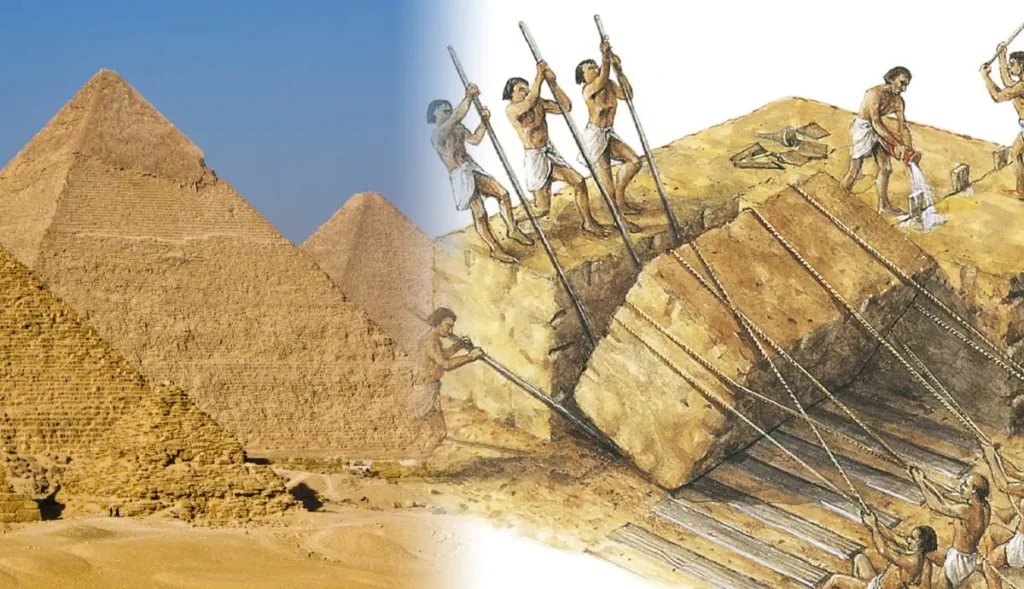
Paintings from ancient tombs depict workers pulling sleds carrying stone. Modern experiments revealed that pouring water on sand reduces friction by 50%, making it easier to drag heavy loads.
This technique could explain how limestone blocks from nearby quarries were moved across the desert.
b) River Transport via the Nile
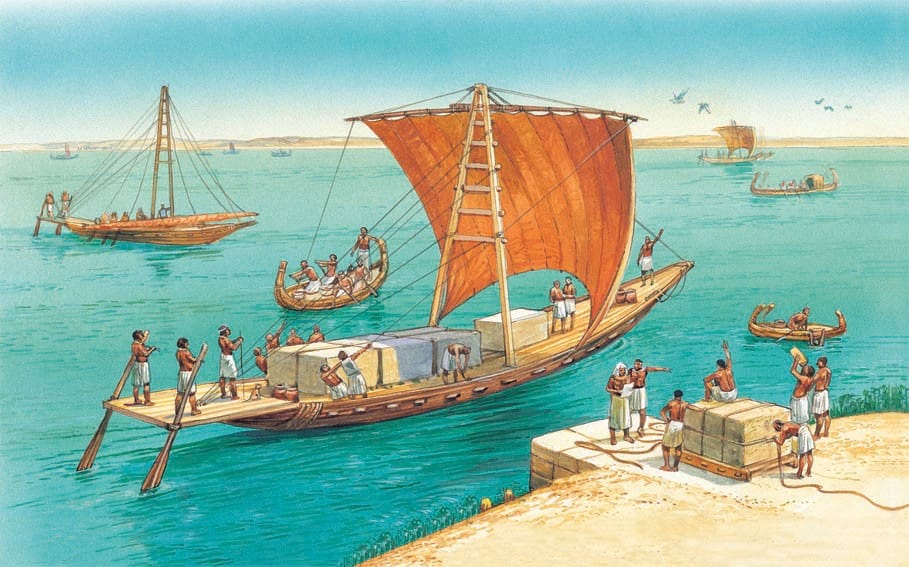
The Ahramat Branch discovery (Section 2) suggests blocks were shipped directly to the pyramid sites. Boats could have carried stones from Aswan (granite) and Tura (fine limestone) along canals linked to the Nile.
c) Rollers and Lubrication
Some researchers suggest wooden logs acted as rollers, or that clay and oil lubricants were used on sled paths.
How the Pyramids Were Built
3. Raising the Stones: Ramp Theories
Lifting multi-ton blocks to heights of over 140 meters was no small feat. Theories include:
-
Straight Ramp Theory: A long, straight earthen ramp leading up the pyramid.
-
Problem: It would require more material than the pyramid itself.
-
-
Zigzagging Ramp Theory: A ramp spiraling around the pyramid, reducing the slope but complicating angles.
-
Internal Ramp Theory: French architect Jean-Pierre Houdin proposed a system of ramps built inside the pyramid, which aligns with thermal scans showing spiral-like voids.
Each theory has supporters, but none fully explain every detail. The truth may lie in a combination of methods.
4. Precision Without Modern Tools
What amazes scientists most is the pyramid’s accuracy:
-
The Great Pyramid’s base is square to within 2 cm.
-
Its sides align almost perfectly with the cardinal directions.
-
The mortar binding the stones is stronger than the limestone itself, yet its chemical formula is still debated.
How did they achieve this? Likely with:
-
Simple tools like plumb bobs, leveling instruments, and ropes.
-
Knowledge of astronomy to align the structure with the stars.
-
Advanced surveying techniques lost to time.
5. Legends and Alternative Theories
Over the centuries, countless myths and alternative ideas emerged about pyramid construction:
-
Magic or Divine Power: Ancient Greeks believed the pyramids were too advanced to be human-made.
-
Aliens or Lost Technology: A modern fringe theory claims extraterrestrials taught Egyptians how to build. While entertaining, no evidence supports this.
-
Sound or Vibration Technology: Some suggest Egyptians used sound waves or unknown physics to levitate stones — a theory rooted more in speculation than science.
While fascinating, most of these remain legends, overshadowed by evidence of real human ingenuity.
6. Teamwork, Faith, and National Unity
Ultimately, the pyramids are a testament to human spirit. They were not just tombs; they were national projects that unified Egypt, mobilizing resources, workers, and faith in the divine role of the pharaoh.
When modern visitors stand before them — whether arriving by bus, minivan, or flight from Hurghada — they don’t just see stone. They see the endurance of human vision, crafted in a way that still defies time.
Unlocking the Ancient Mystery: How the Pyramids Were Built
For centuries, the question of How the Pyramids Were Built has captivated historians, engineers, and dreamers alike. These colossal stone monuments, standing tall against the desert sky, are a testament to human ingenuity that continues to baffle and inspire.
The mystery of How the Pyramids Were Built isn’t just about moving massive stones; it’s about understanding the mind of an ancient civilization. While we may never know every single detail, modern science and archaeology have given us incredible insights into How the Pyramids Were Built.
So, let’s dive into the fascinating theories on How the Pyramids Were Built.
The Workforce: It Wasn’t Slaves
A key part of understanding How the Pyramids Were Built is looking at the workforce. Evidence from worker villages near Giza shows they were skilled, well-fed laborers who were proud to work on a national project. This changes our entire perspective on How the Pyramids Were Built.
The River Nile’s Lost Branch: A Game-Changer
A 2024 discovery might be the biggest clue yet in solving How the Pyramids Were Built. Scientists found a long-buried branch of the Nile, called the Ahramat Branch, which ran right past the pyramid fields. This river was the ancient superhighway that made transporting millions of stone blocks possible. This discovery is crucial to explaining How the Pyramids Were Built.
Moving the Mountains of Stone
The core of the puzzle of How the Pyramids Were Built lies in logistics.
-
Water Transport: The lost Ahramat River explains How the Pyramids Were Built by allowing giant barges to float stones directly to the construction site.
-
On Land: Workers likely used wooden sleds on wet sand to reduce friction, which is a compelling theory for How the Pyramids Were Built.
Raising the Blocks to the Sky
Perhaps the most complex part of How the Pyramids Were Built involves getting the blocks to ever-increasing heights. The most supported theory involves a massive, spiraling ramp system that wrapped around the rising structure. This ramp theory is a leading idea on How the Pyramids Were Built.
Precision Engineering
How the Pyramids Were Built with such stunning accuracy is another marvel. They are aligned almost perfectly with the cardinal points. This precision is a central part of the wonder of How the Pyramids Were Built.
The quest to understand How the Pyramids Were Built is a journey into human ambition. Every new discovery adds a piece to the puzzle of How the Pyramids Were Built.
While we may never have the complete manual on How the Pyramids Were Built, the evidence points to a combination of a brilliant, organized workforce, a now-vanished river, and simple but incredibly effective engineering techniques. That is the most likely story of How the Pyramids Were Built.
The mystery of How the Pyramids Were Built remains one of history’s greatest stories.
Hurghada to Cairo tour
Visiting the Pyramids Today — A Traveler’s Guide from Hurghada to Giza
For all their grandeur and mystery, the pyramids are not just relics of the past. They are very much alive in the present, drawing millions of travelers every year who stand in awe before the last surviving Wonder of the Ancient World. If you’re based in Hurghada, one of Egypt’s most popular seaside resorts, the pyramids are closer than you think. With a variety of tour options available, your journey from the Red Sea to the Giza Plateau can be a seamless and unforgettable adventure.
This guide will help you explore the best ways to visit the pyramids, what to expect, and how HurghadaToGo can make your trip smooth, safe, and extraordinary.
1. Why the pyramids tour from Hurghada?
Hurghada is famous for its crystal-clear waters, coral reefs, and laid-back holiday vibe. Yet beyond the beaches lies Egypt’s ancient heart — and the pyramids are the ultimate highlight.
From Hurghada, you can:
-
Experience two worlds in one trip — the Red Sea’s beauty and Cairo’s timeless wonders.
-
Witness the Great Pyramid of Khufu, the Pyramid of Khafre, the smaller Pyramid of Menkaure, and the Great Sphinx.
-
Visit the Grand Egyptian Museum (GEM), now housing treasures of Tutankhamun and more.
-
Discover a living connection between modern Egypt and its pharaonic past.
2. The Journey from Hurghada to Giza
The distance between Hurghada and Cairo is about 450 km (280 miles). Thanks to modern roads and flights, reaching the pyramids is easier than ever. Here are the main options:
Pyramids tour from Hurghada
a) By Flight (Fastest & Most Comfortable)
-
✈️ Duration: About 1 hour.
-
Ideal if you want maximum time in Cairo without a long road journey.
-
Tours include airport transfers, flights, an Egyptologist guide, lunch, and all main tickets.
-
HurghadaToGo offers packages like “Day Trip to Cairo by Flight” where you fly in the morning and return in the evening.
b) By Private Car or Minivan (Flexible & Personalized)
-
🚐 Duration: 4.5–5 hours each way.
-
Perfect for families, small groups, or travelers who want comfort and flexibility.
-
Private tours include hotel pickup, licensed driver, guide, lunch, and full itinerary control.
-
You can customize stops — such as at Sakkara or Memphis — in addition to the pyramids.
c) By Bus or Coach (Budget-Friendly Group Option)
-
🚌 Duration: 6–7 hours each way.
-
Best for travelers who enjoy meeting new people and keeping costs low.
-
A classic Cairo Day Trip by Bus includes a guided tour of the Egyptian Museum, pyramids, Sphinx, and lunch.
3. What to Expect at the Pyramids
When you step onto the Giza Plateau, you’re entering a world that has mesmerized visitors for over 4,500 years.
-
The Great Pyramid (Khufu): The tallest and most famous pyramid, originally 146m (481 ft). You can enter via the robber’s tunnel to reach the Grand Gallery and King’s Chamber (extra ticket).
-
The Pyramid of Khafre: Easily recognized by the limestone casing stones still visible at its peak.
-
The Pyramid of Menkaure: Smaller but accompanied by three subsidiary pyramids for queens.
-
The Great Sphinx: Half-lion, half-human guardian of the plateau, symbolizing strength and wisdom.
-
The Solar Boat Museum (near Khufu’s pyramid): Houses a reconstructed wooden boat buried to transport the king’s soul.
-
Panorama Point: The best spot for photography, capturing all three pyramids in one frame.
4. The Grand Egyptian Museum (GEM)
No pyramid visit is complete without a stop at the Grand Egyptian Museum — the world’s largest archaeological museum. Opened in stages since 2024, it displays over 100,000 artifacts, including:
-
The complete treasure of Tutankhamun, much of which has never been displayed before.
-
Giant statues of Ramses II and other pharaohs.
-
Interactive exhibits that bring Ancient Egypt’s history to life.
Located just a short drive from the pyramids, it’s a perfect complement to your Giza experience.
5. Tips for a Smooth and Memorable Visit
-
Start early: Beat the crowds and the midday sun.
-
Bring essentials: Water, sunscreen, hat, and comfortable shoes.
-
Photography: Be ready for iconic shots, but respect rules in museums and tombs.
-
Extra activities: Consider a camel ride or horse carriage around the plateau for a unique perspective.
-
Guided tours: Always better with a licensed Egyptologist, who adds context and storytelling.
6. Why Book with HurghadaToGo?
While you could arrange a visit on your own, choosing a professional local agency like HurghadaToGo ensures:
pyramids tour from Hurghada
-
✅ Reliable transfers — no stress with transport or timing.
-
✅ Official tickets & permits — everything handled in advance.
-
✅ Expert Egyptologist guides — bringing history to life with passion and accuracy.
-
✅ Custom options — from luxury private cars to affordable bus trips.
-
✅ 24/7 support — peace of mind throughout your trip.
For inquiries and bookings:
🌐 Website: HurghadaToGo.com
📱 WhatsApp: +201009255585
📧 Email: [email protected]
Hurghada to Cairo tour
Traveler Testimonials and Modern Experiences at the Pyramids
When you stand in front of the pyramids for the first time, it’s more than just sightseeing. It’s a journey into 4,500 years of history, a moment where the ancient world and the modern traveler meet. For many visitors, this experience becomes the highlight of their trip to Egypt.
At HurghadaToGo, we are proud to have guided thousands of travelers from Hurghada to Cairo tour, and their words best describe what the pyramids mean today.
1. Stories from Travelers Who Stood Before the Pyramids
🌍 From Germany – “A Dream Come True”
“I always saw the pyramids in books, but standing in front of them was beyond imagination. Our Egyptologist explained how each stone was placed, and when I touched the blocks of the Great Pyramid, I felt connected to history. HurghadaToGo arranged everything perfectly — from the comfortable minivan to the delicious lunch overlooking the pyramids. It was the best day of our holiday.” – Katrin M., Berlin
🇬🇧 From the UK – “Seamless, Stress-Free, and Magical”
“Traveling with two children, I worried about the long day trip. But HurghadaToGo took care of every detail. The private car was spacious and air-conditioned, and our guide was amazing with the kids, telling stories about mummies and the Sphinx. Seeing their eyes light up when they spotted the pyramids for the first time — unforgettable!” – David L., London
🇫🇷 From France – “The Highlight of Our Egypt Tour”
“We had already enjoyed snorkeling in Hurghada, but the pyramids were the crown jewel. Our guide took us to the Grand Egyptian Museum, where we saw Tutankhamun’s treasures before heading to Giza. The camel ride with the pyramids in the background felt like a scene from a movie. Thank you, HurghadaToGo, for this perfect day.” – Marie & Thomas, Lyon
2. Common Themes in Traveler Experiences Hurghada to Cairo tour
From hundreds of reviews and personal stories, several common feelings emerge:
-
Awe and Wonder: Almost every traveler mentions the overwhelming size and mystery of the pyramids.
-
Smooth Travel: Guests appreciate the seamless transfers and planning, especially when the trip covers such a long distance from Hurghada.
-
Passionate Guides: Egyptologists add depth, explaining myths, astronomy, engineering, and pharaonic traditions.
-
Comfort & Care: From air-conditioned vehicles to fresh water and flexible itineraries, comfort is always a highlight.
-
Memories for Life: Families, couples, and solo travelers alike describe it as a “once-in-a-lifetime” experience.
3. The Modern Pyramid Experience Hurghada to Cairo tour
While the pyramids connect you to Ancient Egypt, the modern travel experience adds its own unique touches:
-
Panorama Photography: Instagram-worthy shots at the panoramic viewpoint, where all three pyramids align.
-
Camel or Horseback Rides: A fun way to capture the desert vibe and imagine how ancient Egyptians moved across the plateau.
-
Local Flavors: Lunches in restaurants with views of the pyramids — a rare moment of dining with history as your backdrop.
-
The GEM Connection: Visiting the Grand Egyptian Museum before or after Giza provides context that enriches the pyramid visit.
-
Safety & Guidance: With professional guides and organized tours, travelers can enjoy the wonders stress-free.
4. A Legacy That Inspires Travelers Hurghada to Cairo tour
For every traveler, the pyramids are not just stone monuments. They are symbols of human achievement, resilience, and vision.
Standing where pharaohs once walked, travelers often reflect on:
-
How such colossal structures were built without modern technology.
-
How ancient Egyptians combined science, spirituality, and engineering.
-
How these monuments survived thousands of years, wars, and natural disasters.
Planning Your Own Pyramid Adventure with HurghadaToGo
After reading the history, mysteries, and personal stories of travelers who have stood before the pyramids, the next question is: How can you experience it yourself?
At HurghadaToGo, we make sure that your journey from the Red Sea to the heart of Ancient Egypt is seamless, comfortable, and unforgettable. Here’s how we help you plan the perfect pyramids tour from Hurghada.
1. Tour Options: How You Can Travel from Hurghada to Cairo tour
Whether you want a private, relaxed journey or a more budget-friendly option, we have several ways to reach Cairo and the pyramids:
Pyramids tour from Hurghada
-
✈️ By Flight:
-
The fastest and most comfortable way.
-
From Hurghada airport to Cairo in about 1 hour.
-
Perfect if you want to maximize your time exploring the pyramids and the Grand Egyptian Museum.
-
-
🚐 Private Car or Minivan:
-
Ideal for families, couples, or small groups who want privacy.
-
Air-conditioned vehicles with professional drivers.
-
Travel at your own pace, with flexibility for photo stops and extra sightseeing.
-
-
🚌 Small Group Minivan (max 8 people):
-
A balance between affordability and comfort.
-
Travel with like-minded explorers in a modern 2025 Toyota minivan.
-
Includes a licensed Egyptologist guide.
-
-
🚌 Large Coach (up to 42 seats):
-
A budget-friendly option.
-
Perfect for those who enjoy traveling in larger groups.
-
Still includes all the key highlights of Cairo and Giza.
-
Hurghada to Cairo tour
-
2. What’s Included in Your Hurghada to Cairo tour
Every pyramids tour from Hurghada with HurghadaToGo is designed to be worry-free. Here’s what’s typically included:
✅ Transfers in air-conditioned vehicles
✅ Entrance tickets to the pyramids area & the Sphinx
✅ Guided tour with a professional Egyptologist
✅ Visit to the Grand Egyptian Museum (GEM)
✅ Open-buffet lunch at a pyramids-view restaurant (drinks extra)
✅ Free time for photos and optional camel rides
✅ Assistance with permits and logistics
(We also offer add-ons like a Nile River cruise in Cairo or entry to the interior of the Great Pyramid — just ask when booking.)
3. Tips for Making the Most of Your Trip
-
Start Early: It’s a long day, so get a good night’s sleep in Hurghada before your journey.
-
Bring Essentials: Sunscreen, hat, sunglasses, and comfortable shoes.
-
Stay Hydrated: Egypt’s sun can be intense — we provide water, but extra is always good.
-
Charge Your Camera: The pyramids are among the most photographed monuments in the world, and you’ll want plenty of photos.
-
Embrace the Moment: Don’t just take pictures — pause, breathe, and imagine the world of Ancient Egypt around you.
4. Why Choose HurghadaToGo
-
Local Expertise: Based in Hurghada, we know the best routes, guides, and hidden gems.
-
Passionate Egyptologists: Not just guides — real storytellers who bring history alive.
-
Flexible Options: From luxury private tours to affordable group trips.
-
Trusted by Travelers: Hundreds of 5-star reviews from guests around the world.
-
Personal Support: Direct contact via WhatsApp or email for a smooth booking process.
- pyramids tour from Hurghada
5. Booking Made Easy Hurghada to Cairo tour
Booking your pyramids tour from Hurghada is simple:
📌 Visit our website: HurghadaToGo.com
📌 WhatsApp us directly: +20 100 925 5585
📌 Email: [email protected]
Our team responds quickly, confirms your pickup details, and ensures your journey is stress-free from the very beginning.