

F
or more than four thousand five hundred years, the Great Pyramid of Giza has stood at the edge of the desert like a silent oracle, refusing to surrender its truth. Generations of pharaohs, priests, conquerors, scholars, and travelers have stared at its slopes and asked the same impossible question. What was it really for? Today, a new generation of engineers, acousticians, and hydraulic specialists believe they have finally cracked the door open — revealing the hidden secret behind the construction of the pyramids, a secret that may upend everything we were taught in school.
This article is the eighth chapter in our flagship investigative series, The Code of Egyptian Civilization: The Untold Story. Here, we travel beyond tourist guidebooks and dusty textbooks. We follow the controversial yet rigorously argued theories of British engineer Christopher Dunn, hydraulic engineer John Cadman, and acoustic specialist Tom Danley — three minds who looked at Giza not as a tomb, but as the most sophisticated stone machine ever built by human hands.
Prepare yourself. By the time you reach the final paragraph, you will never look at a pyramid the same way again.
1. The Enigma of the King’s Chamber and Its Mysterious Cracks

In the late 19th century, the legendary British Egyptologist Sir William Matthew Flinders Petrie — a man whose obsession with measuring stones helped invent modern archaeology — entered the King’s Chamber armed with the most precise instruments of his era. What he documented was unsettling. The granite walls and floor had shifted outward from their original positions by one to two inches. The ceiling had risen approximately three inches. Cracks ran through the massive stones in ways that suggested something had once shaken the chamber from within.
Petrie’s notebooks describe “clear signs of significant vibration and expansion.” That single observation, recorded over a century ago, contained the spark that would eventually ignite a global rethinking of the hidden secret behind the construction of the pyramids. Why would the inner core of a so-called silent tomb show evidence of intense mechanical movement?
The questions multiply the deeper we look. Why does the Great Pyramid possess five complete relieving chambers stacked above the King’s Chamber — an architectural feature found in no other pyramid in Egypt? Why is the Queen’s Chamber coated with a thick crust of salt deposits, the kind one would expect from prolonged contact with mineral-rich water or chemical reaction? And why do we find pyramid structures not only across Egypt and Sudan, but also in Bosnia, China, Mexico, Peru, and dozens of other locations? Is it coincidence, or is there a single forgotten technology behind them all?
The extraordinary precision of the passages, the laser-flat surfaces of the granite sarcophagi, and the staggering scale of the limestone blocks all whisper the same uncomfortable truth: the pyramids were not merely tombs. The most important question in Egyptian history remains stubbornly unanswered. Why were they really built?
2. Christopher Dunn and the Deconstruction of the Internal Design

The year was 1977. A British engineer named Christopher Dunn sat reading Peter Tompkins’ landmark book Secrets of the Great Pyramid. Dunn was not an archaeologist. He was a man who spent his life designing precision tools, working with tolerances measured in thousandths of an inch. And as he turned the pages, something began to disturb him.
The book documented the pyramid’s near-perfect alignment to true north, the corbelled vault of the Grand Gallery, the laser-straight passages, the obsessive precision of the chamber dimensions. To a trained engineer, this was not the work of a Bronze Age civilization that supposedly used copper chisels and ropes. This was the signature of a culture that understood machine-grade engineering. Dunn began asking questions that no Egyptologist seemed willing to ask — questions that would eventually lead him to the hidden secret behind the construction of the pyramids.
The first puzzle was geometric. Why does the Great Pyramid have three primary chambers — one underground (the Subterranean Chamber), one in the middle (the so-called Queen’s Chamber), and one near the top (the King’s Chamber)? Mainstream Egyptology offers a tidy explanation: the king kept changing his mind. He started with the Subterranean Chamber, then ordered a new chamber halfway up, then changed his mind again and demanded a third near the apex. A pharaoh’s indecision, we are told, dictated the architecture of the most precisely built structure on Earth.
Dunn was not buying it. From an engineering standpoint, the “design change” theory collapses under the weight of one simple observation: the passages leading to the abandoned chambers were finished with the same obsessive precision as the rest of the structure. If the king had truly abandoned the middle chamber, why did the workers continue carving its corridors with mathematical accuracy? Why complete what no longer mattered?
The answer, Dunn realized, was unavoidable. The three chambers were never abandoned. They were never afterthoughts. They were components of a single, unified system — a machine.
❖ A TIMELINE OF DISCOVERY ❖
Sir Flinders Petrie documents vibration cracks and outward expansion inside the King’s Chamber.
Christopher Dunn begins his decade-long engineering investigation of the Giza Plateau.
Tom Danley conducts a month-long acoustic study, discovering the King’s Chamber resonates at 30 Hz.
Dunn publishes The Giza Power Plant — the first comprehensive engineering theory of the pyramid as a machine.
John Cadman builds a working concrete model of the Subterranean Chamber, proving the hydraulic ram pump theory.
3. The Five Relieving Chambers: An Engineering Paradox

Above the King’s Chamber sit five additional chambers, stacked like floors in a skyscraper. In the 19th century, a British naval officer named Howard Vyse — not an architect, not an engineer, not a structural specialist — entered them and offered a casual hypothesis: they must be there to relieve the structural load on the King’s Chamber below. Without rigorous study, his guess hardened into “fact” and was repeated for over a hundred and fifty years in textbooks worldwide.
But the engineering does not survive scrutiny. If those five chambers truly existed to relieve weight, why was the same technique not applied to the Queen’s Chamber, which sits beneath far more stone? Why was it not used in the pyramids of Sneferu, or in the Pyramid of Khafre next door, both of which carry comparable or even heavier loads?
And here is the strangest detail of all: the stones forming the ceilings of these chambers were carefully polished smooth on the underside but left rough and irregular on top. If they were merely structural relief beams, no one would ever see them — and there would be no reason to polish them. Unless, of course, the polishing served an acoustic function: tuning the chambers to a specific resonant frequency.
This is one of the boldest pieces of the puzzle pointing toward the hidden secret behind the construction of the pyramids — the idea that the pyramid’s upper architecture was not designed to hold weight, but to vibrate.
📌 Why the Tomb Theory Fails
| Anomaly | Tomb Theory Explanation |
| No mummy ever found | “Stolen by ancient thieves” |
| No hieroglyphic inscriptions | No accepted explanation |
| Five “relieving” chambers | Structural support (disputed) |
| Salt deposits in Queen’s Chamber | No accepted explanation |
| Vibration cracks (Petrie) | No accepted explanation |
4. Reinterpreting the Pyramid as a Stone Machine

The conventional tomb theory cannot explain three undeniable features of the Great Pyramid: the absence of inscriptions, the absence of a mummy, and the bewildering complexity of its internal architecture. Christopher Dunn approached the problem from a radically different angle. He treated the pyramid as he would treat any unknown machine that arrived at his workshop. He assumed nothing was random. He assumed every component had a function. He assumed the engineers who built it were as intelligent as — or more intelligent than — engineers today.
To grasp how a stone structure could be a machine, consider a modern analogy: the hydroelectric dam. A dam is, at its core, a colossal stone wall. It blocks water. But it also generates electricity through hidden turbines and electromagnetic systems embedded within. If our civilization were to vanish tomorrow, and another emerged ten thousand years from now, every metal component would have rusted away. All that would remain would be the immense stone shell. Future archaeologists might call it a “ceremonial flood barrier” and never imagine it once powered millions of homes.
This is the lens through which Dunn invites us to see the Great Pyramid — not as a religious monument, but as the stone shell of a vanished technology. The metallic and organic components of its inner mechanism may have decayed, leaving only the silent geometric blueprint behind. And that blueprint, when read by an engineer, screams function.
For nearly a decade, Dunn assembled the evidence. Finally, in 1997, he published his comprehensive theory in his now-classic book The Giza Power Plant, a work that triggered an earthquake in the world of alternative Egyptology and continues to challenge mainstream science to this day.
5. Tom Danley, the 30 Hz Resonance, and the Day the Workers Fled

In 1995, world-renowned acoustic engineer Tom Danley received official permission from the Egyptian Ministry of Antiquities to conduct one of the most unusual scientific experiments ever performed inside an ancient monument. For an entire month, his team installed precision microphones, ultra-sensitive vibration sensors, and frequency generators throughout the King’s Chamber, the upper relieving chambers, and the connecting passages.
The findings shook the world of Egyptology. Two of them are particularly central to the hidden secret behind the construction of the pyramids:
Discovery #1 — The Free-Standing Chamber
The King’s Chamber, including its walls, ceiling, and floor, stands completely free within the body of the pyramid. It is not bonded to the surrounding masonry. Deliberate gaps separate it on all sides. Beneath the floor, geometric voids interrupt the bedrock. The chamber sits inside the pyramid like a tuning fork suspended in air. The crushing weight above is supported entirely by the gabled stones overhead — not by the chamber itself.
Discovery #2 — The 30 Hz Panic
When Danley’s equipment emitted a low frequency of 30 Hz, the King’s Chamber entered a state of total resonance. The vibration was so violent and palpable that workers and supervisors inside the chamber panicked and fled, fearing the pyramid was about to collapse. Danley immediately stopped the experiment to prevent any structural damage.
Read those words again. The most precisely built structure in human history was deliberately engineered to vibrate when struck with a specific low-frequency tone. This is not religion. This is not symbolism. This is mechanical engineering.
6. The Science of Natural Frequency — And Why It Changes Everything

To understand why Tom Danley’s discovery matters, you have to understand a phenomenon that physicists call resonance.
Every object on Earth has a natural frequency — a specific vibration rate determined by its mass, density, geometry, and composition. A tuning fork is the simplest example. A 440 Hz fork will, when struck, vibrate at exactly 440 cycles per second. But here is the magic: if you place a second identical 440 Hz fork nearby and direct a sound wave of exactly 440 Hz toward it, the second fork will start vibrating on its own — without ever being touched. The sound wave, perfectly matched to its natural frequency, transfers energy directly into its molecules.
This is why a trained opera singer can shatter a wine glass with her voice. She is not screaming louder. She is matching the glass’s exact resonant frequency. It is not power that breaks the glass. It is precision.
Resonance has built and destroyed worlds. In 1940, the Tacoma Narrows Bridge in Washington State collapsed only four months after opening because steady winds happened to match its natural frequency. The bridge oscillated more and more violently until it tore itself apart, the entire disaster captured on film. Modern engineering uses resonance constructively in ultrasonic drills, kidney-stone pulverizers, and sound therapy devices.
Two conditions must be met for resonance to occur:
- The external frequency must exactly match the object’s natural frequency.
- The object must be free to vibrate — not rigidly clamped or bonded.
And now look again at the King’s Chamber. It is free to vibrate — deliberately suspended within the pyramid’s body. It is precisely tuned — the upper relieving chambers act as carved acoustic dampers, polished smooth on their undersides. It enters perfect resonance at 30 Hz. Nothing about this is accidental. Every detail points toward the hidden secret behind the construction of the pyramids: a deliberate, sophisticated machine engineered for vibration.
7. Hathor, the Sistrum, and the Sacred Power of Sound


Sound was never marginal in ancient Egyptian thought. It was sacred technology. The goddess Hathor — mother, healer, sky goddess, and patroness of music — symbolized the very power of vibration. Her sacred instrument, the sistrum, produced a precise rattling tone used during temple rituals, royal births, and ceremonies of healing.
This was not entertainment. The Egyptians understood that frequency carried force, that sound could move matter, and that the cosmos itself was woven from vibration. Echoes of this ancient technology persist in modern Egyptian folk practice. During the “Sebou” ceremony — held seven days after a child’s birth — women still strike iron mortars rhythmically to bless the newborn. Mothers across Cairo still calm crying infants with rattles whose tones echo the sistra of pharaonic temples.
The link between Hathor’s sound rituals and the engineered resonance of the King’s Chamber is no longer wild speculation. It is the missing thread that ties the spiritual to the technological in a civilization that may have understood sound far better than we do today — another shimmering clue pointing back to the hidden secret behind the construction of the pyramids.
8. The Subterranean Chamber and the 100-Meter Tunnel

Christopher Dunn was certain, based on his calculations, that the source of the acoustic pulses lay deep beneath the bedrock — in the mysterious Subterranean Chamber. To reach it, one must crawl through a perfectly straight, narrow, downward-sloping tunnel carved with extraordinary precision into the limestone of the Giza Plateau, exactly 100 meters long.
The Subterranean Chamber itself appears, at first glance, to be unfinished. The walls are rough, jagged, almost chaotic. Tourist guides have repeated the official line for over a century: the chamber was abandoned mid-construction. But Dunn and other engineers noticed something the guides ignored. The ceiling is perfectly flat and beautifully finished. A neatly carved passage exits the chamber. If the workers truly abandoned it, why did they meticulously level the ceiling and shape the exit corridor while leaving the walls “in chaos”?
The answer, when it finally arrived, was breathtaking.
9. John Cadman and the Hydraulic Ram Pump Theory
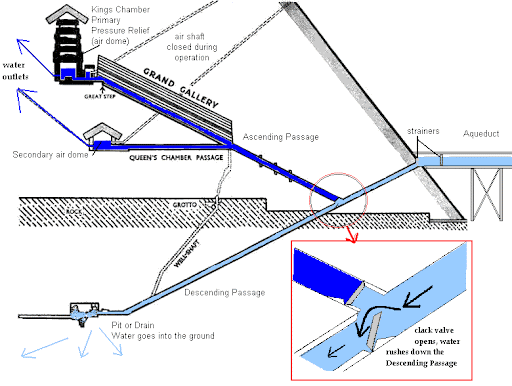
Hydraulic engineer John Cadman read Dunn’s research and immediately recognized something familiar. The bizarre architecture of the Subterranean Chamber — the long straight tunnel, the flat ceiling, the “rough” walls — matched almost perfectly the operating geometry of a hydraulic ram pump. A hydraulic ram pump is a remarkable device that uses nothing but flowing water and air pressure to lift water uphill. It needs no electricity, no fuel, no moving parts beyond a simple valve. It is, in essence, a self-sustaining water engine.
In June 1999, Cadman built a scaled concrete replica of the Subterranean Chamber in his garden in Washington State. The result? With a single push of a valve, the 500-pound concrete block began vibrating and emitting regular mechanical pulses automatically. Through glass observation panels and ink injectors, Cadman watched the water form a rhythmic, heart-shaped pulsing vortex inside the chamber — a living, breathing flow that perfectly matched what the pyramid’s designers must have intended.
Suddenly, every “random” feature of the Subterranean Chamber made sense:
- The 100-meter straight tunnel was a pressurized water conduit.
- The flat ceiling was the strike surface for hydraulic pulses.
- The “chaotic” walls were precisely shaped flow channels.
- The narrow exit passage was a return pipe.
The Great Pyramid’s outer enclosure walls — long dismissed as mere protection against thieves — were almost certainly water reservoirs filled from the Nile. Water poured through the 100-meter tunnel, smashed against the ceiling of the Subterranean Chamber, and generated rhythmic shockwaves at approximately 223 Hz. Those shockwaves traveled upward through the body of the pyramid, striking the precisely tuned King’s Chamber and sending it into perfect resonance at 30 Hz.
The pyramid was not a tomb. It was an enormous, self-sustaining vibration generator powered by the river itself.
10. The Material Evidence Carved Into the Stones

The hydraulic ram pump theory does not stand on speculation alone. Three pieces of physical evidence inside the Great Pyramid powerfully support it:
💧 1. Visible Water Erosion
The walls and floor of the Subterranean Chamber show clear hydraulic wear consistent with prolonged water flow — smooth grooves, dissolution patterns, and mineral residues that no dry burial chamber would display.
📐 2. Polished Ceiling, Rough Walls
The deliberate contrast between a perfectly leveled ceiling and rough walls only makes engineering sense if water needed to strike a flat surface to generate regular pulses, while the walls served as engineered flow channels.
📏 3. The 100-Meter Precision Tunnel
A laser-straight 100-meter tunnel makes no sense as a funeral corridor. It makes perfect sense as a high-velocity hydraulic conduit designed to channel pressurized water into the generation chamber.
Add the salt deposits in the Queen’s Chamber, the vibration cracks Petrie documented, the polished underside of the relieving chamber stones, and the deliberate free-standing design of the King’s Chamber, and the picture becomes overwhelming. The Great Pyramid was a fully integrated mechanical system. Every detail, every block, every angle was part of the hidden secret behind the construction of the pyramids — a machine of stone, water, and sound, lost to time.
Conclusion: The Pulsing Heart Beneath the Plateau
For centuries, the Great Pyramid has been treated as a tomb that swallowed its own answers. But when engineers, not archaeologists, study its architecture, an entirely different monument emerges — one engineered to vibrate, resonate, and pump water with breathtaking precision. The “unfinished” Subterranean Chamber was the engine. The 100-meter tunnel was the fuel line. The free-standing King’s Chamber was the resonator. And somewhere in the relationship between water, stone, and frequency lies a forgotten technology that may finally explain why the ancients built mountains of stone with such impossible precision.
This is only the beginning. In the next article of The Code of Egyptian Civilization, we will descend deeper into the apparent “chaos” of the Subterranean Chamber to reveal the second half of the mystery — the chemical, electromagnetic, and energetic dimensions of the greatest stone machine ever built. Stay with us. The pulse beneath the plateau is still beating.
🏛️ Walk the Pyramids Yourself
Stand at the foot of the Great Pyramid. Descend into the Subterranean Chamber. Feel the silence of the King’s Chamber on a guided expert-led tour with HurghadaToGo.
❓ Frequently Asked Questions
What is the hidden secret behind the construction of the pyramids?
According to engineers Christopher Dunn and John Cadman, the Great Pyramid was designed as a sophisticated hydraulic and acoustic machine — a vibration generator that used Nile water to produce mechanical pulses, causing the King’s Chamber to resonate at 30 Hz.
Was the Great Pyramid actually a tomb?
No royal mummy has ever been found inside it, and there are no inscriptions in its main chambers. Many engineers and researchers argue the tomb theory cannot explain its complex architecture, vibration cracks, salt deposits, or precision passages.
Who is Christopher Dunn?
Christopher Dunn is a British precision engineer and author of The Giza Power Plant (1997), the foundational book proposing that the Great Pyramid was an advanced energy-generating machine.
What did Tom Danley discover at Giza?
In 1995, acoustic engineer Tom Danley conducted a month-long study showing the King’s Chamber is a free-standing structure that enters full resonance at 30 Hz — a discovery that supports the engineered-machine hypothesis.
How does a hydraulic ram pump work?
A hydraulic ram pump uses the kinetic energy of flowing water and trapped air pressure to lift water uphill without any electricity or fuel. John Cadman’s 1999 concrete model proved the Subterranean Chamber operates on this exact principle.
Can I visit the Great Pyramid and the King’s Chamber?
Yes. HurghadaToGo offers full-day and overnight tours from Hurghada to Cairo, including expert-guided access to the Giza Plateau, the Great Pyramid, the Sphinx, and the Grand Egyptian Museum. View all tours here.
🔗 Share This Mystery
Facebook
Instagram
TikTok
Pinterest
Medium
LinkedIn
TripAdvisor
Google Maps
📚 Continue The Code of Egyptian Civilization
The Hidden Secrets of the Egyptian Pyramids: 7 Mind-Blowing Facts
A foundational read on the unanswered mysteries of the Giza Plateau.
Cairo Day Trip from Hurghada by Flight 2026
Visit the Pyramids, Sphinx, and Grand Egyptian Museum in one unforgettable day.
Luxor East and West Bank Temples Full Day Tour 2026
From Karnak to the Valley of the Kings — walk through Egypt’s greatest open-air museum.
✉️ Join the Code of Egyptian Civilization
Receive every new chapter, exclusive Egypt travel deals, and ancient mysteries delivered straight to your inbox.