
The Riddle of the Statues: Did the Ancient Egyptians Carve Granite with Lasers?
An engineering investigation into the impossible precision hidden inside Egypt’s most sacred sculptures.
Behind the mesmerizing artistry of Pharaoh’s statues lies a terrifying engineering precision — faces symmetrical to the micron, carved into the hardest stones on Earth. In this fifth chapter of The Code of Egyptian Civilization, we decode the Riddle of the Statues: was this digital-grade perfection truly achieved with copper chisels and dolerite balls… or are we staring at the fingerprints of a lost technology?
B
ehind the mesmerizing beauty of Egyptian sculpture lies a quiet, almost terrifying form of engineering precision. Faces sculpted with symmetry measured at the micron level. Curves carved into stones harder than steel. Eyes, lips and royal crowns repeated across thousands of kilometres — from the Nile Delta to the cataracts of Aswan — with such consistency that it forces a question modern scholars still struggle to answer.
How did the ancient Egyptian sculptor achieve digital-level symmetry thousands of years before the invention of the computer? Are primitive “dolerite stones” truly enough to explain this miracle, or are we facing a lost technology whose secrets are only now being revealed by modern cameras and symmetry-analysis software? This is the heart of the Riddle of the Statues.
1. The Origin of the Riddle — A British Engineer in Mit Rahina
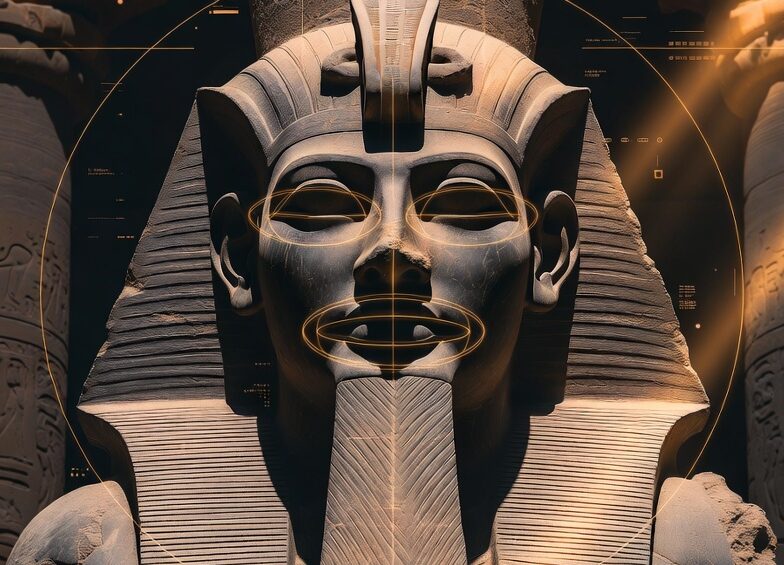
The granite head of Ramses II in Luxor Temple — the moment that launched a decade of investigation.
The story begins not in academia but in a quiet museum hall in the 1990s. British engineer Christopher Dunn — a man whose career was spent inside aerospace machine shops — visited Egypt and stood before the colossal statue of King Ramses II at the Mit Rahina Museum. A strange detail caught his trained eye: the perfect mirror match in shape and size between the king’s two nostrils.
At first he dismissed it as artistic skill. But the image refused to leave him. For eight years it haunted him until he returned to Egypt, this time targeting the granite head of Ramses II at Luxor Temple. He arrived not as a tourist but as an industrial engineer with a camera and a hypothesis.
Dozens of photographs were taken from carefully measured angles. When the digital analysis was complete, his conclusions shocked him. They led him to propose a hypothesis that remains controversial to this day: that the ancient Egyptians possessed advanced techniques and tools — tools that have still not been rediscovered — that allowed them to carve these masterpieces. Despite countless studies since, the technological challenge buried inside the Riddle of the Statues remains unexplained.
“
The faces matched to within a fraction of a millimetre. This is not artistry alone — this is industry.
2. Modern Technology Meets Ancient Genius
It would have been impossible to grasp the true scale of ancient Egyptian genius without modern technology. Just as cameras and aircraft revealed that the Great Pyramid of Giza has eight faces rather than four, today’s tools are giving us a sharper window into the artifacts the pharaohs left behind.
The ancient Egyptians produced thousands of statues — of kings, gods, scribes, and ministers. Some were created in staggering quantities:
Most of these masterpieces were carved from extremely hard stones — granite, basalt, and quartzite — materials that remain difficult to work with even in our modern era, where large granite statues are produced only in very limited numbers. This single fact deepens the Riddle of the Statues with every passing year of archaeological discovery.
The goddess Sekhmet alone has more than 700 known statues scattered across museums worldwide. Many remain buried beneath the sands of Luxor today — each one carved from black granodiorite harder than modern construction stone.
3. Engineering Precision in Carving Hard Stones
Beyond artistic beauty, engineering precision is the silent thread linking the pyramids, the obelisks, and the Riddle of the Statues. Measuring this precision is challenging because statues are not simple geometric shapes — they are organic, intertwined, complex.
A Camera, a Tripod, and a Centred Nose
When Christopher Dunn examined the broken granite head of Ramses II at Luxor Temple, he saw with the naked eye a high degree of facial symmetry. To prove it digitally, he mounted his camera on a tripod facing the statue, aligning the lens precisely with the centre of the nose. Computer analysis of the resulting images confirmed that the dimensions of the face matched between left and right to a degree that defies hand carving in granite.
Design Accuracy and Archaeological Symmetry
Researchers now use advanced visual techniques: duplicating the statue’s image, converting it to a negative to highlight contour lines, then merging the images with transparency settings until they overlap. When this is done with a Ramses face, the result confronts you directly: the symmetry is so consistent it strongly suggests mechanical means for cutting and measuring.
To be clear — absolute 100% perfection is impossible. There is always a slight margin of error, perhaps a tilt in the false beard or a hair-thin deviation in an eyebrow. But on a granite block weighing tonnes, achieving even a 99.7% match is a miracle of either patience or technology.
4. The Dolerite Stone Hypothesis: Theory vs. Practice
Most museums, archaeological references, and university curricula support a single answer: granite statues were quarried, carved, and polished using dolerite balls. The evidence cited is the discovery of 12 dolerite balls near a statue of Ramses paired with the god Ra. The same explanation is applied to obelisks, sarcophagi, and statues alike.
But the Riddle of the Statues persists for one stubborn reason: the lack of well-documented practical experiments. If proponents had truly tested the method, taken a granite block, and reproduced even a single Ramses-quality face from start to finish — documenting every blow, every hour, every gram of dust — the matter would be settled.
At best, dolerite balls can break a main block to create a rough outline, exactly as we see in unfinished pieces preserved in the Egyptian Museum. The real crisis lies in the second stage — the carving of fine details, eyelids, lip lines, and the contours of the nose. Dolerite, no matter how patiently swung, appears utterly incapable of this surgical precision.
⚒️ The Practical Test That Was Never Done
If a determined volunteer were given dolerite balls, copper chisels, and an unworked granite block, could they reproduce a New Kingdom royal head — symmetrical, polished, complete — within a human lifetime? In all of Egyptology, no such successful experiment has ever been recorded.
5. The Ramses II Statue at Memphis — Discovery & Survival
The limestone colossus of Ramses II at Memphis is one of the most beautiful and massive statues ever created — originally standing about 10 metres tall. When it was discovered in 1820, Egypt’s ruler Muhammad Ali Pasha offered it to the British Museum. London declined: the cost of transport and insurance was too steep even for an empire.
The statue lay where it had fallen for years, until the Egyptian Antiquities Authority decided to keep it on site and build a dedicated museum around it. Today its facial features display exceptional precision and beauty — an ideal candidate for testing the modern symmetry theory.
Researchers used the “Grid Overlay” feature available in cameras to adjust shooting angles using guide lines. Despite the limitations of standard devices, the resulting images repeatedly returned the same verdict: this face was carved from a precise design, not improvised by hand.
6. Symmetry Technology — Decoding the Engineering Cipher
To overcome the limitations of traditional tools, a specialised application called “Symmetry” was developed for iPad. It generates detailed guide lines and circles whose shape and colour can be fully controlled, ensuring perfectly symmetrical images even on challenging surfaces such as basalt or red granite.
The process is simple: activate the program, select a coordinate grid or circles, and adjust the central line so it passes precisely between the eyes and nostrils. Capture multiple images. Then let the computer compare the two halves of the face. Five random points are selected for matching — cheek apex, jaw curve, lip corner, eye corner, ear lobe — and the results almost always shock the operator.
The true wonder lies beyond simple symmetry. The carving paths of the lips and eyes appear as segments of precise geometric circles. Not approximations — circles. Curves that demand a fixed mechanical pivot.
📅 A Timeline of Investigation
7. The Artistic School — From the Delta to Aswan
This symmetry study covered nearly forty statues and sarcophagi across various museums and temples over more than two years. Clear, tangible precision was observed in some pieces; others were less precise. The diversity itself reveals a school — a unified design language stretching the entire length of the Nile.
Sarcophagi sometimes surpassed statues in precision. The number of pieces showing high symmetry confirms the existence of a consistent design and carving school — one that followed unified methods from the marshes of the Delta to the granite quarries of Aswan. This is the soul of the Riddle of the Statues.
8. From 2D Photography to 3D Scanning
Even if absolute perfection is unattainable, the extremely low error rate — undetectable by the naked eye and only revealed by computer programs — forces a difficult question: were these statues really carved entirely by hand using chisels and stones?
Two-dimensional photography can only do so much. To deepen the investigation, researchers turned to three-dimensional scanning. The technology is still young and faces logistical hurdles. Some scanners must remain tethered to a laptop — difficult inside museums without special permits. Others demand that the statue itself be rotated, an obviously impractical request for a 7-tonne block.
The Structure Sensor Experiment
The team turned to the Structure Sensor, a tablet-mounted device that projects a light pattern and captures it back to build a 3D model. Despite valiant effort across several statues, results were mixed. The device struggles in bright daylight or the dim ambient lighting common to most Egyptian museums — the very environments where it is needed most.
Where scanners fail, photographers persevere: multi-angle photography, sometimes 100 images per artifact, processed through PhotoScan software, has produced remarkable digital replicas. The world’s leading platform Sketchfab now hosts thousands of these models — including a stunning reconstruction of a 7-tonne red granite Ramses II discovered at the Ramesseum in Luxor and moved to Britain in the early 19th century.
Examining that virtual model is breathtaking. The face is intact, the features mirror-precise. The right side perfectly matches the left, both forming part of a precise oval shape. A carving tool must have followed a fixed curved path to ensure consistency in the jaw, cheek, and headdress. Random hammer strokes do not produce ovals.
9. Royal Crowns & Elliptical Paths
The crowns of the pharaohs add another layer to the mystery. Historically, the White Crown (Hedjet) symbolised the south, the Red Crown (Deshret) the north, and the two merged into the Double Crown after unification. Yet despite their religious centrality, no real crown has ever been recovered — not from a tomb, not from a temple, not from any archaeological site. They appear only in stone, on statues and reliefs.
In Luxor Temple, several detached statue crowns lie on the ground. They display astonishing smoothness and an even more astonishing geometric formation: the conical southern crown, with its superb tapering, forms part of a precise elliptical path.
This is where the mathematics becomes uncomfortable. According to Greek records, the formal drawing of ellipses began only around 400 BC with scientists like Archimedes and Proclus — and Archimedes had to invent a special machine with vertical axes just to draw the shape on flat papyrus. The Egyptians were carving it as a three-dimensional solid in granite, more than a thousand years earlier.
The human hand, free to wander, does not produce perfect ovals. Geometry of this caliber demands a fixed pivot, a guide, a tool — in a word, a machine.
10. The Tool Dilemma & the Philosophy of Secrecy
Official Egyptology tells us that statue carving evolved dramatically across 3,000 years — yet this artistic explosion was not accompanied by any documented evolution in tools. We are asked to believe that the small, modest statues of the Old Kingdom were carved with the same primitive instruments as the colossal granite giants of the New Kingdom. This defies the basic logic of every craft known to humanity.
Why the Tomb of Qar Shows Only Hammers
Sceptics ask a fair question: if advanced tools existed, why do the reliefs in the tomb of Qar in Saqqara show sculptors using only hammers and chisels? The answer touches the deepest layer of Egyptian civilisation — the philosophy of secrecy.
The ancient Egyptians were not naive enough to record their scientific and technical secrets for the public. Just as today’s superpowers do not publish aircraft blueprints, microchip schematics, or vaccine formulae in the village square to protect their advantage, the Egyptians documented only what was safe to display. The absence of records of advanced machines does not prove they did not exist; it suggests they were part of highly guarded sciences reserved for an elite caste of priest-engineers.
Belzoni’s Testimony — 1819
The Italian explorer Giovanni Belzoni, a hydraulic engineer who visited Egypt in 1819 (before the Industrial Revolution had truly armed Europe with hardened steel), confessed openly that the tools available in his time could not easily cut granite or achieve the smoothness he witnessed. Granite’s hardness has not changed since the days of Ramses. The mystery has only deepened.
The Marble vs. Granite Paradox
Some compare Egyptian sculpture to Roman or Renaissance marble work. Science exposes the false equivalence:
Industrial diamond was not used in stone-cutting until the 19th century. So how, then, did the ancient Egyptians achieve micron-level detail in granite without diamond?
Modern Workshops in Luxor — The Final Word
In the heart of Luxor, master craftsman “Uncle Hassan” walked us through the modern reality. Work begins with a raw quarry block, first shaped with an electric grinder nicknamed “the rocket”, then refined with finer attachments. Eyes and ears are carved with “the diamond”, an electric tool resembling a drill. Today’s industry depends entirely on electric machines and diamond-tipped cutters. Steel alone cannot penetrate granite.
A single statue takes about three weeks with a team of four or five assistants. Field visits to four Luxor workshops confirmed an awkward truth: there is no hand carving of granite anywhere. Every workshop owner stated the same thing. The hand-tool theory is, in their professional view, a myth.
In a letter to Christopher Dunn, a professional sculptor admitted that carving a Ramses statue would require tools far stronger than copper. His own modern diamond-bladed equipment, he wrote, would wear out before he had finished even the head. He described carving four such large, precise statues as “virtually impossible — even with today’s technology.”
11. The Geopolymer “Manufactured Stone” Hypothesis
An entirely different hypothesis has gained scientific attention: perhaps some of these statues were not carved at all — but cast. The technology is called geopolymer, and the Luxor alabaster workshops actually have a folk name for it: “mixture statues” or “powder.”
The method is straightforward in theory: collect granite powder generated from previous carving, blend it with chemical binders, apply controlled heat, and produce a synthetic stone that is virtually indistinguishable from natural rock to the naked eye. This would explain the engineering precision and the hauntingly smooth surfaces that astonish visitors today.
However, evidence suggests the Egyptians did not primarily rely on this technique. Two pieces of counter-evidence stand out:
- The unfinished obelisk in Aswan. This abandoned monument shows clear, unmistakable carving traces — not the smooth uniformity of a cast.
- Natural colour variation. Geopolymer produces a uniform colour because the mixture is homogeneous. Museum granite statues display the natural mottling, veining, and crystalline variation of quarried stone.
The truth is likely a hybrid: most statues were carved with a technology we have not yet rediscovered, while a smaller percentage may have employed reconstituted stone for specific applications.
Walk Among the Pharaohs With Hurghada To Go
From the granite colossi of Memphis to the silent giants of Luxor Temple — let our expert guides walk you through the Code of Egyptian Civilization, one masterpiece at a time.
12. Egyptian Architectural Symbolism — A Gateway to the Cosmos
Ancient Egyptian architecture was never merely functional. Every temple, pyramid, obelisk and column was a three-dimensional hieroglyph — a physical manifestation of religious belief, of cosmic order (maat), of the pharaoh’s sacred role in maintaining the universe. Buildings were microcosms of creation, machines for the soul’s eternal journey.
The Pyramid: Primeval Mound & Solar Ray
The most iconic symbol is the pyramid. It represented the Benben Stone — the primordial mound that first emerged from the chaotic waters of Nun at the moment of creation — and the descending rays of the sun god Ra. The smooth white Tura limestone casing made pyramids gleam like sunlight, literally turning them into “rays of stone.” The shape itself was designed to allow the king’s ka and ba to climb into the eternal sky and join the circumpolar “Imperishable Ones.”
The Obelisk: Petrified Sunlight
Obelisks — called tekhen — symbolised a single frozen ray of the sun, the connection between earth and heaven. They were almost always erected in pairs at temple entrances. Their pyramidions (capstones) were gilded or covered in electrum to catch the first and last rays of the sun — a daily reenactment of creation and rebirth.
Temple Design: The Architecture of Creation
Egyptian temples followed a deliberate symbolic progression. As you walked deeper inside, you were literally walking backwards through creation itself:
The floor rose, the ceiling lowered, and the light dimmed as you advanced — simulating the moment the primordial mound emerged from the waters and the divine realm replaced the visible world.
Columns: The Sacred Vegetation
- Papyrus columns — Lower Egypt, rebirth, the marsh of creation.
- Lotus columns — Upper Egypt, purity, the sun rising from the lily.
- Palm columns — Eternal life and fertility.
- Composite columns (New Kingdom) — The unification of the Two Lands.
Sacred Geometry & Astronomical Encoding
Egyptians employed harmonic proportions and sacred geometry long before the Greeks. The 1:2 rectangle and approximations of the golden ratio appear repeatedly. Temple dimensions often encoded astronomical data — the number of columns relating to lunar months or decans. Abu Simbel’s inner sanctuary remains the most famous example, illuminated by the rising sun only twice a year — on Ramses II’s birthday and his coronation day.
If a temple fell into ruin, the Egyptians believed cosmic balance itself was threatened. This is why pharaohs constantly restored or rebuilt sanctuaries — not from vanity, but from sacred duty to renew creation. An Egyptian temple was a machine for eternity, a physical spell cast in stone to maintain the gods, ensure the Nile’s flood, and protect the Two Lands.
Legacy
The symbolic power of Egyptian architecture rippled through the centuries. Greek and Roman builders adopted obelisks and plant columns. Masonic societies and modern monuments — from the Washington Monument to the Louvre Pyramid — still draw from this ancient visual vocabulary. The Egyptian temple was the world’s first marriage of mathematics, religion, and art — and the Riddle of the Statues is simply its most intimate, human chapter.
A Code Still Half-Read
Statues of Amenhotep III, the colossal Memnons of the Theban necropolis, the granite Ramses figures of the Ramesseum — these are not just artifacts. They are witnesses. Witnesses to a civilisation whose engineering literacy we have not yet matched, in some respects, even with our own machines.
The same engineering mindset that built the pyramids carved the obelisks and the giant statues. While the pyramids capture global imagination because of their sheer scale, the other monuments are no less magnificent — perhaps even more so, because they preserve faces. They preserve identity. They preserve the moment a sculptor — or a machine — turned raw stone into a person who would outlive empires.
The Riddle of the Statues is not a closed case. Many secrets remain hidden, far beyond mere stone-carving, standing as silent witnesses to a genius whose code has not yet been fully deciphered. Visiting these monuments in person may open new horizons no scholar has reached before.
And that is exactly why you should come and see them.
❓ Frequently Asked Questions
What is the Riddle of the Statues?
It is the engineering enigma of how ancient Egyptian sculptors achieved micron-level facial symmetry and elliptical precision when carving granite, basalt, and quartzite — stones too hard for the bronze and copper tools historically attributed to them.
Could dolerite balls really carve granite statues?
Dolerite hammer-stones can break a granite block to create a rough outline, as seen in unfinished works at Aswan. They cannot, however, produce the fine details — eyelids, lip lines, elliptical crowns — with the precision found in finished royal statues. No fully successful experiment has ever been documented.
What is the geopolymer hypothesis?
It proposes that some Egyptian statues were not carved but cast from manufactured stone — granite powder mixed with binders and heat-treated. While theoretically possible, the unfinished obelisk in Aswan and the natural colour variation in real granite statues argue against this being the dominant method.
Where can I see the most precise Egyptian statues today?
Top sites include Luxor Temple, the Ramesseum, Mit Rahina (Memphis), Karnak, the Egyptian Museum in Cairo, the Grand Egyptian Museum, the British Museum, the Neues Museum in Berlin (Nefertiti bust), and the Turin Museum. Hurghada To Go runs guided tours to all the Egyptian destinations.
Can modern technology replicate ancient Egyptian statues?
Modern diamond-tipped electric tools can replicate the symmetry, beauty, and hardness — but only with major effort. Producing monolithic statues from single granite blocks weighing up to 800 tonnes remains a feat that even today’s industry rarely attempts.
Why are no real royal crowns ever found?
Despite their religious centrality, no actual White or Red Crown has ever been recovered from any tomb or site. They appear only on statues and reliefs, leaving their original material a complete mystery — another fascinating thread of the Riddle of the Statues.
📚 Continue Exploring the Code
Receive Egypt’s Greatest Mysteries in Your Inbox
Join thousands of explorers receiving exclusive travel guides, hidden Egypt itineraries, and the next chapters of The Code of Egyptian Civilization.
Ready to Decode Egypt for Yourself?
Let Hurghada To Go craft your perfect Egypt experience — from Hurghada to the Valley of the Kings.