
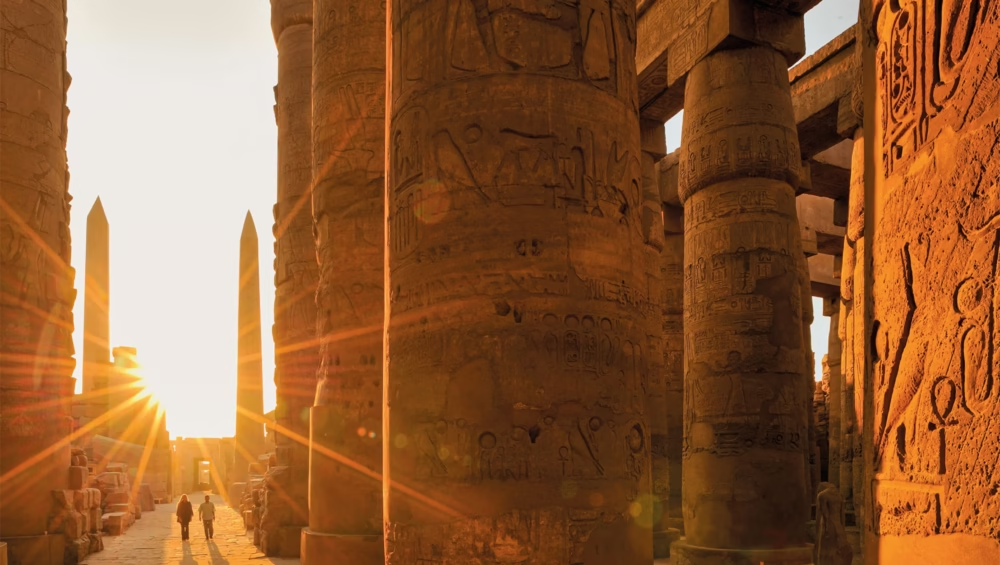
A towering Egyptian obelisk — a timeless symbol of engineering perfection and hidden energy.
★ Estimated Reading Time: 14 minutes
✎ Author: HurghadaToGo Editorial Team
📅 Published: 2026 • Historical Investigation
🔖 Category: The Code of Egyptian Civilization
The Egyptian obelisk is a miraculous structure by every measurable standard — a colossal tapered monolith extracted as a single piece from the hardest granite quarries on Earth. In antiquity, Egypt possessed far more obelisks than we see today. King Ramses II alone is credited with 14 obelisks in the San Al-Hagar area in Sharqia, yet nearly all were broken and scattered by time. The Secret of the Obelisk is not merely a question of stone — it is a puzzle of energy, engineering precision, and lost technology that continues to defy modern understanding.
When historian Abdul Latif Al-Baghdadi visited Egypt in the 13th century AD, he documented seeing two standing obelisks and a vast scattering of broken ones in the Ain Shams area. Today, only one obelisk remains standing there. These monuments present a real dilemma, as most questions about them still lack definitive answers — adding even more mystery to the Secret of the Obelisk.
❖ The Engineering Miracle and Historical Mystery
A surviving Egyptian obelisk standing in the ruins of Karnak Temple.
Questions About Material and Purpose
Why did the ancient Egyptians insist on carving most obelisks from red granite despite its extreme hardness? Why were they sculpted from a single piece, even though carving them in two or three sections would have made the process vastly easier? Was the enormous effort to carve and raise these colossal weights merely to create a symbol of the sun’s ray and immortalize royal titles — or is there a deeper purpose hidden behind the Secret of the Obelisk?
All currently available explanations remain educated assumptions, but one thing is certain: advanced sciences stand behind this engineering miracle. Even today, scholars disagree about their true purpose. Some see them as symbols of the primordial mound on which the god Atum stood during creation. Others view them as crystallized sunrays honoring the god Ra. A third school believes their function was to glorify the king and immortalize his memory. Yet the absolute truth remains unknown.
💡 DID YOU KNOW?
Rome today possesses more standing ancient Egyptian obelisks than all of Egypt combined. Of the dozens originally raised along the Nile, only a small number survived intact on Egyptian soil.
❖ Egyptian Obelisks in the World’s Great Squares
Egyptian obelisks have adorned the public squares of Rome, Paris, London, and Istanbul for centuries.
Obelisks were always coveted treasures across the ages. Most left Egypt to settle in the great European squares. The Romans alone relocated 8 Egyptian obelisks to Rome, so that today the Italian capital contains more standing obelisks than all of Egypt combined — a staggering fact that underscores how deeply the Secret of the Obelisk captivated ancient empires.
Moving an obelisk has always been extraordinarily difficult, requiring massive equipment, huge labor forces, and enormous budgets. Transporting a single monolith could take years. The Istanbul Obelisk, for example, was moved from the Karnak Temple during the Byzantine era. Its original height was 30 meters, yet it reached Turkey only 19 meters tall — 11 meters having broken off during the lifting and transport process.
Logistical Complications and Lifting Challenges
The Secret of the Obelisk posed a major engineering challenge even in later eras. The Vatican Obelisk — 25 meters tall and weighing 330 tons — required an extraordinarily complex transport operation. It was shipped aboard a specially built 80-meter vessel and packed within 1,000 tons of lentils to absorb shocks (the ancient equivalent of modern foam). It first stood in Emperor Caligula’s garden. In 1586 AD, by order of Pope Sixtus V, it was moved to St. Peter’s Square in a journey that took 13 months to cover only 200 meters.
Italian artist Nicola Zabaglia painted a remarkable scene depicting the re-erection process — showing 900 strong workers and 75 horses struggling in unison to raise it. If this colossal effort was required for the Vatican Obelisk, what would have been needed for the Aswan obelisk that weighs four times as much? This question deepens the Secret of the Obelisk and the suspected technical capabilities of the ancients.
Comparative Table: Famous Relocated Obelisks
❖ The Modern Era and France’s Ambitions
The Luxor Obelisk standing proudly in Place de la Concorde, Paris.
During the reign of Muhammad Ali Pasha, and owing to his lack of interest in antiquities, many remaining obelisks were given away as diplomatic gifts to France and England. Based on Champollion’s passionate efforts, France formally requested the two Luxor Temple obelisks — yet they managed to move only one. They failed with the second due to the overwhelming costs and exhausting effort involved.
French engineer Jean Lebas, who oversaw the transport, described his suffering vividly in his memoirs:
“Four and a half months of fears and anxiety. It required gathering more than 90,000 cubic meters of sand, digging large mounds of soil, and demolishing 30 houses … all in the middle of desert sands under a sun that raised the thermometer to 50 degrees Celsius.”
— Jean Lebas, 19th-century French Engineer
To imagine the sheer scale, 90,000 cubic meters of sand equals the volume of 35 Olympic swimming pools. This sand was used to construct artificial mounds that tilted the obelisk to a horizontal level for dragging, as no available force could lift it vertically. And this was only the first stage of the relocation. Despite all this effort, the Secret of the Obelisk now standing in Paris suffers from a crack whose origin — ancient or from that grueling operation — remains unknown to this day.
Key Historical Facts
🏑 90,000 m³ of Sand
Equivalent to 35 Olympic swimming pools — used solely to tilt one obelisk horizontally.
🏠 30 Houses Demolished
An entire section of Luxor was razed to clear the transport path for the monolith.
☀ 50°C Desert Heat
Workers endured unbearable conditions through the full 4.5-month operation.
❖ Transport Dilemmas and Engineering Precision
Every transport of an Egyptian obelisk has required extraordinary engineering measures.
Historical experience shows that no matter the precautions taken, obelisks are rarely moved intact. They suffer breaks or cracks that compromise their stability. For this reason, sensors now surround several relocated obelisks to constantly monitor their integrity and ensure public safety around them.
The London Obelisk and Its High Cost
After other countries had successfully acquired obelisks, Britain made a similar diplomatic request. Muhammad Ali Pasha generously gifted them the obelisk of King Thutmose III that stood in Alexandria. Despite the gift, the obelisk remained in place for fifty years — because the British government refused to fund its transport due to the extremely high costs. It only moved after a wealthy British anatomist privately funded the entire operation. A special vessel was designed to carry it, but the difficulties proved so severe that six men lost their lives during the transport. Their names are still engraved on the base of the obelisk in London today, a silent testimony to the cost of moving the Secret of the Obelisk across the sea.
The Lifting Puzzle Before the Iron Age
Research into the Secret of the Obelisk reveals a fundamental question about the techniques used. The Romans employed iron chains and sophisticated pulleys to lift obelisks and handle the weights. However, historical records confirm that the ancient Egyptians raised these colossal monoliths long before the discovery of iron. What means did they possess that could bear those enormous weights and erect them with such perfect balance — without any iron equipment whatsoever?
Timeline of Obelisk Travels
Original Carving Era
Most surviving obelisks are carved and raised in Egyptian temples before the Iron Age.
Vatican Obelisk to Rome
Emperor Caligula transports the 330-ton monolith to his private garden.
Istanbul Obelisk Relocated
Moved from Karnak Temple to Constantinople, losing 11 meters of its height in transit.
Vatican Obelisk Re-erected
900 workers and 75 horses raise it in St. Peter’s Square by order of Pope Sixtus V.
Luxor Obelisk to Paris
After a grueling 4.5-month operation, the obelisk reaches Place de la Concorde.
Cleopatra’s Needle to London
Six men die in transit; their names remain engraved at the obelisk’s base.
The Three Great Dilemmas of the Egyptian Obelisk
Researchers face three main dilemmas within the Secret of the Obelisk that continue to cause puzzlement:
1. Rock Material: Most obelisks were carved from red granite — one of the hardest natural stones on Earth.
2. Enormous Weights: Obelisks weigh hundreds of tons, requiring tremendous coordinated effort in lifting, transport, and erection.
3. Engineering Precision: The greatest dilemma. Despite the simple four-sided form tapering upward to the pyramidal top known as “Benben,” its execution is that of a perfectly straight geometric beam.
The Free-Standing System and Perfect Balance
It is astonishing that obelisks in Egyptian temples were placed using a “free-standing” system without any fixing materials, mortar, or anchoring. They relied solely on their harmonious geometric shape for balance. This raises the question of how the ancients ensured these giants would not fall. This could only have been accomplished if the sides were carved with absolute straightness and perfect symmetry — an essential and still-baffling part of the Secret of the Obelisk.
❖ The Tool Dilemma and Hardness Challenge
The Aswan granite quarries — birthplace of nearly every major Egyptian obelisk.
Engineering precision in ancient Egyptian monuments is nothing short of astonishing. It is not limited to obelisks, but extends to distinctive pyramids. The Black Pyramid of King Amenemhat III features perfectly straight and equal sides. Geometric analysis of one face shows the same precision and symmetry found in the ideal pyramid. This confirms that perfection was not accidental but a fixed engineering standard in ancient Egyptian architecture — deepening the question about the Secret of the Obelisk and how its pyramidal top was carved to be perfectly centered.
Testing Precision With Modern Technology
To study this precision closely, researchers turned to a broken obelisk attributed to Queen Hatshepsut in Karnak Temple beside the Sacred Lake. A 9.4-meter surviving piece weighing 65 tons remains accessible. To test the pyramidal top’s accuracy, a specialized program called Symmetry was deployed on an iPad. The program helps capture perfectly centered photos using a Grid Overlay to ensure accurate symmetric images. After taking precise photos and aligning the lens with the geometric axes, the data was loaded into engineering design software, specifically Microsoft Visio, to determine: to what extent was the precision of the obelisk’s top achieved?
🔍 DIGITAL ANALYSIS RESULTS
- The first and second axes are exactly equal in length, each inclined at a perfect 45-degree angle.
- The four sides of the obelisk’s top are equal, forming a flawless geometric square.
- The pointed top lies exactly in the center of the square with extraordinary precision.
These dimensions and digital precision raise a pressing question: could this level of perfection truly be achieved using primitive tools like hammers and chisels? Especially since the Egyptian Museum in Tahrir holds two small red granite pyramids (Benben) with identical specifications, where the top sits perfectly centered with a harmony no naked eye can detect any flaw in. All this evidence confirms that the Secret of the Obelisk still hides engineering techniques whose secrets have not been fully discovered.
Modern Techniques vs. The Ancient Miracle
Today, we rely on milling machines — mechanically or computer-controlled — to carve shapes with such precision and accuracy. If these are our tools now, the strong question arises: what tools or systems did the ancient Egyptians possess to achieve these astonishing results? To find an answer, we must travel to the source where these structures were born: the red granite quarries of Aswan.
Aswan Quarries and the Unfinished Obelisk
The Aswan quarries are world-famous for the hardness and quality of the red granite extracted there. They were the main source for carving obelisks, statues, inner pyramid chamber stones, and sarcophagi. The site contains the world’s largest obelisk — the Unfinished Obelisk — still attached to the quarry rock and incomplete. It stands as witness to major engineering dilemmas. The first is the rugged mountainous nature of the quarry, which does not allow more than 150 to 200 people to stand around the obelisk at once. If we theoretically assume one strong worker can lift 200 kilograms, we would need 6,000 workers simply to move it — an impossible task given the limited space available.
Granite Hardness and the Mohs Scale
The second dilemma is the hardness of red granite due to its quartz content, making it a rock resistant to copper or bronze tools. To understand the Secret of the Obelisk here, we refer to the Mohs scale developed by German mineralogist Friedrich Mohs in 1812 to measure material hardness (resistance to scratching). The scale is based on a simple principle: a lower-hardness material cannot carve a higher-hardness one.
Therefore, carving granite requires tools harder than the rock itself — like diamond, with which all modern granite-cutting saws are equipped today. The big gap in the Secret of the Obelisk appears when returning to official references claiming ancient Egyptians used bronze and copper tools to carve granite at a time when iron had not yet appeared. Scientifically, these tools could cut wood or limestone, but using them to carve granite is impossible and challenges physical logic. This leaves the puzzle of ancient carving techniques without a satisfactory answer. Thus, research into the Secret of the Obelisk remains open to further studies to reveal the truth of those tools that conquered the hardest rocks.
❖ Simulation Experiments and the Primitive Tool Gap
Modern experiments attempting to replicate ancient Egyptian carving methods.
In 1995, a team called NOVA — including elite engineers, Egyptian architecture experts, and skilled workers under archaeologist Dr. Mark Lehner — tried to prove the hypothesis of building pyramids and obelisks using only primitive tools. The experiment simulated carving and raising an obelisk in Egypt. They brought in expert Roger Hopkins, a specialist in handling granite stones.
Failure of Soft Metal Chisels
Practical experiments disappointed the team when using bronze and copper chisels. Hopkins found that these metals wore out quickly while removing only minuscule amounts of granite. He stated plainly that the tools of that era were too weak to conquer granite’s hardness. He confirmed that the ancient Egyptians must have possessed exceptional industrial arts beyond current expectations — and that the Secret of the Obelisk lies in other undiscovered techniques.
The Wooden Wedge Dilemma
Some adopted the “wedge” theory, relying on driving wooden or metal wedges into the rock to cause a longitudinal break. Although this method succeeds in breaking stone, comparing results with Egyptian monuments reveals a major flaw: it produces wavy and irregular surfaces, while Egyptian obelisks feature extremely precise geometric straightness. Achieving that level of straightness today requires large circular saws reinforced with diamond teeth — a mineral whose use was not discovered until the 19th century. This again places us before a question about the Secret of the Obelisk and the means that achieved such precision.
Models of wide metal wedges were found in Aswan quarries and the Pompey’s Pillar area in Alexandria. These were methods used later by the Romans — but they do not explain the much more precise ancient Egyptian carving techniques that pre-date them by a thousand years or more.
The Dolerite Stone Theory & Engelbach’s Dilemma
One of the most famous carving theories emerged in the early 20th century through British antiquities inspector Reginald Engelbach. In his book “The Problem of the Obelisks,” he proposed that the Secret of the Obelisk lies in using hard dolerite stone balls for continuous pounding and grinding of granite. He considered the rounded marks in quarries to be the residue of this method.
This theory suggests about 130 people working continuously in narrow corridors around the obelisk, no wider than 75 centimeters. According to Engelbach’s experiments, continuous pounding for one hour removes only about 5 millimeters of granite. Based on these numbers, he claimed carving the obelisk might take 7 months of continuous work by trained workers. However, the realism of this method and its internal logic remain under great question, especially when trying to uncover the Secret of the Obelisk given the narrow space and the enormous muscular effort required for such astonishing results.
❖ Number Contradictions and Simulation Theory Failures
The Unfinished Obelisk at Aswan — abandoned mid-carving yet still embedded in bedrock.
The NOVA team repeated the carving experiment using dolerite balls. Results revealed a huge gap in historically recorded numbers. The team managed to drill only eight-tenths of a millimeter per hour — a tiny amount meaning that extracting a full obelisk this way would take nine full years. These results align closely with independent experiments by Peter Tyson and Christopher Dunn. This raises major question marks over Reginald Engelbach’s numbers. His achievement rates were about 15 times faster than modern experiments, without any scientific explanation for this superior power or speed in removing granite. Caution is needed when relying on his hypotheses to understand the Secret of the Obelisk.
💡 DID YOU KNOW?
An inscription on Queen Hatshepsut’s obelisk base claims the monolith was extracted in just seven months. Modern experiments with primitive tools suggest the same work would take nine years — a gap of more than 1,400%.
Timeline Dilemma and Historical Text
The contradiction appears clearly when comparing these experiments with ancient Egyptian texts. A text on Queen Hatshepsut’s obelisk base states the obelisk took only seven months for extraction work in the mountain. This vast time gap between the documented seven months and the years required by primitive methods confirms another technique was used besides dolerite stones. Even if we hypothetically accept drilling for years, unsolved engineering problems remain — such as how to separate the obelisk from the quarry at the bottom. A worker kneeling simply does not have the necessary force to break the rock beneath the massive beam.
Deep Trenches and the Space Challenge
Deep, narrow trenches appear around obelisks in the Aswan quarries, logically ruling out dolerite ball use. If the goal was simply to extract granite for statues or columns, why make the trenches so narrow and deep that they limit workers to one or two only? It would have been far better to make them shallow and wide to increase worker capacity and speed completion. Engelbach tried to explain this anomaly by assuming long wooden poles ending with dolerite balls were used for pounding from above — an impractical idea that reveals a forced attempt to link all phenomena to the dolerite ball theory.
Lack of Complete Experimental Evidence
The walls of the deep trenches have an extreme smoothness that cannot possibly result from random strikes with stone balls — or the walls would appear deformed and shattered. Additional ideas like heating granite with fire or using water-soaked wooden wedges may work for breaking granite, but not for carving it, and they do not leave the precise engineering effects seen in the quarries. The Secret of the Obelisk endures because no single successful manual experiment has ever carved a complete obelisk to this day. All that has been achieved is digging small parts that do not match extracting or finally shaping giant granite blocks.
Large vs. Small Obelisks
The difference is strikingly clear when comparing granite obelisks with a small sandstone obelisk at the entrance of Karnak Temple belonging to King Seti I — no more than three meters long. This small obelisk lacks precision and straightness. Its corners are rounded, not sharp, and it is clearly tilted. This suggests it could have been carved with primitive means due to sandstone’s softness compared to granite. This contrast confirms that the tools and sciences that revealed the Secret of the Obelisk in large structures differ completely from those used in small models.
❖ Beyond Symbolism: The Energy Properties
Quartz crystals — the hidden electrical heart of every granite obelisk.
Egyptian obelisks raise fundamental questions about their true purpose. If the goal was purely symbolic, it would have been infinitely easier to carve them from limestone — a material far easier to handle and transport than granite. Extracting and carving blocks weighing 200 to 300 tons and transporting them distances up to 1,000 kilometers cannot be explained by symbolism alone, especially in the case of northern obelisks like those at San Al-Hagar and Ain Shams. Even recording royal titles and kings’ achievements could have been done on softer stones. What is particularly surprising is the Vatican obelisk weighing 350 tons that is completely devoid of inscriptions. This strengthens the hypothesis that recording titles was secondary and not the main function hidden by the Secret of the Obelisk.
The Metal Cap Puzzle & Engineering Unity
The choice to carve the obelisk as one piece was not for luxury but a functional necessity. Ancient builders could have constructed them in layers like columns, but they strictly adhered to single-block unity. Equally prominent is the use of metal caps on the tops. Inscriptions on Hatshepsut’s two obelisks mention covering them with electrum (a natural gold-silver alloy). An inscription on Thutmose III’s obelisk in Italy states its top was covered with gold. Historian Abdul Latif Al-Baghdadi in 1200 AD recorded seeing two obelisks in Ain Shams still retaining their metal caps. This raises a pressing question about the technical benefit of these tops — lost over time — and their relation to the Secret of the Obelisk.
Granite & Quartz’s Electrical Properties
The obelisk’s specific function depends on its harmony and material composition. If it were not granite, or if it contained welds or joints, it would fail its task — just like a television screen that must be one unified piece to function. The secret lies in granite’s main component: quartz, which possesses the piezoelectric effect. This property scientifically means that quartz crystals emit measurable electrical charges when subjected to strong mechanical pressure.
Simulation Experiments & Pressure Energy
To understand the Secret of the Obelisk from a physical perspective, a modern experiment can be performed using a quartz slice (piezo disc) connected to a multimeter or oscilloscope. Pressing the slice makes the device detect clear electrical signals, where the generated voltage (V Max) can reach 14 or 15 volts from pressure alone.
The experiment can be advanced by connecting the quartz slice to a breadboard and small LEDs. When pressure is applied to the crystal, the lights glow brightly without any battery or external electricity source whatsoever. These electrical charges result solely from mechanical pressure on quartz crystals — a natural property granted by the Creator to the rocks of this planet. It appears to have been a central part of the Secret of the Obelisk that enabled it to function as a tool for generating or transmitting energy in a way not yet fully understood by modern science.
❖ Energy Horizons & the Puzzle of Sudden Halt
The Unfinished Obelisk as silent evidence of a civilization’s abrupt technological collapse.
News sometimes appears about countries generating electricity from car pressure on highways or pedestrian footfall on busy sidewalks. This technology fundamentally relies on placing quartz crystals that generate electrical charges upon pressure. The scientific explanation for these signals lies in quartz’s chemical composition (silicon dioxide), where negative oxygen charges and positive silicon are arranged in a specific lattice. When atoms are subjected to pressure, they are forced closer together. When pressure is removed, strong repulsion occurs, leading to emission of electrical signals — a principle that may lie at the very heart of the Secret of the Obelisk.
Quartz as an Everyday Energy Source
We find a daily application of this property in lighters, which contain a small quartz stone inside. When the button is pressed, the stone experiences strong pressure that generates a high-voltage electrical charge. When it approaches the gas, it causes ignition. Although studies on electricity generation from quartz are still in their early stages, what is certain is that increasing granite mass inevitably leads to increased generated charges — provided the quartz mass is one single piece without any welds.
Physical Engineering and Mass Stability
The extreme precision and high straightness in building the obelisk primarily aim to ensure “free standing” or self-stability without needing fixing means. The ancient Egyptians preferred the obelisk shape over the traditional column because the column concentrates its weight at the top, weakening its stability. The obelisk has a wide base that tapers upward, making its center of gravity close to the ground. This gives it superior stability that prevents swaying even across millennia.
The Secret of the Obelisk reveals deeper dimensions when reading the inscriptions on Thutmose III’s obelisk in Italy. They mention that “its top is of gold and it illuminated with its beauty ‘Waset’ (current Luxor city).” If we go beyond the metaphorical interpretation of the texts, the illumination here may mean the literal sense — that it actually lit up the city. This hypothesis could justify the widespread presence of obelisks across ancient Egypt.
The Unfinished Obelisk: Evidence of a Sudden Demise
The Unfinished Obelisk in Aswan provides indirect evidence of a catastrophic event that led to the sudden demise of the owners of that advanced civilization. Although it is attributed to Queen Hatshepsut with the claim that work stopped due to a crack during carving, this explanation raises logical questions. The obelisk was cut from three sides — why did later kings not benefit from this ready-made effort to make sarcophagi or statues?
The hypothesis of preserving the obelisk as an “experiment” for future generations contradicts human nature, which always seeks to benefit from available resources. Next to it lies another huge unfinished carving of unknown features, also cut from three sides, with work suddenly halted. This abrupt halt suggests a disaster prevented workers from completing their tasks — to the extent that later civilizations could not handle or complete these pieces. The site also shows marks of an inclined saw cut and incomplete attempts with pins, indicating the granite’s hardness and the failure of later tools to conquer the obelisk’s rocks.
The Reuse Problem and Inscription Overlap
The Secret of the Obelisk is surrounded by a big puzzle regarding the true identity of its owners and the chronology of its inscriptions. The broken Karnak obelisk bears the names of both Hatshepsut and Thutmose III — opening the possibility that Hatshepsut placed her name on an older monument. Similarly, the London obelisk bears Thutmose III’s inscriptions, and King Ramses II added his own inscriptions about his military victories in a small space upon it. Given that these inscriptions are superficial and weakly executed compared to the grandeur of the structure, it is increasingly likely that the obelisks are older than all these kings and were reused later.
✨ THE GREAT UNANSWERED QUESTIONS
- How were obelisks carved with such impossible precision?
- How were mythical weights — like the Unfinished Obelisk’s 1,200 tons — expected to be handled?
- What was the true function that required all this engineering miracle?
The Secret of the Obelisk remains despite numerous studies: how were they carved with such precision? How were they supposed to handle mythical weights like the Unfinished Obelisk weighing 1,200 tons? What was its true function that required all this miracle? These questions await complete answers that will one day lift the veil on one of the greatest wonders of human history.
❖ Frequently Asked Questions ❖
What is the Secret of the Obelisk in simple terms?
The Secret of the Obelisk refers to the combined mystery of how ancient Egyptians carved, transported, and raised massive single-piece granite monoliths with perfect precision — and whether these structures served a hidden energy function beyond mere symbolism.
Why were obelisks carved from a single block of granite?
Ancient Egyptian engineers insisted on one-piece construction because a welded or joined obelisk would lose the continuous piezoelectric property of quartz. Stability and possible energy transmission both depend on the monolithic form.
How heavy is the Unfinished Obelisk at Aswan?
The Unfinished Obelisk weighs an estimated 1,200 tons and would have been approximately 42 meters tall — larger than any successfully raised obelisk in history.
Could copper or bronze tools actually carve granite?
No. On the Mohs hardness scale, copper is 3.5, bronze is 4, and iron is 5 — all below granite’s hardness of 7. Scientifically, these metals cannot carve granite with the precision shown on Egyptian obelisks.
What is the piezoelectric effect and how does it relate to obelisks?
The piezoelectric effect is the ability of quartz crystals to generate electrical voltage under mechanical pressure. Since granite contains quartz, some researchers believe obelisks may have been used as ancient energy generators or transmitters.
Where can I see Egyptian obelisks today?
Major surviving Egyptian obelisks can be visited at Karnak and Luxor temples in Egypt, St. Peter’s Square in Rome, Place de la Concorde in Paris, the London Embankment, and Central Park in New York.
🏛 Discover the Obelisks With Your Own Eyes
Walk through Karnak Temple, stand before the Unfinished Obelisk at Aswan, and feel the power of the Pharaohs with our expert-guided Egypt tours.
✉ Join Our Weekly History Newsletter
Get unforgettable ancient Egyptian stories and travel guides delivered to your inbox.
HurghadaToGo Editorial Team
Ancient Egypt Historians & Travel Experts
Our editorial team researches, writes, and guides travelers through the mysteries of ancient Egyptian civilization — bringing expertly curated history straight to your screen and your travel plans.
❖ Continue Reading ❖
• PART ONE
The Code of Egyptian Civilization: Hidden Origins
Explore the mysterious beginnings of the Egyptian civilization and the secrets buried beneath its origins.
• PART TWO
The Code of Egyptian Civilization: The Pyramid Mystery
Investigating the engineering puzzles of Giza — from perfect alignment to impossible logistics.
• EXPLORE MORE
Full Series: The Code of Egyptian Civilization
Discover every part of this exclusive investigative series on the HurghadaToGo blog.