
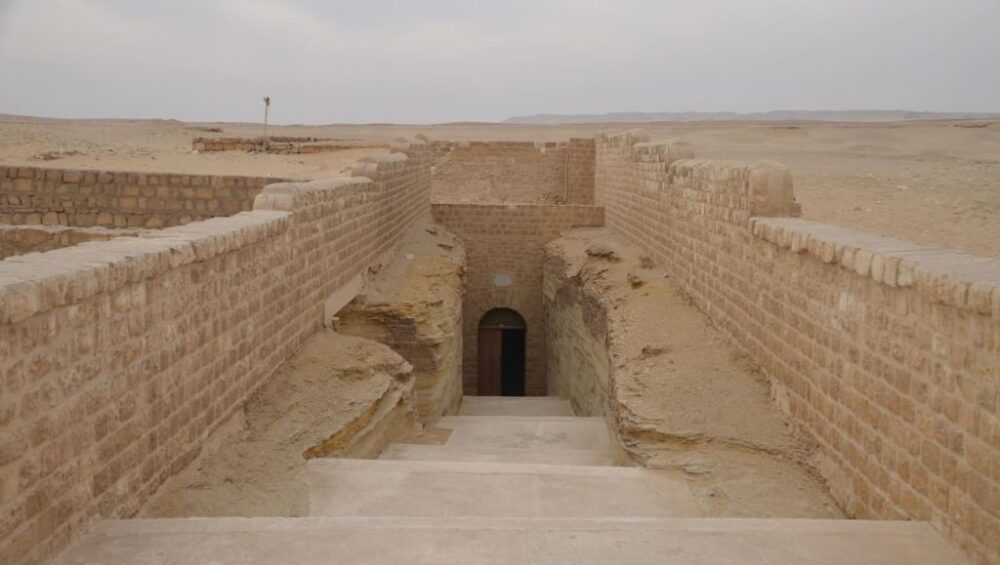
From the Greek Description to the French Discovery

The sand-swept avenue of sphinxes once described by Strabo — a forgotten gateway to the underground temple of Saqqara.
B
eneath the quiet dunes of Saqqara lies one of the most confounding enigmas in the history of human engineering — a cluster of granite giants known today as the Serapeum Sarcophagi. These are no ordinary stone boxes. They are colossal monuments of precision, cut from the hardest rock on Earth, polished to optical perfection, and squeezed into tunnels so narrow that their very existence defies common sense. To stand before them is to confront a riddle that neither archaeology nor modern industry has been able to solve.
In the first century AD, the Greek historian Strabo wrote of a strange Egyptian temple buried beneath the sand. He described a road flanked by sphinx statues — some half-swallowed by the desert, others with only their heads peering above the dunes like drowning sentinels. For nearly eighteen centuries, his words were treated as travel lore, a curious footnote to a lost land.
Then came Auguste Mariette. In the mid-19th century, the French Egyptologist stumbled upon the very sphinxes Strabo had described — statues now gleaming in the halls of the Louvre. For Mariette, this was more than a lucky find; it was a key. He knew he was standing at the threshold of the Serapeum, an underground complex mentioned in classical texts but lost to time. After a full year of exhausting excavation, in 1851, Mariette cracked open the earth and revealed a labyrinth of tunnels holding 24 monumental stone sarcophagi, each weighing between 70 and 100 tons.
“Mariette assumed these were tombs for the sacred Apis bull — yet not a single mummy was ever found inside the Serapeum Sarcophagi.”
The Apis Cult and the Secret of the Carved Corridors

Mariette’s 19th-century sketch of the Serapeum corridors — carved straight through solid bedrock.
Mariette had originally been dispatched by the French government to hunt for Coptic manuscripts, but Strabo’s tantalizing description pulled him into the sands instead. According to the official narrative, the Serapeum served as the sacred resting place of the Apis bull — a creature of very particular identity. The Apis had to be born of a single mother, its birth heralded by lightning. It had to be black with a white triangle on its forehead, white markings on its back, and a double-tufted tail. When such a bull was found, it was treated as a living god, and upon its death, mummified and laid to rest in a dedicated sarcophagus.
References to this site are frustratingly few. Mariette’s original volume, Serapeum of Memphis, has never been translated into English and remains the foundational source. The complex is divided into two main areas: the Great Hall and the Small Hall. The Great Hall stretches through 300 meters of arrow-straight corridors, and it is here that the massive Serapeum Sarcophagi rest — each one hewn from a single block of granite, syenite, or diorite. The box alone can weigh up to 70 tons; the lid, another 30.
The granite used to carve the Serapeum Sarcophagi was quarried in Aswan — more than 800 kilometers south of Saqqara. Some blocks came from even farther, in the eastern desert of Wadi Hammamat. How these 100-ton monoliths were transported across deserts, down the Nile, and finally underground remains unexplained.
The Puzzle of the Empty Boxes and the Dynamite Incident

A single closed sarcophagus defied Mariette’s entire team — forcing him to resort to explosives.
When Mariette cleared the corridors, a chilling detail emerged: every single sarcophagus lid was open, and their interiors were empty. He concluded, naturally, that grave robbers had stripped them centuries ago. But then he found one sarcophagus still sealed. Unable to shift its 30-ton lid with the combined muscle of his workforce, he did something he would regret for the rest of his life — he used dynamite to blast through the stone.
Mariette later apologized for this act of archaeological vandalism. Yet the incident illuminated something profound: the ancient makers of the Serapeum Sarcophagi had possessed technical mastery so refined that even 19th-century explosives could scarcely breach their work. And when the dust finally settled, Mariette peered inside — and found nothing. No mummy. No artifact. No inscription. Just the gleaming, polished emptiness of a box that had apparently never been filled.
The Small Hall, by contrast, told a different story. Here Mariette uncovered mummies of humans and bulls, canopic jars, statues of Apis, and a stunning intact wooden coffin belonging to Prince Khaemwaset, son of Ramses II. His golden mask, amulets, and necklaces were exquisite. These treasures were real, datable, and consistent with traditional Egyptian funerary practice. But the giant granite Serapeum Sarcophagi of the Great Hall stood apart — silent, empty, and engineered beyond reason.
Traditional narratives insist the Serapeum Sarcophagi were plundered. But this theory fractures under simple questions. Why did the supposed thieves leave the Small Hall’s golden treasures untouched? Why did they ignore the closed sarcophagus that Mariette later had to blast open? If robbers had the skill to open 23 giant stone boxes, surely the 24th would not have defeated them. The more honest conclusion is uncomfortable: the Serapeum Sarcophagi may have been empty from the very beginning.
Engineering Challenges Inside the Dark Tunnels

The main corridor — perfectly straight, plunged into total darkness, and carved into solid bedrock.
Imagine the problem. You are standing at the entrance of a passage only 3.20 meters wide, flanked by plateau rock on both sides. Ahead of you lies 300 meters of utter darkness. The floor is not sand — it is bedrock. You must carve this tunnel with mathematical straightness, ventilate it, remove tons of debris, and then somehow deliver a 100-ton granite box to a precise niche at the far end, where it must slide in lengthwise with only centimeters to spare.
Using nothing but fire torches would be agony. Torches devour oxygen. Dust and stone fragments clog the lungs. And yet the corridors are not crude tunnels — they are geometrically perfect, their walls smooth, their axes so straight that replicating them today would require Tunnel Boring Machines, the same technology used to carve subway systems and alpine passes.
Now consider the mathematics of movement. A strong laborer can drag perhaps 150 kilograms. To shift a 70-ton box, you would need roughly 400 workers. But the corridor is only three meters wide. You cannot fit 400 men around the box. You cannot even fit 50. And these men would be working in airless darkness, breathing torch smoke, choking on dust. Logic dictates that the ancients would have either carved lighter sarcophagi or widened the corridors. They did neither.
To deepen the mystery: each sarcophagus sits one and a half meters below the corridor floor, dropped into a carved niche. Lowering a 100-ton box into a snug pit, in darkness, without modern cranes, is not a matter of extra rope. It is a task that would defeat most modern construction crews even today. Traditional theories about ramps and pulleys — so often invoked for the pyramids — find no traction here. There simply is no room for them.
Christopher Dunn’s Vision and the Lost Technology
Modern measurement of the Serapeum Sarcophagi reveals angles accurate to within a fraction of a degree.
The British engineer Christopher Dunn, a veteran of heavy machinery, engine manufacturing, and laser technology, offered a radically different perspective in his 2010 book Lost Technologies of Ancient Egypt. Importantly, Dunn never invoked aliens or extraterrestrial visitors — a myth frequently and unfairly attached to his work. He argued instead that the ancient Egyptians themselves possessed industrial tools and techniques that have since been lost.
Dunn’s hypothesis is anchored in a principle he calls Engineering Precision. To grasp this, consider the humble school set-square. It is designed for a 90-degree angle, but tiny deviations are tolerated because the purpose is basic and the cost must be low. Contrast this with the turbine blades of a jet engine, where tolerances must reach 90.00 degrees — a level of accuracy that can cost 50 times more in tooling alone. The direct relationship is clear: the tighter the tolerance, the greater the technological investment.
So what happens when we measure the Serapeum Sarcophagi?
The Light-Beam Experiment
Dunn’s most famous test was elegantly simple. He placed a high-precision metal square against the inner wall of one sarcophagus and shone a powerful light behind it. If the angle were even slightly off, light would leak between the square and the wall. The result? Not a single photon passed through. The angle was a perfect 90 degrees, and the surfaces were polished to a mirror finish.
Modern Digital Confirmation
A contemporary team repeated Dunn’s experiment using a Bosch laser distance meter (accurate to 1 mm over 50 meters) and a digital angle gauge. The findings were staggering:
These numbers leave no room for romantic speculation. This is not the work of skilled stonemasons chipping with copper chisels. This is industrial precision, delivered into granite, 4,500 years ago or earlier.
Infinite Precision That Defies Logic

The polished inner surfaces of the Serapeum Sarcophagi reflect light like mirrors — a feat impossible by hand.
The more you measure, the more impossible the Serapeum Sarcophagi become. Their inner walls are perfectly parallel — a geometric state that cannot be achieved by eye or by hand-guided sawing. It requires what engineers call Maintaining Straightness, a controlled cutting process where the tool is prevented from drifting even a single millimeter.
Independent confirmation has come from multiple sources. The Russian-led Isida Project, dedicated to precision studies of Egyptian temples and pyramids, measured four sarcophagi in detail. All returned perfect 90-degree angles. Swiss engineer Gregor Spörri conducted his own survey and reached the same conclusion: 90.0 degrees, with astonishing surface smoothness. These findings are not anomalies — they are a pattern.
⏱ Timeline of the Serapeum Mystery
1st Century AD
Greek historian Strabo describes a buried temple in Saqqara with a sand-drowned avenue of sphinxes.
1850–1851
Auguste Mariette rediscovers the sphinxes, excavates for a year, and uncovers the Serapeum complex.
1851
Mariette uses dynamite to open a closed sarcophagus — and finds nothing inside.
2010
Christopher Dunn publishes Lost Technologies of Ancient Egypt, proposing industrial-grade tooling.
Today
Modern measurements confirm 90.0° precision. No satisfying explanation has yet been offered.
The Gap of the Missing Tools

The tools displayed in Egypt’s museums — chisels, wooden squares, copper saws — cannot explain this level of work.
When you walk through the Luxor Museum, you see rows of ancient Egyptian tools: wooden squares, basalt rulers, copper chisels, stone hammers. They are, by any fair assessment, primitive. Ask any working engineer: could this toolkit produce a 70-ton granite box with mirror-polished walls and mathematically parallel sides? The answer is unanimous: no.
There is a missing link in the technological record. Some Egyptian objects — like the unfinished sarcophagus at Mit Rahina — clearly show the marks of primitive methods: rough surfaces, uneven angles, visible chisel scars. That sarcophagus is, in a sense, honest about the limits of its makers. But the Serapeum Sarcophagi belong to an entirely different category of craftsmanship. Their execution demands a separate class of tools — tools that have vanished without a trace.
Nova’s Experiment and Dr. Mark Lehner
In a much-cited PBS Nova experiment, Dr. Mark Lehner tested the copper-saw-with-sand-abrasive theory on an unfinished red granite sarcophagus. Copper alone cannot cut granite — it is far too soft. But when copper presses sand grains into the groove, those grains do the cutting. Lehner’s team achieved a cutting rate of 4 mm per hour, or roughly 4 cm per day. By that rate, cutting four meters of granite would take about 25 days. The outer form of a single sarcophagus would require eight months of nonstop sawing.
That is theoretically possible — just barely. But the experiment only explains the outside. It says nothing about the infinite precision of the inside. How did the ancients reach into a sealed box and polish walls they could barely fit their arms into? How did they guarantee a perfect 90-degree corner where no human hand can apply even pressure? On these questions, Nova’s experiment falls silent.
Modern Industry vs. Ancient Achievement
Even modern CNC machines with diamond tips struggle to replicate the Serapeum Sarcophagi in a single monolithic piece.
Determined to ground the question in practical reality, Christopher Dunn contacted four major American granite fabrication companies. He asked each one a straightforward question: could they, using today’s best technology, replicate a Serapeum sarcophagus? The replies stunned him. All four admitted they lacked the capability.
One engineer from True Stone explained that the raw granite for a single 100-ton block alone would cost around $115,000 — before a single cut or transport mile was paid for. He confessed that no standard workshop owned the equipment to carve such a box from a single stone. The only realistic option, he suggested, was to assemble it from five separate pieces: one base and four walls. The ancients, inexplicably, refused this shortcut.
Building the Serapeum Sarcophagi today remains technically possible — but only at facilities with truly industrial scale: shipyards, aerospace foundries, or military installations. It cannot be done in any ordinary stone workshop. And even with diamond-tipped CNC milling machines, flood-cooled by jets of water to prevent cracking, the work would consume months and massive computing power.
Before the rise of computer-controlled CNC machines in the late 20th century, humanity had no technology capable of producing the Serapeum Sarcophagi at this scale and precision. Not in 1900. Not in 1800. Not ever — until very recently.
Questions About Function and Purpose

Without funerary texts or prayer inscriptions, the Serapeum Sarcophagi’s original purpose remains a mystery.
Here is the most radical possibility: the Serapeum Sarcophagi may not have been tombs at all. Consider the evidence. No mummies were ever found inside the Great Hall boxes. There are no funerary texts. There are no standard prayer inscriptions. And there is no convincing reason to quarry 100-ton blocks from Aswan and Wadi Hammamat, then transport them hundreds of kilometers, just to build a container four times larger than the body of a bull.
Imagine a medieval monk stumbling upon a modern refrigerator. He would likely describe it as a “strange white box” — because he could not understand its true function. We may be doing the same thing when we call these granite giants “sarcophagi.” The label tells us more about our expectations than about their actual purpose.
Clues in the Materials
A closer look reveals deliberate, almost scientific choices. The boxes are not uniform. Some are red granite, others black granite, diorite, or syenite. Each material has different thermal, acoustic, and electromagnetic properties. Why this diversity? Why not settle on a single nearby quarry? The variation suggests purpose-driven selection — the kind of engineering logic one finds in a research lab, not a cemetery.
There is also the question of wall thickness. The Serapeum Sarcophagi have walls 40–45 cm thick, sealed with 20–30 ton lids that press down by sheer weight. This over-engineering has led some researchers to propose that the boxes were designed to withstand internal pressure — as if they were built to contain something under force, or to isolate something dangerous. Assembly from multiple welded pieces would have failed catastrophically under such conditions. A single monolithic block would not.
The Inscriptions That Don’t Fit
Of the 24 Serapeum Sarcophagi, only four bear inscriptions — attributed to Ahmose II, Khabash, Cambyses, and one anonymous owner. But the inscriptions are shaky, primitive, and clearly inferior to the perfection of the boxes themselves. It is illogical to believe the same hand that produced flawless 90-degree interior angles could not carve a straight hieroglyphic line. One cartouche is even empty — left blank as if the carver never finished. This strongly suggests later reuse, with names added by subsequent rulers trying to claim ownership of objects already ancient in their own time.
The Sudden Halt of a Lost Civilization

A civilization that vanished before completing its masterpiece — the echoes of a sudden catastrophe.
Perhaps the most haunting detail of Saqqara is this: the site was never finished. There are 28 niches but only 24 sarcophagi. Seven of those sarcophagi are unpolished, their surfaces still rough. One lies alone in a corridor, stopped just 15 meters from its intended niche — as though the workers set down their tools one evening, expecting to return at dawn, and never did.
The phenomenon of reuse compounds the confusion. The Persian king Cambyses, remembered in Egypt for brutal massacres, attempted to placate his rebellious subjects by claiming to dedicate a sarcophagus to the Apis bull — carving his name into a box that had almost certainly been made long before he was born. This was political theater, not original craftsmanship.
This kind of reuse is universal in history. Consider Hagia Sophia in Istanbul: first a cathedral, then a mosque, now a museum layered with Christian frescoes and Islamic calligraphy side by side. Without clear documentation, a future archaeologist might be hopelessly confused about its original purpose. The same dilemma applies to the Serapeum Sarcophagi. Dating them by their inscriptions is like dating Hagia Sophia by its minarets.
“The workers left their tools and never came back. What ended their world — and took their knowledge with it?”
The most plausible explanation for this sudden interruption is catastrophe — a natural disaster of such magnitude that it wiped out the original generation of builders. What followed were inheritors: later Egyptians who marveled at the monuments, reused what they could, and never mastered the original techniques. The fact that we still cannot explain how the Serapeum Sarcophagi, the Great Pyramid, or the obelisks were built supports this theory. The knowledge was not simply hidden — it was lost.
A Mystery That Still Breathes Beneath the Sand
The Serapeum Sarcophagi are more than stone boxes. They are questions carved in granite. They whisper of a civilization that knew more than we give it credit for — a people who cut mountains into mirrors, who moved impossible weights through impossible spaces, who built for reasons we have not yet understood.
Every new measurement we take deepens the riddle. Every engineer who studies them walks away changed. And somewhere beneath the sands of Saqqara, the unfinished sarcophagus still waits for the workers who never returned — a silent testimony to knowledge that vanished before it could be recorded.
At Hurghada To Go, we believe stories like this are not meant to be read on a screen alone. They are meant to be lived. Stand in these corridors. Touch the cool granite. Feel the weight of time pressing on your shoulders. The mystery is real — and it is waiting for you.
Frequently Asked Questions
What are the Serapeum Sarcophagi?
The Serapeum Sarcophagi are 24 massive granite and diorite boxes housed in an underground complex beneath Saqqara, Egypt. Each weighs between 70 and 100 tons and was carved from a single block of extremely hard stone with astonishing precision.
Were the Serapeum Sarcophagi really tombs for the Apis bull?
This is the traditional interpretation, but no mummified bulls were ever found inside the Great Hall sarcophagi. Bone remains appear only in the nearby Small Hall. The absence of mummies, funerary texts, and standard inscriptions in the Great Hall casts strong doubt on the funerary purpose.
How precise are the Serapeum Sarcophagi?
Modern laser and digital angle measurements have confirmed interior angles of exactly 90.0 degrees with no measurable deviation. Lengths match to the millimeter across opposite sides, and interior walls are polished to optical smoothness.
Can the Serapeum Sarcophagi be replicated today?
Four major American granite companies contacted by Christopher Dunn stated they could not produce these boxes as monolithic pieces with current workshop technology. Only industrial-scale facilities such as aerospace foundries or shipyards — using diamond CNC equipment — could attempt it.
Can visitors tour the Serapeum today?
Yes, the Great Hall of the Serapeum is generally open to the public as part of the Saqqara archaeological complex, though the Small Hall remains closed. Guided tours with licensed Egyptologists provide the best experience, and Hurghada To Go offers specialized excursions to Saqqara.
Who was Auguste Mariette?
Auguste Mariette was a 19th-century French Egyptologist who rediscovered the Serapeum in 1851 after a year of excavation. He founded the Egyptian Antiquities Service and is credited with protecting countless sites from looting, though his own use of dynamite on a sealed sarcophagus remains a notorious incident.
Continue Your Journey