
A Nobel Laureate’s Testimony Before the Majesty of Giza
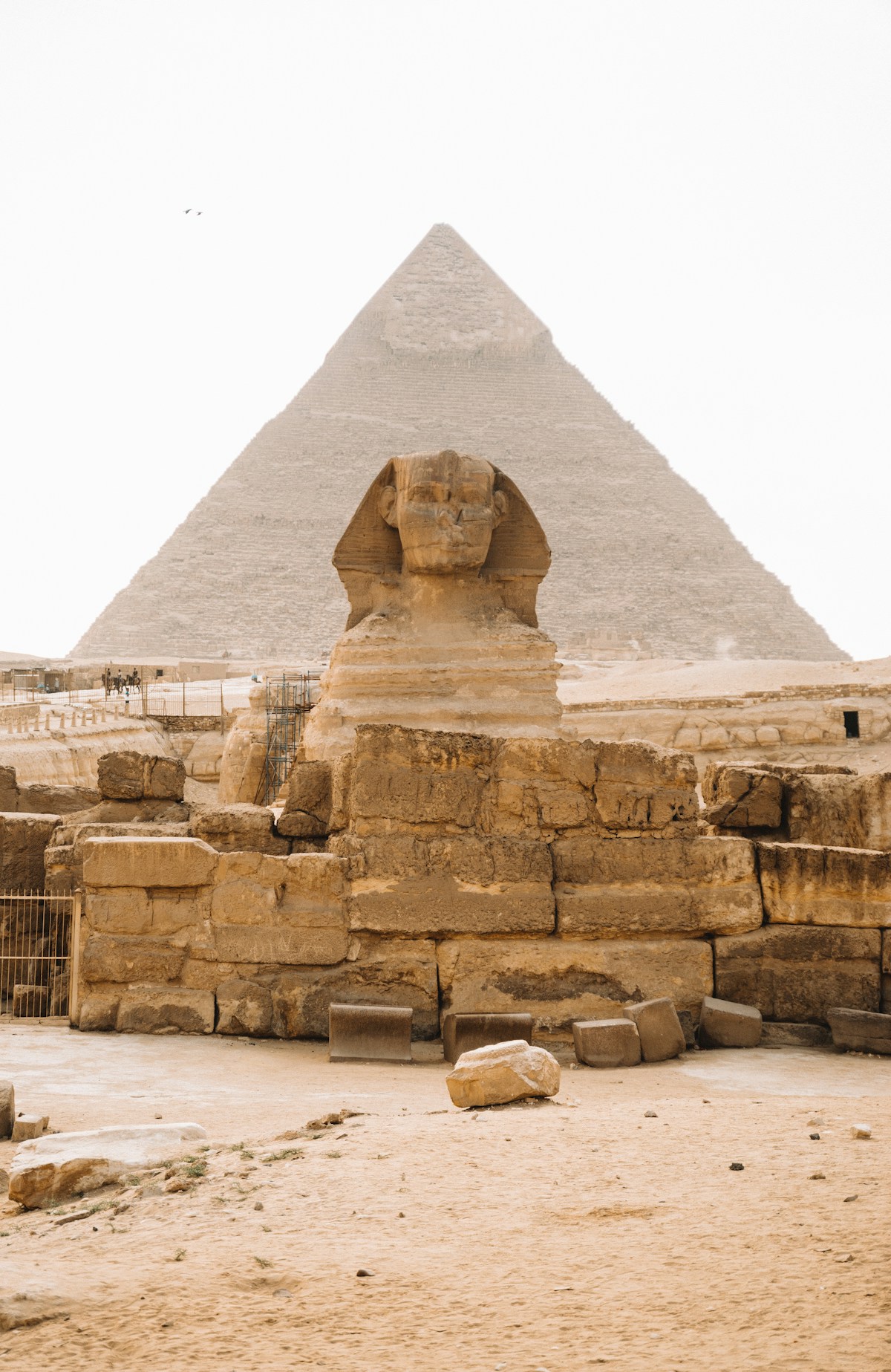
When the Nobel Prize-winning physicist Dr. Luis Walter Alvarez visited the pyramids of Mexico, he stood in quiet contemplation and remarked: “These pyramids do not impress me much, but those on the edge of the desert at Giza — those are the real enigma.” This statement from a towering scientific figure confronts us immediately with the Pyramid Construction Mystery — not merely an architectural triumph, but a direct challenge to the laws of nature, gravity, and time itself.
For thousands of years, the brightest human intellects have stood powerless before the simplest questions about these monuments. Why were the pyramids built using stones of such colossal size? What method was used to lift these massive blocks to dizzying heights? How were tunnels and passages carved beneath the pyramids with such astonishing precision? Despite the thousands of inscriptions, drawings, and papyri left behind by ancient Egyptian civilization, not a single clear text or depiction explains the exact construction methods. This silence has cemented the Pyramid Construction Mystery as one of history’s most enduring unsolved secrets.
“If you see the two pyramids in Egypt, you would think that neither humans nor jinn could create their like, and none but the Creator of the heavens and earth could have undertaken them.”
Questions That Have Stumped the Greatest Minds
The wonder did not begin with modern scholars. Ancient historians were equally dumbfounded. Medieval travelers like Yaqut al-Hamawi and Ibn Zulāq expressed open disbelief that humans alone could achieve such feats — their judgment based on first-hand experience constructing fortresses and citadels using the most advanced manual techniques of their age.
Between Humans and Jinn: Historical Astonishment
This historical awe reflects the profound depth of the Pyramid Construction Mystery and the difficulty of grasping human capability for such monumental works. The fundamental question persists across the millennia: How could a people at the dawn of their civilization construct buildings that still baffle us today?
Geography of the Pyramids and the Repetition of the Experiment

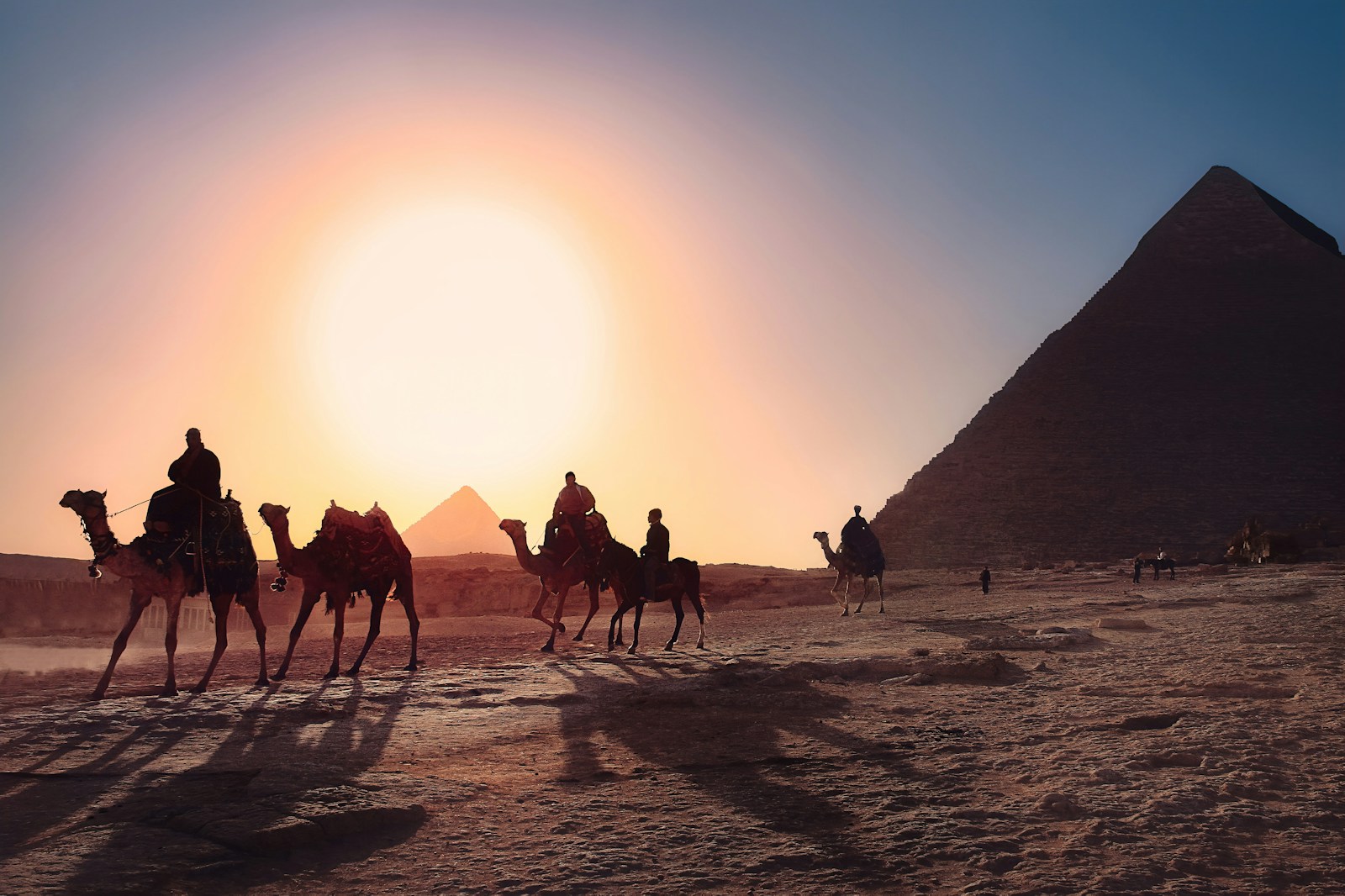
While the Giza pyramids are the largest and most famous, other massive pyramid complexes exist at Dahshur and Fayoum. Ancient Egyptians viewed the west as the realm of the dead because the sun sets there — and so all the pyramids stretch west of the Nile Valley across ten major groups, from Abu Rawash in the north to Fayoum in the south.
Due to their exceptional scale, the pyramids have attracted travelers and scientists since antiquity in attempts to unravel their secrets, considered the hardest riddle of Egyptian civilization. Yet these structures have defeated every investigator. The Pyramid Construction Mystery continues to baffle experts in physics, geology, astronomy, and architecture alike.
The 70-Year Gap: A Leap Logic Cannot Explain

According to mainstream historical accounts, Egyptian civilization coalesced with the unification of the country by King Narmer around 3300 BCE. They began with simple mud-brick mastabas, which evolved into stone mastabas, then stacked mastabas forming the step pyramid — and finally the true pyramid form.
The first major flaw in the official narrative appears when examining the sudden leap in construction technology. The Step Pyramid of Djoser at Saqqara was built around 2630 BCE under the architect Imhotep. It is impressive yet replicable, consisting of six stepped layers using medium-sized stones.
⏳ Timeline of the Impossible Leap
Unification of Egypt under King Narmer. Civilization formally begins.
Imhotep designs the Step Pyramid of Djoser — the first large-scale stone pyramid.
Three colossal pyramids rise — including the Great Pyramid of Khufu, weighing nearly 6 million tons.
Sudden, unexplained collapse in pyramid quality and scale across subsequent dynasties.
A mere 70 years is an extremely short period for such a gigantic technological leap. Suddenly, heights doubled, stones became gigantic, and construction shifted from simple stacked mastabas to complex true pyramid forms. This temporal gap lies at the heart of the Pyramid Construction Mystery. Such rapid advancement would normally require an exceptional discovery — comparable to humanity moving from horses in 1850 to airplanes just 70 years later.
A Quantum Leap Without an Engine
Major civilizational leaps in human history are typically tied to tangible material discoveries: the steam engine, iron, electricity, the computer. Yet between Djoser’s pyramid and the Dahshur pyramids, we face the Pyramid Construction Mystery in its purest form. The stone was the same, the workers were the same, the tools remained primitive. Iron had not yet been discovered. Wheels and pulleys were unknown. Yet construction advanced from simplicity to absolute complexity — without any clear material innovation to justify the outcome.
Even more remarkable: the era of giant pyramids lasted less than 100 years before a strange and sudden decline in quality during subsequent dynasties. Some explain this through economic pressure or resource scarcity, which only deepens the Pyramid Construction Mystery and renders that earlier leap an unexplained historical anomaly.
The Great Pyramid: A Marvel of Precision and Cosmic Alignment

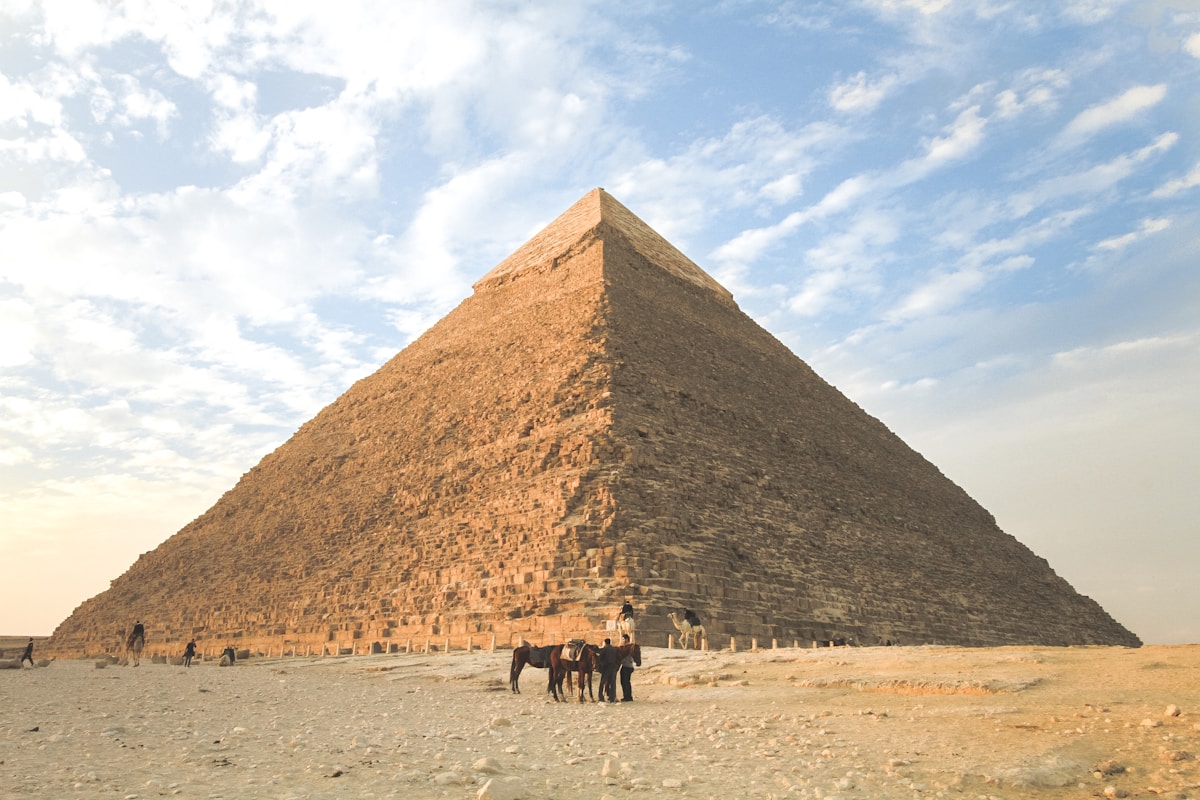
The Great Pyramid is the most studied pyramid in the world due to its immense size and extraordinary precision. The Pyramid Construction Mystery becomes evident when measuring its four equal sides — each approximately 230 meters long, oriented with extreme accuracy toward the four cardinal directions.
The pyramid’s axis deviates from true north by only 3/60th of a degree — while the Greenwich Meridian (1884) deviates by 9/60th of a degree. Modern science’s error is three times greater.
Numbers and Weights That Defy Explanation
The King’s Chamber and its ceilings were entirely carved from granite transported from Aswan. The chamber’s roof consists of five beams, each weighing up to 70 tons. The entire chamber weighs around 1,500 tons and sits 40 meters above the base inside the pyramid’s body. The method used to lift these enormous weights to such heights remains an integral unsolved part of the Pyramid Construction Mystery.
Site Preparation: A Foundation Larger Than Eight Football Fields
Before construction began, an astonishing site preparation occurred. The plateau was leveled with precisely cut limestone bedrock, followed by a pavement of stones from the Tura quarries to create a perfectly flat surface. This involved preparing a vast area of approximately 13 acres — equivalent to eight football fields — forming the solid foundation that would support the colossal structure.
Theories of Ascent: Between the Ramp and Engineering Reality

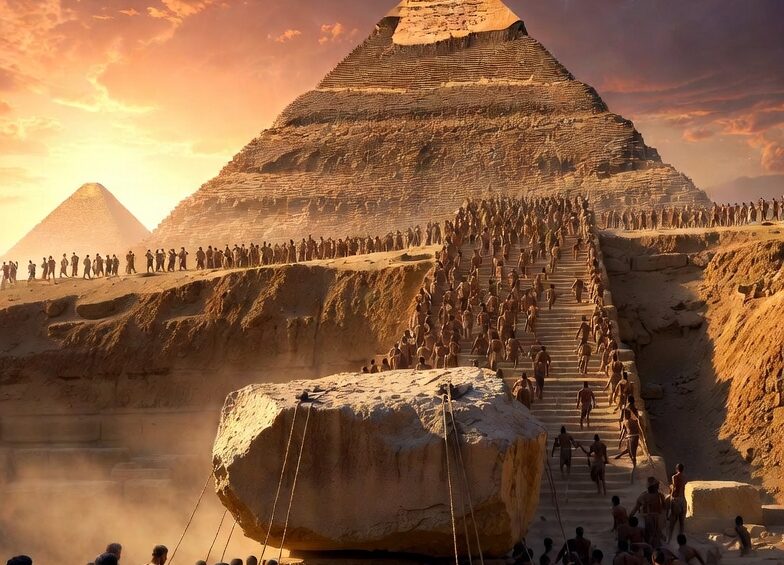
The most common explanation is the “ramp theory.” However, it lacks archaeological consensus on exact specifications. Hypotheses range from a straight ramp, to multiple ramps, or a spiraling ramp encircling the pyramid. Building an effective ramp would itself be a project nearly as difficult as the pyramid — requiring a solid rock structure capable of bearing enormous weights.
Some interpretations rely on a famous relief in the tomb of Djehutihotep showing workers pulling a colossal statue on a sledge. Dr. Mark Lehner notes that the scene depicts 172 men pulling an estimated 58-ton statue. Simple math suggests each man pulled about 340 kg — roughly four times the realistic capacity of an average person.
“Even with the best tools of the 1960s, relocating Abu Simbel required massive cranes and steel cables for 30-ton blocks — while the ancients routinely handled 70-ton stones without such equipment.”
Pierre Tallet’s Experiment: Field Challenges of Transportation

To understand real-world conditions, Egyptologist Pierre Tallet and engineer Franck Burgos conducted experiments simulating the dragging of stone blocks. They faced severe difficulties. In one case, 33 workers took an entire day to move a single block just 46 meters up a 25-degree incline.
Even with temporary wooden sledges and lubrication attempts, the team managed only 275 meters by the end of the day — about 32 meters per hour for a relatively modest block. The core issue of the Pyramid Construction Mystery is the enormous difference in scale: the experiment involved 2–3 ton blocks, while the pyramids contain stones up to 70 tons in the King’s Chamber and over 100 tons in surrounding temples.

Mark Lehner’s Ramp Theories on Pyramid Construction

Mark Lehner, a leading Egyptologist with decades of fieldwork at Giza (including the Giza Plateau Mapping Project and excavations of the “Lost City of the Pyramids”), is one of the foremost authorities on how the ancient Egyptians built the pyramids. He strongly supports the use of ramps as the primary method, combined with sledges, levers, and meticulous organization. He rejects fringe ideas and emphasizes practical, evidence-based engineering.
Core Principles of Lehner’s Views
- Ramps were essential but not a single massive straight ramp — that would require nearly a mile of construction at a 1:10 slope.
- Material efficiency: Egyptians reused quarry waste (limestone chips, gypsum, tafla clay) for ramps.
- Sledges and lubrication: Blocks were dragged on wooden sledges, lubricated with water (or possibly milk).
- Combination techniques: Ramps for most work, supplemented by levers for the upper levels.
The Spiraling Ramp Theory
Lehner’s most notable contribution is the proposal of an external spiraling ramp that begins at the quarry southeast of the Great Pyramid and winds around the structure. The ramp would lean against or be supported by the growing pyramid itself, reducing the volume of material needed compared to a straight ramp.
However, critiques remain: a full external spiral could obscure the pyramid’s corners during construction, complicating the surveying and alignment that achieved such legendary precision. As the pyramid narrows toward the top, space for the ramp decreases — requiring adjustments or a switch to other methods entirely.
The NOVA Experiment (1992)
Lehner co-led a practical test with stonemason Roger Hopkins, building a small ~6-meter-high pyramid using ~186 blocks averaging 2.2 tons. They found 12–20 men could move a 2-ton block. Yet challenges with copper chisels (constant resharpening) led to shortcuts — iron tools and machinery were used for filming deadlines, drawing later criticism. The experiment supported ramp feasibility for average blocks but highlighted scaling issues for the largest 70-ton granite beams.
Modern Technology and the Failure of Conventional Explanations

The Japanese Expedition (1978)
A high-level Japanese team of 24 experts attempted to build a miniature pyramid using traditional methods. They quickly reduced the planned 20-meter height to 10 meters, abandoned hand tools for electric hammers, used trucks and boats, built railway tracks, and ultimately relied on cranes and even a helicopter. Their “pyramid” had only 10 layers (versus over 200 in the Great Pyramid) and lacked internal chambers or granite — yet still required modern machinery.
Edward Leedskalnin and Coral Castle
In a striking contrast, one man — Edward Leedskalnin — single-handedly built Coral Castle in Florida using 30-ton blocks, claiming he had rediscovered ancient Egyptian secrets involving magnetism and gravity manipulation. His work remains unexplained by conventional means. Modern applications like maglev trains demonstrate that levitation is scientifically possible. Leedskalnin’s claims gain credibility when compared to the failures of large teams using traditional methods.
“The pyramids cannot be reduced to mere royal tombs. Their construction demanded the collaboration of the finest minds in astronomy, engineering, chemistry, and geology.”
Conclusion: The Mystery That Refuses to Die
The Pyramid Construction Mystery endures — waiting for those who might rediscover the sciences and techniques that allowed ancient Egyptians to command stone and defy time itself. Whether through lost mechanical genius, forgotten engineering, or knowledge that predates our recorded history, the truth still hides somewhere in the shadow of those colossal monuments.
What we know for certain is this: the pyramids stand as the ultimate proof that ancient Egyptian civilization possessed knowledge, organization, and ambition far beyond what any conventional explanation can account for. They remain an open invitation — to scholars, scientists, dreamers, and travelers alike — to walk into the desert, look up at those impossible stones, and ask the question that has haunted humanity for 4,500 years: How?
Walk Where Pharaohs Walked
Stand before the Great Pyramid. Touch the stones that have outlasted empires. Let our expert Egyptologists guide you through the mystery of Giza on an unforgettable tour.
Frequently Asked Questions

Why is the Pyramid Construction Mystery still unsolved today?
Because no ancient Egyptian text describes the precise techniques used. Despite thousands of papyri and inscriptions, none directly explains how 70-ton stones were lifted, cut, and aligned to astronomical precision. Modern experiments have all failed to replicate the work using only ancient tools.
How did the Egyptians achieve such precise alignment with true north?
The Great Pyramid deviates from true north by only 3/60th of a degree — three times more accurate than the Greenwich Meridian. The exact method remains unknown, though theories suggest the use of stellar observation, plumb-line measurements, and a deeply advanced understanding of astronomy.
What does Mark Lehner say about how the pyramids were built?
Lehner proposes a spiraling external ramp combined with sledges, levers, and skilled organization. He emphasizes evidence-based engineering and rejects fringe theories — though he acknowledges scaling issues for the largest 70-ton granite beams remain unresolved.
Can I visit the pyramids inside, including the King’s Chamber?
Yes! Visitors can enter the Great Pyramid and explore the Grand Gallery and King’s Chamber. Hurghada To Go offers guided day trips from Hurghada, Sharm El Sheikh, and Cairo — with expert Egyptologists who bring the experience to life.
How long did it really take to build the Great Pyramid?
Mainstream estimates suggest about 20 years using rotating teams of skilled labor (not slaves). However, given the scale of 2.5 million blocks and the precision required, many engineers consider this timeline mathematically improbable without unknown advanced techniques.
Are there other pyramids worth visiting besides Giza?
Absolutely. Egypt has over 100 discovered pyramids. The Step Pyramid of Djoser at Saqqara, the Bent and Red Pyramids of Dahshur, and the pyramids of Fayoum each tell a unique chapter in the story of the Pyramid Construction Mystery.
Written by Ahmed Diaa
Egypt travel specialist and historical content writer at Hurghada To Go. Passionate about ancient engineering, Pharaonic mysteries, and curating unforgettable journeys for travelers worldwide.
📜 Join Our Travel Community
Get exclusive Egypt travel guides, hidden archaeology stories, and members-only tour discounts delivered to your inbox.
📚 Continue the Journey
The Code of Egyptian Civilization
Explore all parts of our exclusive investigation into ancient mysteries.
Cairo Day Trip from Hurghada
Visit the Pyramids, Sphinx & Grand Egyptian Museum.
Hurghada To Go on Google Maps
Visit our office or contact us for personalized Egypt tours.