
⏱ Reading time: 14 minutes
✎ Updated: 2026
★ Category: Spiritual & Heritage Tours
A
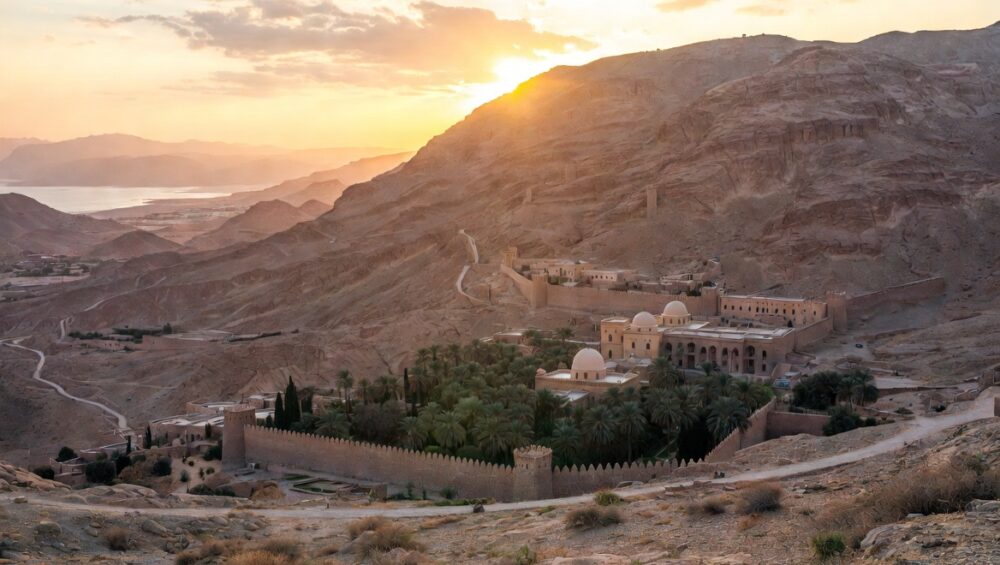
private tour st anthony and st paul monastery is not simply a day trip — it is a quiet, soul-stirring pilgrimage into the very cradle of Christian monasticism. Carved into the wild silence of Egypt’s Eastern Desert, these two ancient Coptic monasteries have stood for more than 1,600 years, watching empires rise, fall, and dissolve into the sand. To stand within their golden walls is to step inside a living manuscript.
Whether you are travelling from Hurghada, Cairo, El Gouna, or Soma Bay, a private tour st anthony and st paul monastery offers something no group bus can deliver: intimacy. You travel in air-conditioned comfort, pause where the desert moves you, and listen to a private guide who can speak fluently about Coptic theology, hieroglyphics, hermits, and history. This in-depth guide reveals everything — spiritual history, what to see, practical advice, hidden details, and how to plan an unforgettable journey.
Why Choose a Private Tour St Anthony and St Paul Monastery?
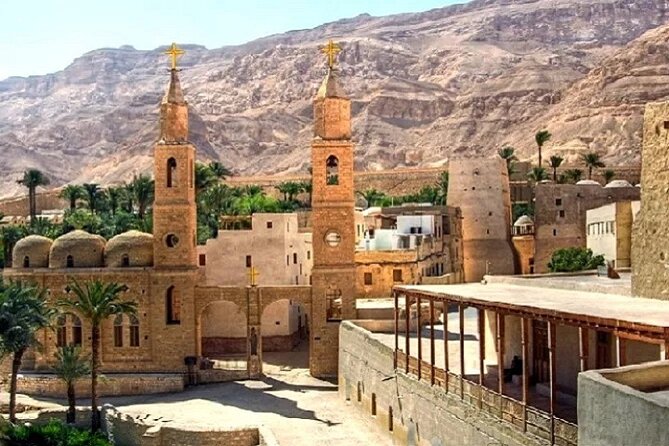 The cinematic drive through the Eastern Desert — one of the most scenic stretches of road in Egypt.
A private tour st anthony and st paul monastery is the gold standard for travelers who value depth over numbers. Unlike crowded coach excursions, a private journey gives you space to breathe, ask questions, linger before a fresco, and listen to the wind echo through the courtyards. The journey typically lasts 10–14 hours, with early hotel pickups around 4–6 AM to outpace the desert heat.
Key Benefits at a Glance
- Flexibility — stop for photos in dramatic wadis, extend your time at St. Anthony’s cave, or skip a section if needed.
- Comfort — modern air-conditioned vehicles, bottled water, snacks, and a hot lunch typically included.
- Depth of storytelling — private Egyptologists or Coptic specialists share details that simply do not fit into a group format.
- Exclusivity — ideal for couples, families, photographers, and spiritual seekers craving silence and reflection.
St. Anthony the Great: Father of All Monks
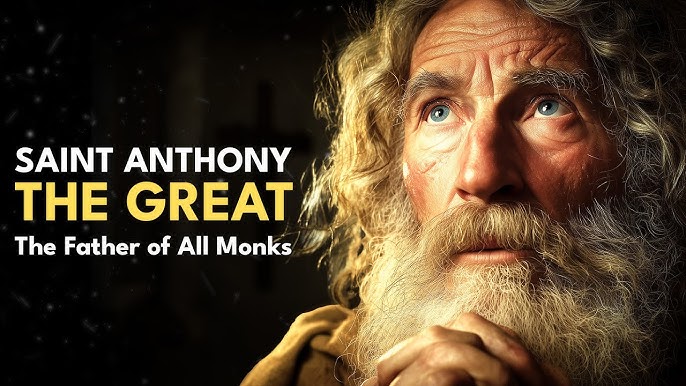 Coptic frescoes inside the Church of St. Anthony preserve faces painted more than 1,300 years ago.
St. Anthony (c. 251–356 AD), known as Anthony the Great or Anthony of Egypt, was born in Coma, near modern Al-Minya, into a wealthy Christian family. Orphaned in his late teens, he heard the Gospel proclaimed in church: “Go, sell what you have, give to the poor, and follow me.” He obeyed instantly. He sold his lands, entrusted his sister to a community of virgins, and walked into the desert.
What followed became legend. The hagiography Life of Saint Anthony, written by Athanasius of Alexandria around 360 AD, describes Anthony battling demons in the form of wild beasts, seductive visions, and mountains of gold. He emerged from these trials radiant and unshaken. His example pulled hundreds of seekers into the desert behind him — the spark that ignited Christian monasticism worldwide.
Anthony never founded a formal monastery. After his death in 356 AD, his disciples built the Monastery of St. Anthony at the foot of Mount Galala, near his hermit cave. Today it is recognized as the oldest active monastery in the world, a self-contained oasis of gardens, mills, bakeries, and chapels — and it remains one of the centerpieces of every private tour st anthony and st paul monastery.
💡 Did You Know?
The Western tradition of monasticism — including the Benedictines and Franciscans — can be traced directly back to Anthony’s desert example. Without this Egyptian hermit, Europe’s great abbeys may never have existed.
St. Paul the Anchorite: The First Christian Hermit
St. Paul of Thebes (c. 227–341 AD) is recognized by tradition as the first Christian hermit, predating Anthony. Born into a wealthy Alexandrian family, he fled into the desert around the age of 16 during the Decian persecution (c. 250 AD) and never returned. He survived for over nine decades in a cave, sustained by a single palm tree — its dates fed him, its leaves clothed him — and a small spring of fresh water still flowing today.
The most famous story tells of Anthony, then 90 years old, receiving a vision of Paul’s impending death. Guided through the mountains, he found Paul. They shared a meal of bread brought miraculously by a raven. After Paul died, two lions are said to have helped Anthony dig his grave. Anthony, the founder of communal monasticism, called Paul the true first hermit.
The Monastery of St. Paul (Deir Anba Bola) was built in the 5th century directly over his cave. Nicknamed the “Monastery of the Tigers” for its remoteness, it features high defensive walls, a medieval entry hoist, and a tower used as refuge during Bedouin raids. Today it is roughly 30–35 km from St. Anthony’s — making the two a perfect pairing on a single guided journey.
Inside the Monastery of St. Anthony
St. Anthony’s Monastery sprawls over more than 18 acres, enclosed by towering stone walls. Stepping inside on a private tour st anthony and st paul monastery is like crossing a threshold between centuries.
Highlights You’ll Discover
- Church of St. Anthony — the oldest and most sacred space, decorated with extraordinary 7th–13th century frescoes and home to the saint’s tomb.
- Church of the Apostles, Church of the Virgin, and the New Church — layered architecture from the medieval and early modern periods.
- The Library — once one of the richest in the Christian world; many Coptic manuscripts have been moved to Cairo for preservation.
- The Fortified Tower — a medieval keep where monks retreated during invasions.
- Gardens, mill, and bakery — date palms, fruits, vegetables, and bread baked the same way for centuries.
- St. Anthony’s Cave — the spiritual climax for many travelers: a 1–2 hour climb up about 1,200 steps and 680 m of elevation, rewarded with sweeping views of desert and Red Sea.
Recent restorations — including a major preservation project worth roughly $14.5 million — have stabilized frescoes and revealed 4th-century foundations now visible beneath protective glass floors. Today around 120 monks live here, keeping the ancient rhythm of prayer, work, and hospitality.
Inside the Monastery of St. Paul: Intimate, Quiet, Eternal
Smaller and quieter than its famous neighbour, St. Paul’s Monastery offers something even rarer: stillness. On a private tour st anthony and st paul monastery, this is often the moment travelers describe as the most moving of the day.
Sacred Spaces Within
- Cave Church of St. Paul — built directly over the hermit’s cave, it glows with candlelight, ostrich eggs (a symbol of Resurrection), murals, and aged icons.
- Churches of St. Mercurius and St. Michael — smaller chapels filled with devotion.
- Tower / Keep — a multi-purpose stronghold serving as cemetery, storeroom, and emergency chapel.
- Ancient Refectory and Mills — medieval dining hall and animal-powered stone mills still partially intact.
- Spring of St. Paul & Pool of Miriam — the life source of the monastery, linked by tradition to the Exodus narrative.
A Typical Private Tour Itinerary: From Hurghada or Cairo
Below is a sample private tour st anthony and st paul monastery itinerary from Hurghada — easily adaptable for departures from Cairo, El Gouna, Sahl Hasheesh, Soma Bay, or Marsa Alam.
Dress code: modest clothing covering shoulders and knees; comfortable walking shoes for the cave hike; women may wear a light scarf inside churches. Best season: October through April for cooler temperatures.
Sacred Art & Iconography: A Walk Through Coptic Masterpieces
Walking through these monasteries on a private tour st anthony and st paul monastery is also a slow walk through one of the world’s richest galleries of early Coptic art. Frescoes layered across centuries depict warrior saints on horseback, the Virgin Mary in regal robes, apostles in mid-conversation, and apocalyptic visions painted in earthy reds, ochres, and indigo blues.
Iconography here follows strict theological rules: large eyes signify spiritual awareness, elongated faces communicate ascetic discipline, and gold leaf evokes the eternal light of God. Many panels were rediscovered only after decades of soot and candle smoke were carefully removed during recent restoration campaigns.
Archaeological Discoveries
Excavations beneath St. Anthony’s church have revealed 4th-century foundations, ancient cells, and pottery fragments — some now displayed beneath glass floors. These finds confirm continuous occupation since the earliest days of Christian monastic life.
Spiritual & Cultural Significance Today
Both monasteries remain active pilgrimage sites for Coptic Christians worldwide. Major feast days (St. Anthony’s on January 17, St. Paul’s on January 30) draw thousands. Throughout the year, monks lead retreats, host youth programmes, and welcome respectful travelers from every faith.
Egypt’s Christianity predates Islam by six centuries and traces its origin to St. Mark the Evangelist, who preached in Alexandria around 42 AD. From the Hanging Church in Old Cairo to the monasteries of Wadi Natrun, this Coptic heritage forms a continuous thread — and a private tour st anthony and st paul monastery places you directly inside that thread.
Monastic Daily Rhythm
Monks rise long before dawn for the midnight office, followed by communal prayer, manual labour (gardening, baking, copying texts), study, and hospitality. Silence and obedience are central. On a private tour, your guide will explain the small ceremonial details — the lighting of candles, the meaning of incense, the chanted Coptic hymns — that bring the rhythm to life.
Practical Tips & Planning Checklist
Smart preparation transforms a great private tour st anthony and st paul monastery into an unforgettable one. Here’s your essential checklist:
✓ Travel Checklist
- Passport or national ID
- Modest attire (covered shoulders and knees)
- Comfortable walking shoes for the cave hike
- Sun hat, sunglasses, and sunscreen
- Refillable water bottle
- Light scarf (women, for inside chapels)
- Camera or smartphone fully charged
- Small cash tip for monastic donations
- Reliable, licensed tour operator (always verify)
- Open mind and a respectful spirit
Health, Safety & Photography
Roads are well-paved and safe with professional drivers, but always book through licensed operators familiar with the route. Photography is allowed in courtyards and gardens; inside churches you should always ask permission first. Drones are not permitted.
Combining Your Tour
Many travelers extend their private tour st anthony and st paul monastery with a Red Sea snorkeling day, a Cairo extension, or a Luxor flight to see the temples of Karnak and the Valley of the Kings. Explore more options on our complete tour collection.
The Desert Landscape: Where Nature Becomes a Cathedral
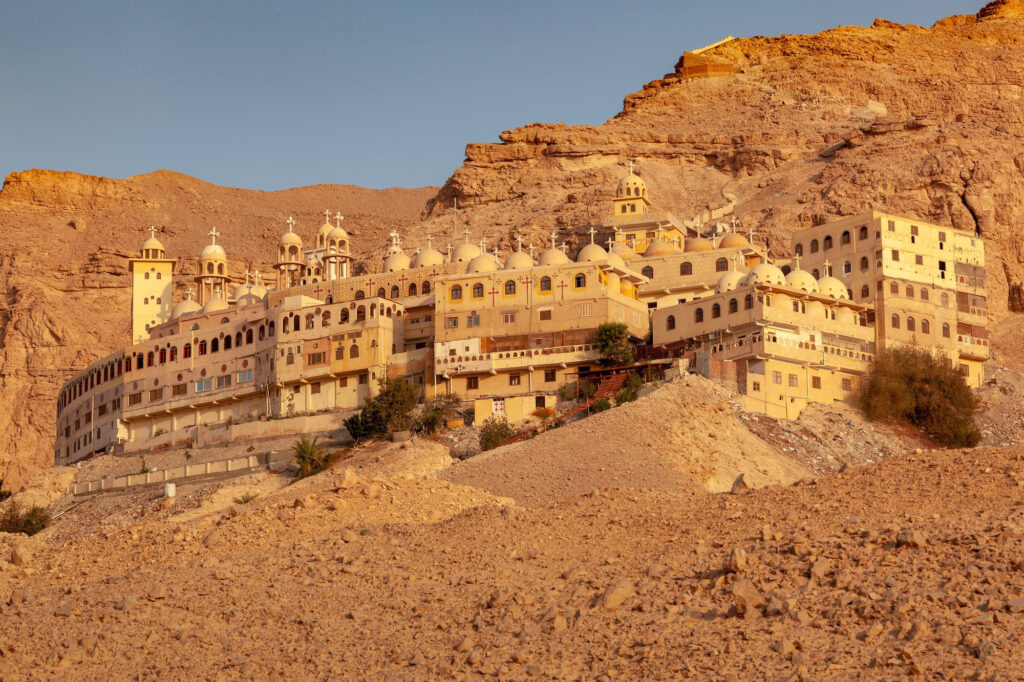 The Eastern Desert is itself a sacred landscape — a backdrop that shaped the monks’ inner journey.
The drive to and from the monasteries is a destination in itself. Jagged red mountains rise from sand-coloured plains, deep wadis cut through the rock, and ibex sometimes appear on distant ridgelines. This is the same landscape that shaped the inner lives of Anthony and Paul — a place where the noise of the world is replaced by the soundtrack of wind and sky.
On a quality private tour st anthony and st paul monastery, your guide will pause for photo stops at the most dramatic geological points, share Bedouin folklore, and explain the mineralogy of the Red Sea Mountains, where granite and porphyry meet ancient seabeds.
Beyond the Visit: Extending Your Spiritual Egypt Journey
If your private tour st anthony and st paul monastery awakens a deeper hunger for Egypt’s sacred history, consider expanding your trip with these unforgettable additions:
- Coptic Cairo — the Hanging Church, Saints Sergius & Bacchus, the Coptic Museum.
- Wadi Natrun — four still-active monasteries set among salt lakes.
- St. Catherine’s Monastery & Mount Sinai — the burning bush and the route of Moses.
- Luxor & Karnak — the apex of Pharaonic spirituality, where temples once outshone the stars.
- Red Sea Snorkeling or Diving — the perfect counterbalance: silence above water, wonder beneath it.
Frequently Asked Questions
Is a private tour st anthony and st paul monastery safe?
Absolutely. Roads are paved and well-maintained, drivers are licensed and experienced, and licensed tour operators follow strict safety protocols including bottled water, first-aid kits, and tracked itineraries.
Can I stay overnight at the monasteries?
Both monasteries offer limited guesthouse facilities for genuine pilgrims, especially men, but advance written permission from the Coptic Patriarchate is usually required. Most travelers visit as a single day trip.
What are the photography rules?
Outdoor photography is generally welcomed. Inside churches you must always ask first; flash and tripods are usually not allowed. Drones are forbidden.
Are there options for vegetarian or special dietary needs?
Yes. Egyptian cuisine includes many vegetarian, vegan, and gluten-aware options such as koshary, ful medames, salads, and fresh bread. Notify your operator in advance.
How physically demanding is the cave hike?
St. Anthony’s cave climb is moderate-to-strenuous — around 1,200 steps and 680 m of elevation. It is optional. The monasteries themselves are mostly walkable on flat ground.
When is the best time of year to visit?
October through April offers cool, clear desert weather. Avoid mid-summer when daytime heat exceeds 40°C.
Conclusion: Walk Where the Saints Walked
A private tour st anthony and st paul monastery is not just sightseeing — it is a meeting with Christianity at its source, a pilgrimage into the silence that birthed monasticism, and a personal journey through Egypt’s most powerful desert landscapes. Few experiences in the country are as quietly transformative.
You will return with sand on your shoes, candlelight in your memory, and a renewed sense of how vast time really is. Travelers consistently rank a private tour st anthony and st paul monastery among their most meaningful Egyptian moments — sometimes even surpassing the pyramids in emotional weight.
Ready to walk where the saints walked? Let HurghadaToGo design a journey that fits your pace, your interests, and your dreams. Browse our handpicked Egypt tours and excursions and begin the most cinematic chapter of your travel story.
Related Articles
Luxor Full Day Tour from Hurghada
Explore Karnak, Hatshepsut, and the Valley of the Kings.
Cairo Day Trip — Pyramids & Museum
Visit Giza and the Grand Egyptian Museum in one unforgettable day.
The Best Things to Do in Egypt
Discover top-rated experiences across Egypt.
Follow & Share
Connect with HurghadaToGo across the web