

🕑 Estimated Reading Time: 22 minutes
📖 Series: Code of Egyptian Civilization
F
or more than four and a half thousand years, the Great Pyramid of Giza has stood at the threshold between fact and legend, daring every generation to explain how a civilization without electricity, steel, or cranes could raise a monument of such impossible precision. The conventional answer — a royal tomb — satisfies the historian. But it leaves the engineer restless. A growing body of investigators argue that the structure on the Giza Plateau was never simply a grave at all, but a colossal machine: the so-called Giza Power Plant, an ancient electromagnetic generator engineered from stone, water, and crystal.
This is not a claim made lightly. The Giza Power Plant theory grows from observable physics, documented anomalies, and a strange convergence with the work of one of the modern world’s greatest minds, Nikola Tesla. In the pages that follow, we will walk the corridors of the monument, examine its conductive minerals, descend toward the ancient channel of the Nile, and follow the electrical thread that connects Giza to a demolished tower on Long Island. Whether you arrive a believer or a sceptic, the evidence assembled around the Giza Power Plant deserves a careful, open-minded hearing.
“The pyramids were not built to bury the dead, but to power the living.”
— THE GIZA POWER PLANT HYPOTHESIS
1. Physical Phenomena on the Summit of the Greatest Monument
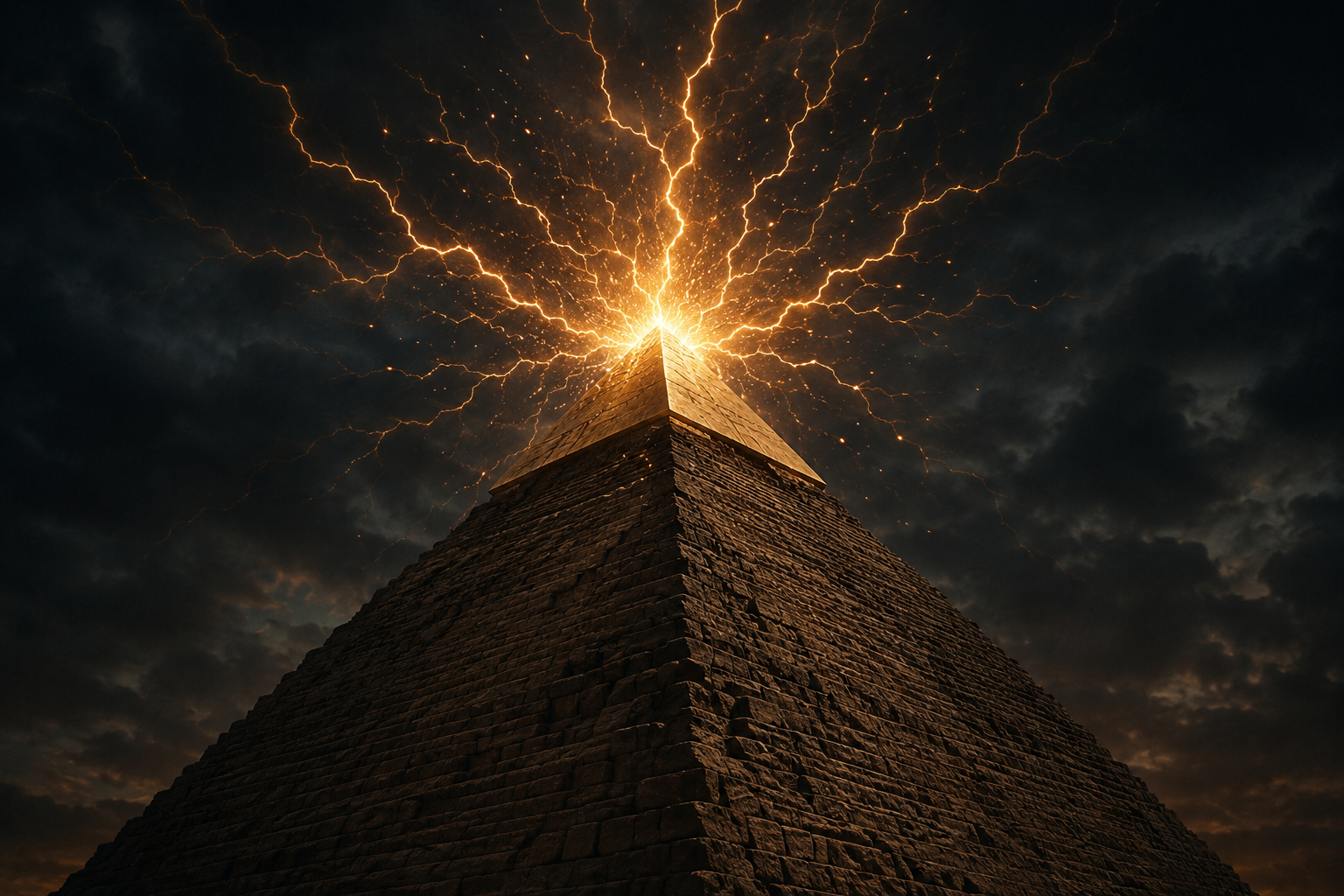
Eyewitnesses report static discharges near the apex — a recurring clue in the Giza Power Plant debate.
If you ascend to the apex of the Great Pyramid carrying a bottle wrapped in a damp cloth, you will soon observe minor, lightning-like sparks crackling around the fabric — an early hint of the physical phenomena on the summit of the greatest monument. Should you linger at that altitude, there is a distinct possibility that your own body will begin to emit subtle electrical discharges. To the casual climber these crackles are a curiosity; to the proponent of the Giza Power Plant theory, they are a fingerprint left behind by a still-active electromagnetic field.
This monumental structure is characterised by its unique four-sided geometry, with its faces aligned toward the four cardinal directions — North, South, East, and West — with an astonishing orientation accuracy that leaves an error margin of a mere half a degree. Intriguingly, when viewed from orbit under specific lighting conditions, its true eight-sided concave architecture is revealed, each face subtly indented down the centre. Such fanatical precision is hard to reconcile with a simple burial mound, but entirely logical for a tuned resonating instrument like the proposed Giza Power Plant.
Completed around 2560 BC on the Giza Plateau, the construction of this mega-structure required approximately 2.3 million stone blocks, with individual weights ranging from 3 to 30 tonnes. These masses were precisely cut, seamlessly aligned side by side, and bound together using a specialised gypsum mortar. Notably, the gypsum utilised in fixing these stones possesses a high-pressure tolerance that renders it significantly stronger than the bedrock itself — a deliberate engineering choice that would later prove central to the Giza Power Plant argument.
Standing at an original height of 148 metres, the project spanned 20 years and demanded the labour of roughly 10,000 highly organised workers. Before the groundbreaking discovery of the Wadi al-Jarf Papyrus, the true identity of the builders remained shrouded in myth, giving rise to fringe theories attributing the feat to the lost tribe of ‘Ad, the ancient Israelites, extraterrestrials, or the inhabitants of Atlantis. These speculative narratives frequently intersect with an alternative engineering hypothesis: that the pyramid was designed as a highly sophisticated, geometric power generator — in essence, the original Giza Power Plant.
💡 DID YOU KNOW?
The Great Pyramid is the only structure on Earth with eight sides instead of four — an optical illusion visible only at dawn or dusk during the spring and autumn equinoxes. Supporters of the Giza Power Plant model believe this concavity helped focus and concentrate energy toward the apex.
2. The Wadi al-Jarf Papyrus and the Secrets of the Outer Casing
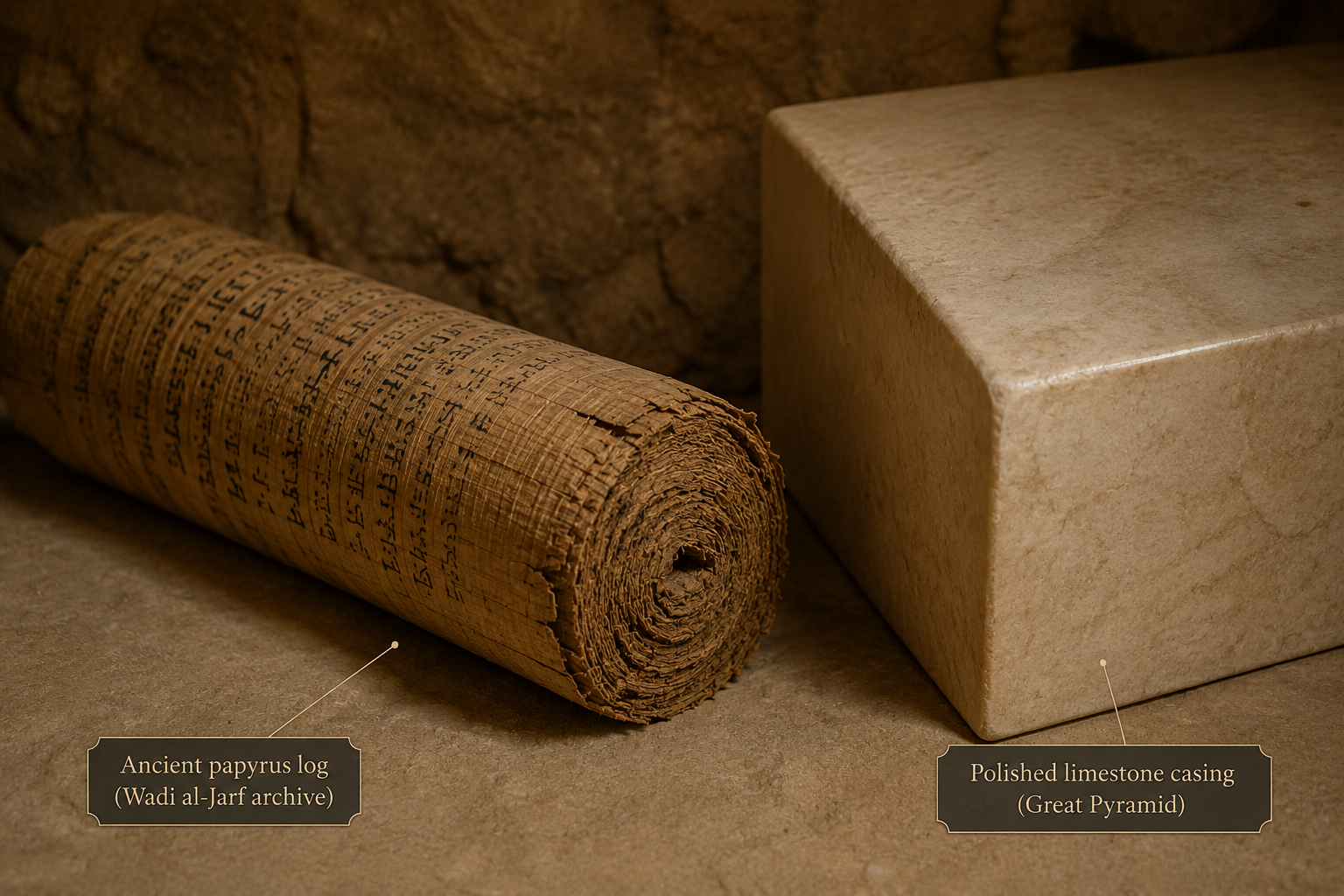
The Wadi al-Jarf Papyrus, the oldest written document ever found, finally named the builders.
The discovery of the Wadi al-Jarf Papyrus ultimately settled the long-running historical debate. This ancient logbook meticulously documented worker logistics, advanced construction methods, the geographical sources of the stones, and even the daily food rations distributed to the workforce, confirming beyond doubt that the ancient Egyptians themselves were the sole architects of the pyramids. The aliens-and-Atlantis chapter could finally be closed — yet, intriguingly, naming the builders did nothing to dismiss the deeper question of function that fuels the Giza Power Plant theory.
Dr Zahi Hawass hailed this archival find as the greatest archaeological discovery of the 21st century, noting that its historical value surpasses even the unlooted tomb of Tutankhamun. For the first time, the world heard the voices of the men who shaped the monument — and yet none of them recorded why their pharaoh demanded such extreme engineering tolerances.
In antiquity, the pyramid was entirely encased in 144,000 blocks of highly polished Tura limestone, each measuring up to 100 inches in thickness and weighing no less than 15 tonnes. These casing stones were masterfully polished to a mirror-like sheen, allowing them to reflect intense sunlight so brilliantly that the monument could be seen glittering from the hills of distant Sinai. This brilliant facade served as total thermal and atmospheric insulation for the internal shafts and chambers.
A flawless seal of polished limestone is exactly what any self-contained generator requires — and exactly what the Giza Power Plant hypothesis predicts.
This is no minor detail. A power plant cannot leak. Any machine designed to build and hold an electromagnetic charge must isolate its interior from the chaotic temperature swings and humidity of the open desert. The mirror-smooth casing did precisely that, transforming the structure into a perfectly sealed insulation system — a requirement that heavily supports the proposition of a self-contained Giza Power Plant capable of sustaining the physical phenomena on the summit of the greatest monument.
3. Internal Components and Electrical Conductivity
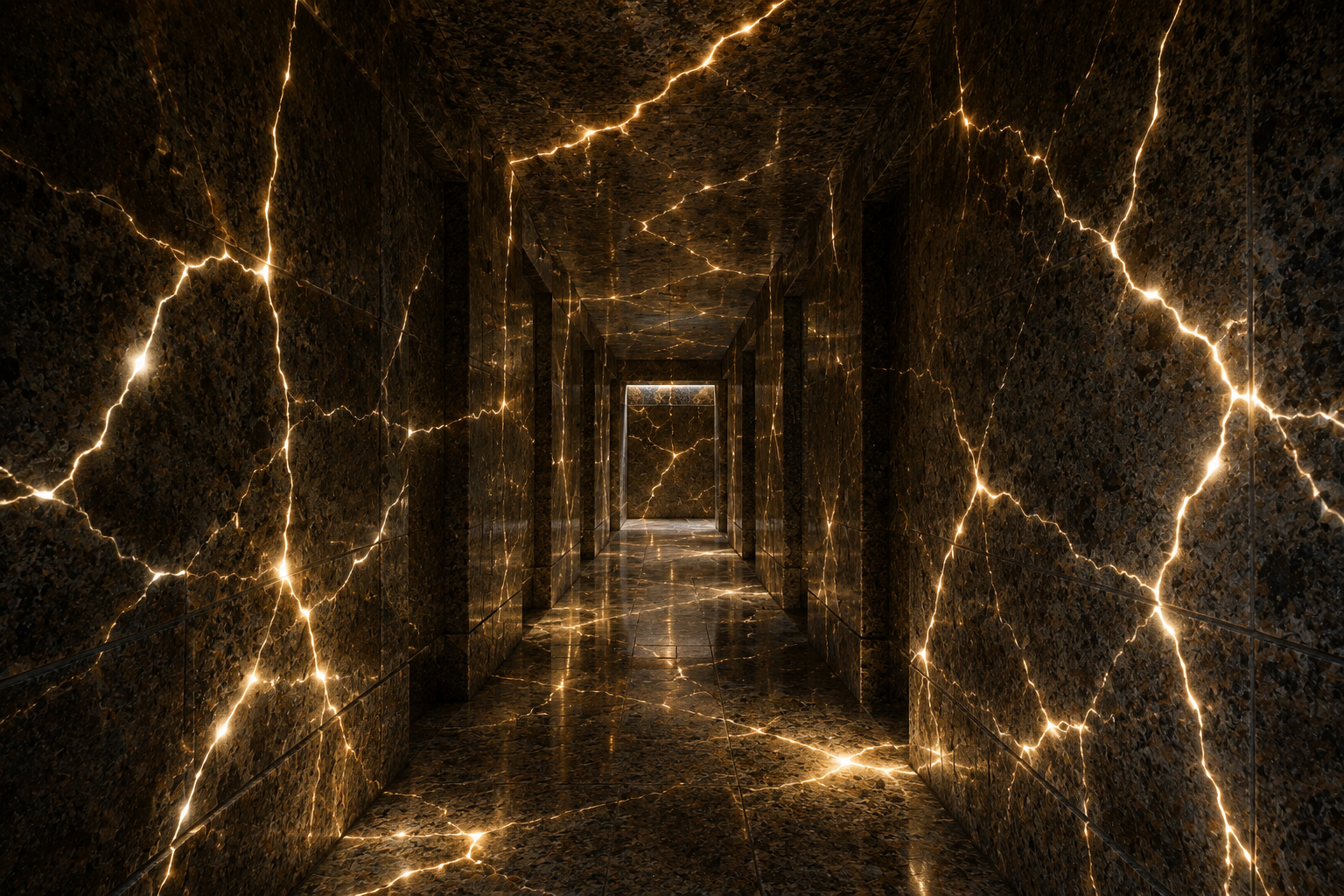
The interior was built from conductive, quartz-rich granite — not the soft limestone of the outer shell.
Deep within the monument, the internal walls and passages were constructed using dolomite, a mineral widely recognised in engineering for its ability to drastically enhance electrical conductivity. Why would tomb builders haul a conductive mineral into the dark heart of a grave? For the Giza Power Plant theorist, the answer is self-evident: conductivity is only useful where current must flow.
Furthermore, the internal shafts, corridors, and primary chambers were carved from radioactive granite, which is rich in quartz crystals. Both materials are exceptional conductors of electrical currents. The quartz embedded within this granite acts as a distinct piezoelectric mineral, meaning it generates a direct electrical current when subjected to intense structural pressure or high-frequency acoustic vibrations.
Here the engineering logic of the Giza Power Plant becomes difficult to dismiss. Piezoelectricity is not mysticism; it is the same effect that powers a quartz wristwatch and the spark in a gas lighter. Squeeze a quartz crystal and it releases a measurable voltage. Now imagine that principle scaled up to a chamber lined with tonnes of quartz-bearing granite, vibrating under enormous mechanical stress. This specific geological composition inevitably revives the central investigative question: was the Great Pyramid designed to function as an active power generator?
⚡
Piezoelectric Quartz
Generates voltage under pressure — the proposed engine of the Giza Power Plant.
🧪
Conductive Dolomite
Amplifies the flow of electrical current through the inner passages.
🧱
Limestone Insulator
Seals the structure and prevents the charge from dissipating outward.
4. Secrets of the Chambers and Hidden Copper Wires
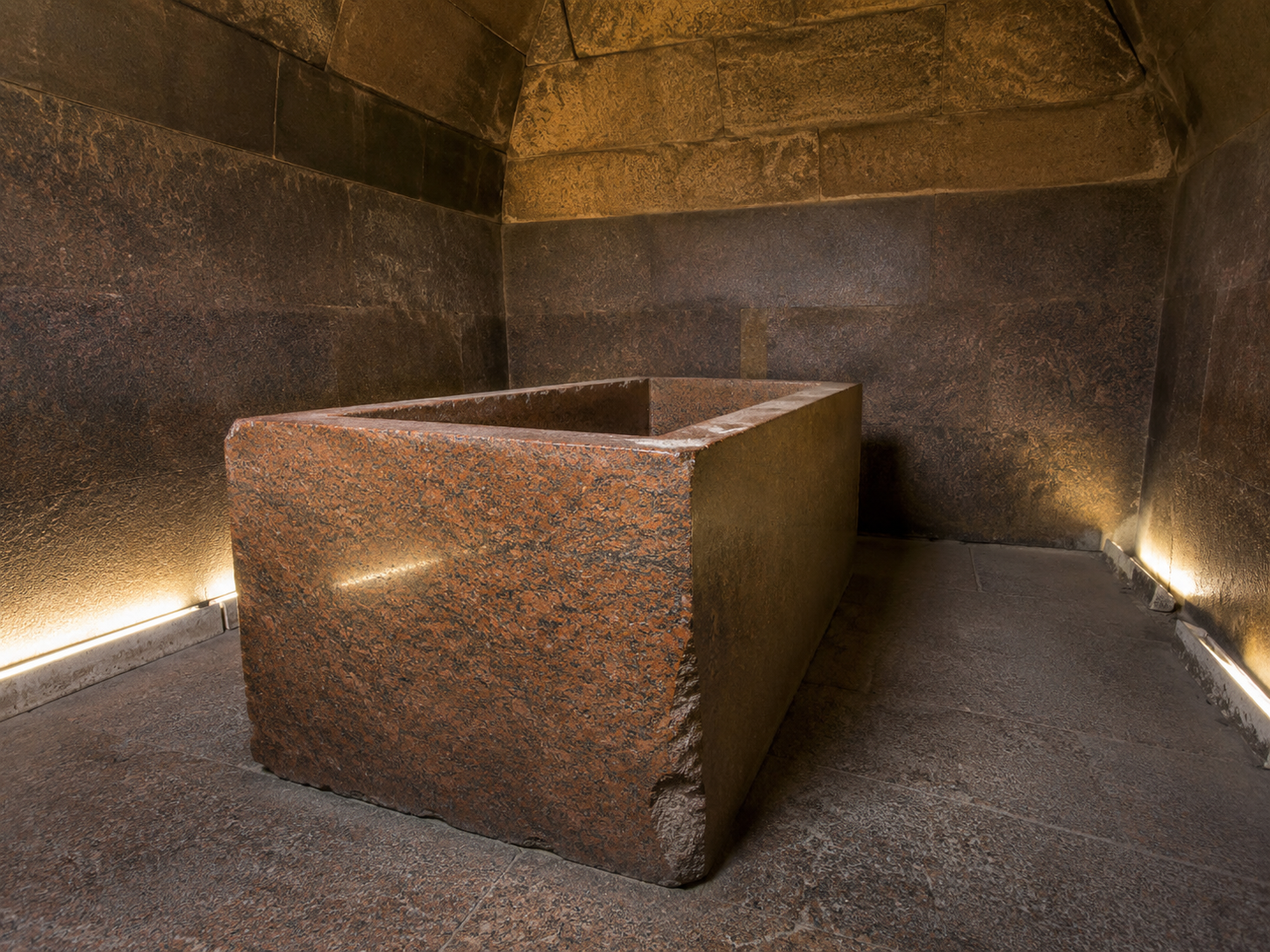
The empty coffer is too large to fit through the chamber’s entrance — it was sealed inside during construction.
The internal matrix of the pyramid features two primary chambers. The first is the “King’s Chamber,” which houses an enigmatic, empty granite coffer. Remarkably, the dimensions of this stone chest exceed the clearance of the chamber’s entrance and the connecting internal shafts, rendering it impossible to have been introduced from the outside after completion. Consequently, this coffer must have been positioned inside the chamber during the structural phase of construction — built into the machine rather than carried into a tomb. To the Giza Power Plant investigator, this is the signature of a fixed component, not a removable sarcophagus.
In 1993, engineers utilising robotic explorers discovered a hidden chamber deliberately sealed away from the rest of the layout, colloquially referred to by researchers as part of the “Queen’s Chamber” complex. By 2011, advancements in non-destructive exploration technologies allowed scientists to probe these tightly sealed enclosures without physical disruption. The investigation yielded a startling revelation: the presence of deliberately routed copper wires alongside precise, non-hieroglyphic symbols reminiscent of modern electrical battery schematics.
Copper wire, sealed inside a perfectly insulated chamber, is not the language of the dead. It is the language of electricity.
The presence of copper wiring within such a perfectly insulated environment provides the ideal conditions to manifest a potent electromagnetic field, further validating the theory of an integrated, technically astounding power generation matrix. This highly technical arrangement closely mimics contemporary electrical circuitry, leaving us to wonder how these elements interacted to trigger the documented physical phenomena on the summit of the greatest monument. The Giza Power Plant begins to read less like a metaphor and more like a wiring diagram.
When analysing the core materials, a clear engineering pattern emerges. Limestone functions as a heavy-duty insulator. Dolomite amplifies electrical conductivity. Granite and quartz generate electrical currents via physical pressure and acoustic resonance. Copper wire serves as the conductive medium for current transmission. This structural blueprint mirrors modern electrical wiring systems almost perfectly. However, it leaves one fundamental mystery unresolved: how could a static stone monument experience the immense pressure or vibrational frequency required to stimulate the quartz crystals while standing completely motionless? That single question is the doorway to the most extraordinary part of the Giza Power Plant story.
5. The Intersection of Research with Nikola Tesla’s Theories
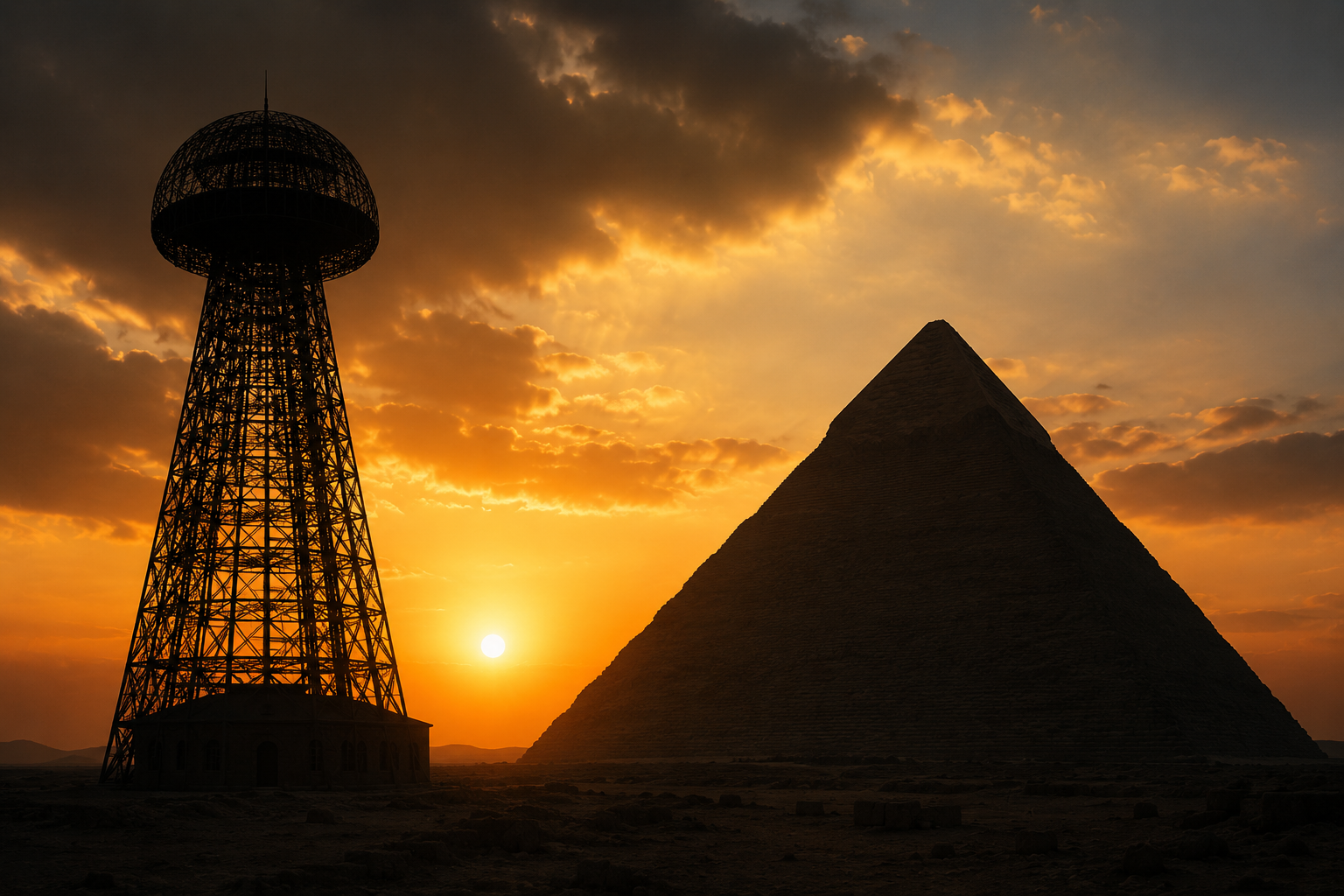
Tesla modelled his 1901 tower on the proportions of the Giza pyramids.
This profound engineering question directly intersects with the pioneering research of the legendary physicist Nikola Tesla, the mastermind behind much of our modern technological infrastructure and the inventor of the AC induction motor. Tesla asserted that Planet Earth functions as a gargantuan, inexhaustible energy generator. He theorised that this terrestrial energy could be wirelessly harvested through the atmosphere — specifically utilising the ionosphere, a layer heavily charged with ambient electricity.
Tesla believed that the pyramids were far more than mere royal tombs or ostentatious mastabas; he maintained that a profound energetic secret lay within their precise geometry and geographic placement. In his eyes, the ancient builders had stumbled upon — or inherited — the very principles he spent his life chasing. The original Giza Power Plant, he suspected, had solved wireless energy millennia before the modern grid was even imagined.
Driven by this conviction, Tesla constructed his famous Wardenclyffe Tower in 1901, explicitly applying the proportional laws observed in the Giza Plateau pyramids to achieve global wireless power transmission. Standing 57 metres tall, the tower featured a massive 55-tonne dome constructed of conductive metals, anchored by a deep iron substructure that penetrated more than 300 feet into the earth to interface directly with the water table. The detail of the water table is no accident — it is the very mechanism the Giza Power Plant theory assigns to the ancient Nile.
In 1901, the telegraph system recorded the initial signs of operational success. However, funding shortages led to the tower’s demolition in 1905. Following Tesla’s death in 1943, the Federal Bureau of Investigation seized all of his personal effects and research papers, causing the foundational secrets of the tower to vanish from the public domain. For believers in the Giza Power Plant, the parallel is haunting: an ancient machine forgotten in sand, and a modern one erased from the record — both promising the same gift of free, wireless energy.
💡 DID YOU KNOW?
Tesla anchored Wardenclyffe more than 300 feet into the earth specifically to reach groundwater — the same hydraulic principle the Giza Power Plant theory attributes to the ancient channel of the Nile flowing beside the Great Pyramid.
6. Nile Hydraulics and Capillary Action
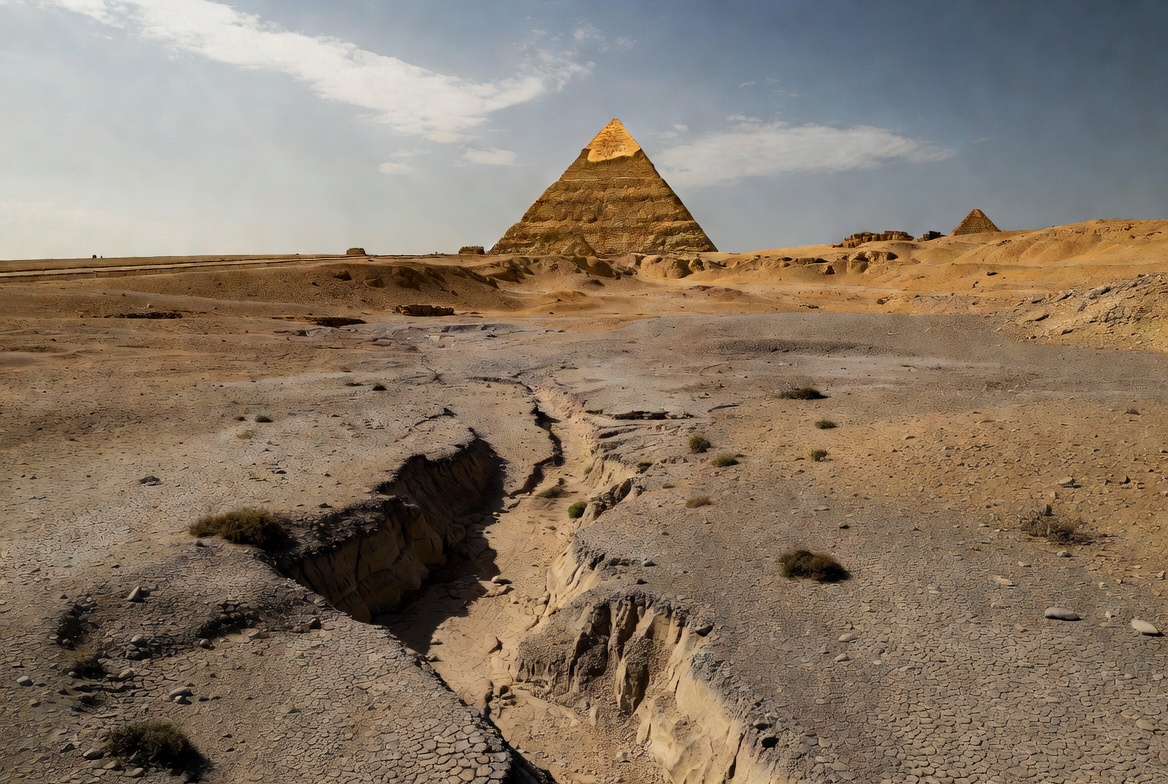
Satellite radar has confirmed a buried branch of the Nile once flowed at the pyramid’s feet.
Here the great unanswered question — how a motionless monument could vibrate — finally finds its answer. Thousands of years ago, the path of the Nile River ran directly adjacent to the Great Pyramid. Modern satellite imagery has confirmed the existence of this ancient paleochannel, while deep erosion patterns around the base of the Great Sphinx offer undeniable physical proof of past hydrological activity. Water, it turns out, may have been the missing fuel of the Giza Power Plant.
In fluid mechanics, liquids naturally exhibit a phenomenon known as “capillary action,” or the “capillary effect,” which enables water to migrate upward through tightly confined porous spaces, completely defying gravity. From an engineering perspective, it is highly probable that the Nile’s waters migrated upward through the porous limestone foundation or drained downward into subterranean channels.
This constant, high-pressure hydraulic movement generated intense subterranean acoustic vibrations, creating sufficient seismic and mechanical stress to trigger the piezoelectric properties of the quartz crystals. The motionless stone was never truly still — it was humming, deep below the threshold of human hearing, driven by the relentless surge of the river. This is the beating heart of the Giza Power Plant: water in, vibration through, voltage out.
Water became vibration, vibration became pressure, pressure became electricity — and electricity rose to the sky. That is the elegant logic of the Giza Power Plant.
This generated current produced immense electromagnetic energy that surged upward toward the apex, culminating in the shocking physical phenomena on the summit of the greatest monument. This energy was channelled via a highly conductive capstone — likely overlaid with gold — which acted as a direct conduit to the ionosphere, capturing negative ions and discharging them into the atmosphere toward global receptors like obelisks and surrounding pyramids.
Historical accounts even suggest that the ancient Lighthouse of Alexandria was illuminated wirelessly using energy harvested from Giza, providing a clean current across ancient Egypt and reinforcing the overarching Giza Power Plant theory. Whether or not one accepts so dramatic a claim, the architecture of obelisks, capstones, and aligned monuments forms a tantalisingly coherent network — an ancient grid radiating outward from a single, central station.
7. Technical Comparisons and Pharaonic Tombs
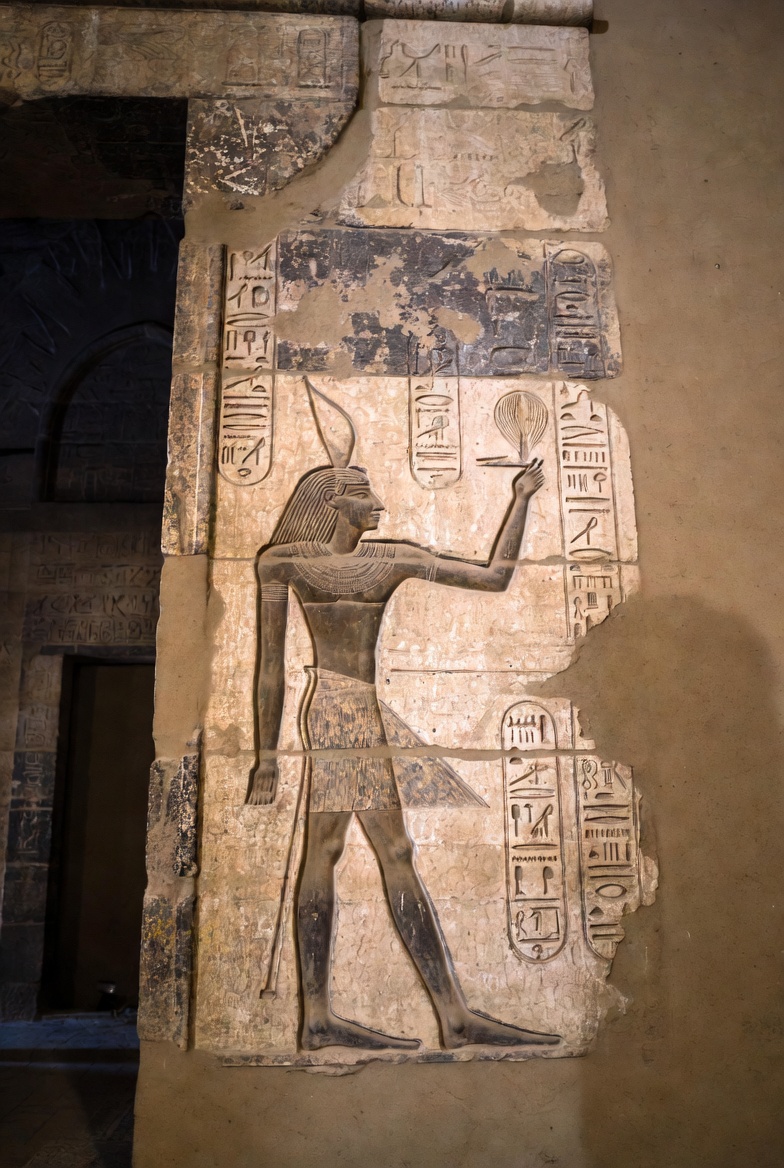
The famous Dendera relief shows bulb-like objects with serpentine filaments connected to a box.
Ancient historical reliefs provide curious visual evidence for this hypothesis. In the Dendera Temple Complex, dedicated to the goddess Hathor, well-preserved reliefs depict figures holding elongated, bulbous objects containing twisted, snake-like filaments. To modern eyes, the resemblance to an incandescent light bulb — complete with its glowing internal coil — is uncanny, and it is a centrepiece of the Giza Power Plant discussion.
These “bulbs” are explicitly connected via cables to a central receiver box, while an ancient “djed pillar” — which strongly resembles a modern telecommunications antenna or a high-voltage insulator — stands on the opposite side. Other temple carvings portray ancient Egyptians holding wireless staff apparatuses and rod-like implements tipped with luminescent, bulbous nodes. Conventional Egyptologists interpret these as lotus flowers and symbolic snakes; the Giza Power Plant camp sees lamps, cables, and insulators.
There is, too, a quiet practical riddle that has long puzzled visitors: how did the ancient artisans paint such intricate, vibrant murals deep inside sealed tombs and corridors where no torch soot has ever been found? The absence of smoke residue on those ceilings has been offered as indirect support for a clean, electrical source of light — precisely the kind of illumination a functioning Giza Power Plant could have distributed across the kingdom.
8. The Engineering Blueprint of the Giza Power Plant
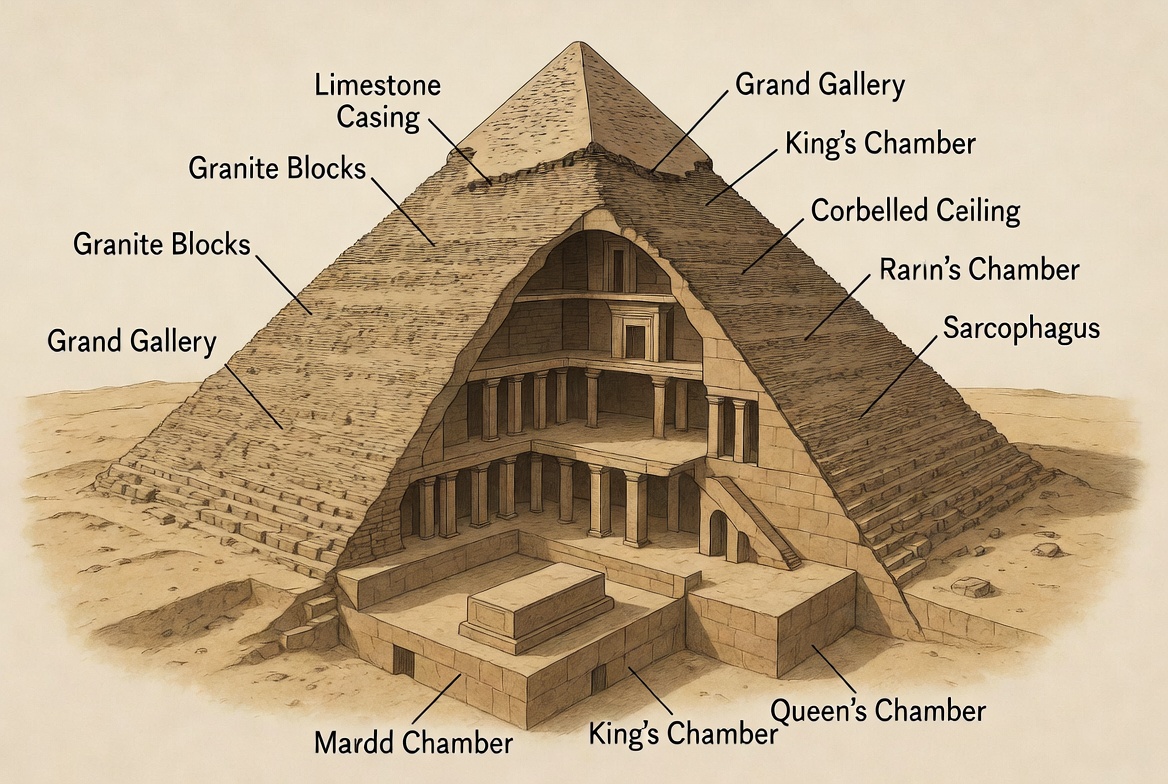
Each material plays a defined electrical role — the logic of the Giza Power Plant in one view.
When the individual clues are laid side by side, the Giza Power Plant reads like a deliberate circuit. The table below summarises how each material and feature maps onto a recognised electrical function within the proposed generator.
| Component | Material / Feature | Electrical Role |
|---|---|---|
| Outer Casing | Polished Tura Limestone | Heavy-duty insulator & sealed shell |
| Inner Walls | Dolomite | Amplifies conductivity |
| Chambers & Shafts | Granite + Quartz | Piezoelectric current generator |
| Hidden Wiring | Copper Wire | Conductive transmission medium |
| Fuel Source | Nile Hydraulics | Vibration & mechanical stress |
| Apex / Capstone | Gold-overlaid Pyramidion | Conduit to the ionosphere |
A Timeline of the Power Plant Mystery
c. 2560 BC
The Great Pyramid is completed on the Giza Plateau using 2.3 million precisely cut blocks.
1901
Tesla erects the Wardenclyffe Tower, modelled on Giza’s proportions, for wireless power.
1993
Robotic explorers reveal a deliberately sealed hidden chamber within the structure.
2011
Non-destructive scans detect copper wiring and battery-like symbols inside sealed enclosures.
Today
Satellite radar confirms the buried Nile channel — renewing the Giza Power Plant debate.
9. From Ancient Power to the Microscopic Future of Nano-Pyramids

Modern laboratories are building pyramid-shaped nanostructures to trap light and energy.
Perhaps the most striking twist in the Giza Power Plant story is unfolding not in the desert, but under the microscope. In the search for more efficient solar cells and energy-harvesting surfaces, materials scientists have discovered that the pyramid is one of the most effective shapes in nature for capturing and concentrating energy. Microscopic pyramid-shaped textures etched onto silicon dramatically reduce light reflection, trapping photons and boosting the output of modern solar panels.
These so-called nano-pyramids represent a quiet vindication of the geometry the ancients chose with such fanatical precision. Whether or not the original Giza Power Plant ever lit a single lamp, the principle that pyramidal form excels at gathering energy is now established, peer-reviewed science. The shape works. That alone forces us to ask whether the builders understood something profound about the relationship between geometry and energy.
It is humbling to consider that the future of clean energy may be shaped — quite literally — like the monument that has watched over the Giza Plateau for forty-five centuries. From the colossal stone of antiquity to the invisible lattice of a solar wafer, the pyramid endures as humanity’s most persistent symbol of harnessed power. The Giza Power Plant, real or imagined, has become a bridge spanning the oldest engineering on Earth and the newest.
The same shape that may have powered ancient Egypt is now powering tomorrow’s solar revolution.
Stand Where the Power Plant Theory Was Born
Touch the granite, climb toward the apex, and feel the mystery for yourself. Hurghada To Go takes you straight to the Giza Plateau with expert guides and seamless transfers.
10. Frequently Asked Questions
What is the Giza Power Plant theory?
The Giza Power Plant theory proposes that the Great Pyramid was engineered as a large-scale electromagnetic generator rather than a tomb. It suggests that Nile-driven vibrations triggered piezoelectric quartz in the granite, producing current that was channelled through copper wiring toward a conductive capstone and into the ionosphere.
Is there real evidence for the Giza Power Plant?
Supporters point to conductive dolomite walls, quartz-rich granite chambers, the reported copper wiring found in sealed enclosures, the perfectly insulating limestone casing, and the confirmed ancient Nile channel beside the plateau. Mainstream Egyptology, however, still regards the Great Pyramid as a royal tomb, so the Giza Power Plant remains a debated hypothesis rather than established fact.
How is Nikola Tesla connected to the pyramids?
Tesla believed the pyramids encoded a secret of wireless energy and modelled his 1901 Wardenclyffe Tower on Giza’s proportions, anchoring it deep into the water table. The parallels between his tower and the proposed Giza Power Plant are a cornerstone of the modern theory.
What are the strange sparks at the summit?
Climbers have reported static electrical discharges near the apex — small sparks around damp cloth and tingling on the skin. These physical phenomena on the summit are cited as living evidence that an electromagnetic field still lingers around the structure.
Can I visit the Great Pyramid from Hurghada?
Yes. Hurghada To Go operates day trips and private tours to Giza by flight and by road, letting you explore the pyramids, the Sphinx, and the Grand Egyptian Museum. Browse the options on our tours page.
Conclusion: The Monument That Refuses to Sleep
Forty-five centuries after its completion, the Great Pyramid still hums with questions. Whether you accept the Giza Power Plant theory in full, dismiss it as romantic speculation, or settle somewhere thoughtful in between, one truth is undeniable: the builders achieved a fusion of geometry, geology, and hydraulics so advanced that we are still reverse-engineering it today. From Tesla’s vanished tower to the nano-pyramids in our solar laboratories, the monument keeps proving that its shape and substance were chosen with a purpose far deeper than the grave.
The most powerful way to understand the Giza Power Plant debate is not to read about it — it is to stand at the base of the pyramid, lay your hand on stone that was placed with sub-degree precision, and let the silence ask its own questions. Egypt does not give up its secrets to the distant observer. It rewards the traveller who comes close.
Discover Egypt with Hurghada To Go
Walk the Giza Plateau, descend into the chambers, and feel the legend for yourself with our expert-led excursions.
Ahmed Diaa
Travel writer and researcher for Hurghada To Go, exploring the science, history, and mysteries of Ancient Egypt — from the Giza Plateau to the Red Sea.
Related Articles
CODE OF EGYPTIAN CIVILIZATION
Are the Pyramids Kings’ Tombs? The Riddle of Egypt’s Giant Edifices
CODE OF EGYPTIAN CIVILIZATION
Riddle of the Statues — The Code of Egyptian Civilization, Part 5
TOURS
Cairo Day Trip from Hurghada by Flight — Pyramids & Sphinx
✉ Join the Journey
Subscribe for more deep dives into Ancient Egypt’s greatest mysteries and exclusive tour offers.
Follow Hurghada To Go