
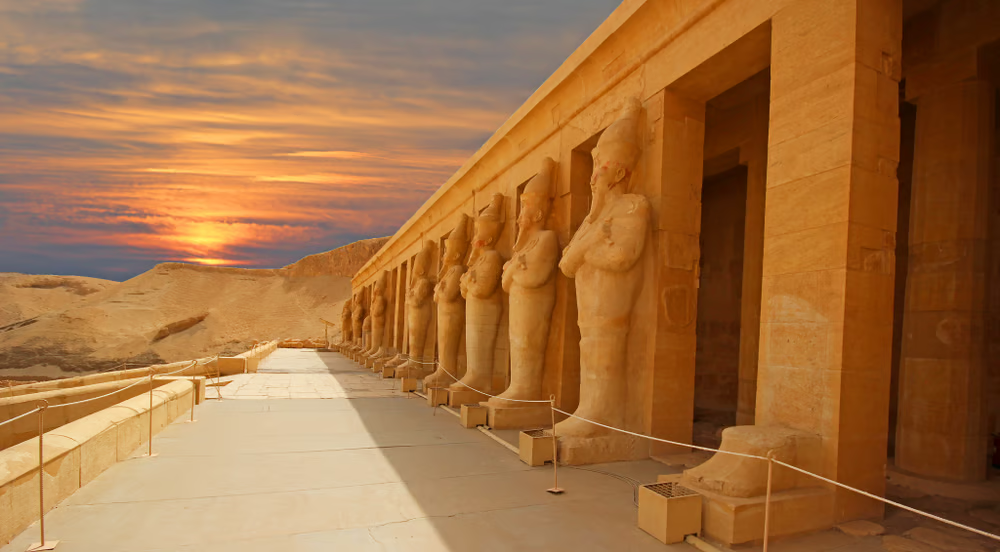
–>
S
omewhere beneath the bone-dry limestone cliffs of the Theban Hills, carved deep into the living rock by armies of skilled artisans working across five centuries, lie the eternal resting places of the most powerful rulers the ancient world ever knew. This is the Valley of the Kings Egypt — a narrow, sun-scorched gorge on the west bank of the Nile, yet one of the most astonishing places on the surface of the earth. It is a landscape of paradox: a desert that conceals galaxies, a silence that screams with stories, a gateway between mortality and eternity.
For nearly five hundred years, from approximately 1550 to 1070 BCE, every major pharaoh of Egypt’s New Kingdom was buried here. Thutmose I, Ramesses the Great, Seti I, Hatshepsut, Tutankhamun — names that echo through history with the weight of millennia — all chose this remote, guarded valley as the site of their passage from earthly power to divine eternity. Their tombs, cut deep into the cream-colored limestone, were not simply graves. They were elaborate machines for navigating the afterlife: painted from floor to ceiling with sacred texts, divine maps, protective spells, and visions of cosmic reality that rank among the greatest artistic achievements in human history.
“The Valley of the Kings does not surrender its secrets — it negotiates them, slowly, reluctantly, and on its own terms.”
Today the Valley of the Kings Egypt is a UNESCO World Heritage Site, one of Egypt’s most visited landmarks, and arguably the single most important archaeological site in the world. It has yielded more information about ancient Egyptian civilization than almost any other location. And yet, despite more than two centuries of systematic excavation, it continues to surprise. New discoveries emerge. New technology reveals hidden chambers. New readings of ancient texts overturn long-held assumptions. The valley keeps its secrets well — and reveals them only to those patient enough to listen.
This is everything you need to know about the Valley of the Kings Egypt: its dramatic origin story, its architectural genius, the most important tombs you can still visit, the workers who built it, the archaeologists who rediscovered it, and how you can stand inside its painted chambers yourself — whether you arrive from Luxor, Cairo, or as part of an unforgettable day trip from Hurghada.
The History of the Valley of the Kings: Why the Pharaohs Abandoned the Pyramids

The Problem with Pyramids
To understand why the Valley of the Kings Egypt exists, you must first understand the problem that created it. For nearly a thousand years before the New Kingdom, Egypt’s pharaohs had announced their greatness with the most conspicuous monuments ever constructed: the pyramids. The Great Pyramid of Khufu at Giza, built around 2560 BCE, remains one of the most recognized structures in human history. But as an anti-theft device, it was spectacularly unsuccessful.
Every pyramid in Egypt was robbed in antiquity. The very visibility that made them symbols of divine power also made them irresistible targets. The message carved in stone by a pyramid was, in effect: here lies a king, surrounded by unimaginable treasure. Grave robbers heard that message clearly, and they acted on it. By the time the New Kingdom began, the pharaohs of a reunified Egypt had drawn a stark conclusion: a tomb that could be found was a tomb that would be robbed. Security required invisibility.
💡 Did You Know?
The Arabic name of the Valley of the Kings — Wadi Biban al-Muluk — literally means “Valley of the Gates of the Kings.” Each tomb entrance was considered a sacred doorway between worlds.
The First Royal Burial in the Valley
After the Hyksos invaders were expelled from Egypt and the country was reunified under Ahmose I around 1550 BCE, the new Eighteenth Dynasty pharaohs established their capital at Thebes — the city we now call Luxor. When it came time to plan their eternal resting places, they chose a remote, cliff-enclosed valley on the Nile’s west bank, just behind the bay of cliffs at Deir el-Bahri.
The choice was deliberate and inspired. The valley was naturally isolated, enclosed on three sides by steep limestone cliffs that made unauthorized entry difficult. Towering above it, visible from the Theban plain below, was the natural pyramid-shaped peak of al-Qurn — known to the ancient Egyptians as Ta Dehent, meaning “The Peak.” This geological accident echoed the sacred geometry of the pyramids without actually being one, providing a cosmic connection to royal burial tradition while eliminating the visibility problem entirely.
The first royal tomb in the Valley of the Kings Egypt is generally attributed to Thutmose I, the third pharaoh of the Eighteenth Dynasty, who reigned around 1506–1493 BCE. Designed by his architect Ineni, who reportedly boasted that he oversaw the excavation “alone, no one seeing and no one hearing,” the tomb set the template for what would follow.
Five Centuries of Royal Burials — A Timeline
Ahmose I expels the Hyksos. The Eighteenth Dynasty begins. Thebes becomes Egypt’s spiritual capital.
Thutmose I commissions the first royal burial in the valley, designed by the architect Ineni in absolute secrecy.
The boy king is interred in KV62, a small tomb that will accidentally become the most famous on earth.
Ramesses II, Seti I and their successors construct the most architecturally ambitious tombs of the New Kingdom.
The Twentieth Dynasty ends. Royal mummies are secretly relocated to caches by the priests of Amun.
Howard Carter unearths the intact tomb of Tutankhamun — the archaeological event of the century.
The practice of royal burial in the valley ended around 1070 BCE with the close of the Twentieth Dynasty. Egypt was entering political fragmentation, and the elaborate tombs could no longer be properly maintained. In a remarkable act of preservation, the priests of the Twenty-First Dynasty systematically removed the royal mummies and reinterred them in two secret caches — one at Deir el-Bahri and one in the tomb of Amenhotep II — where they lay undisturbed until their rediscovery in the nineteenth century CE.
The Geography and Layout of the Valley
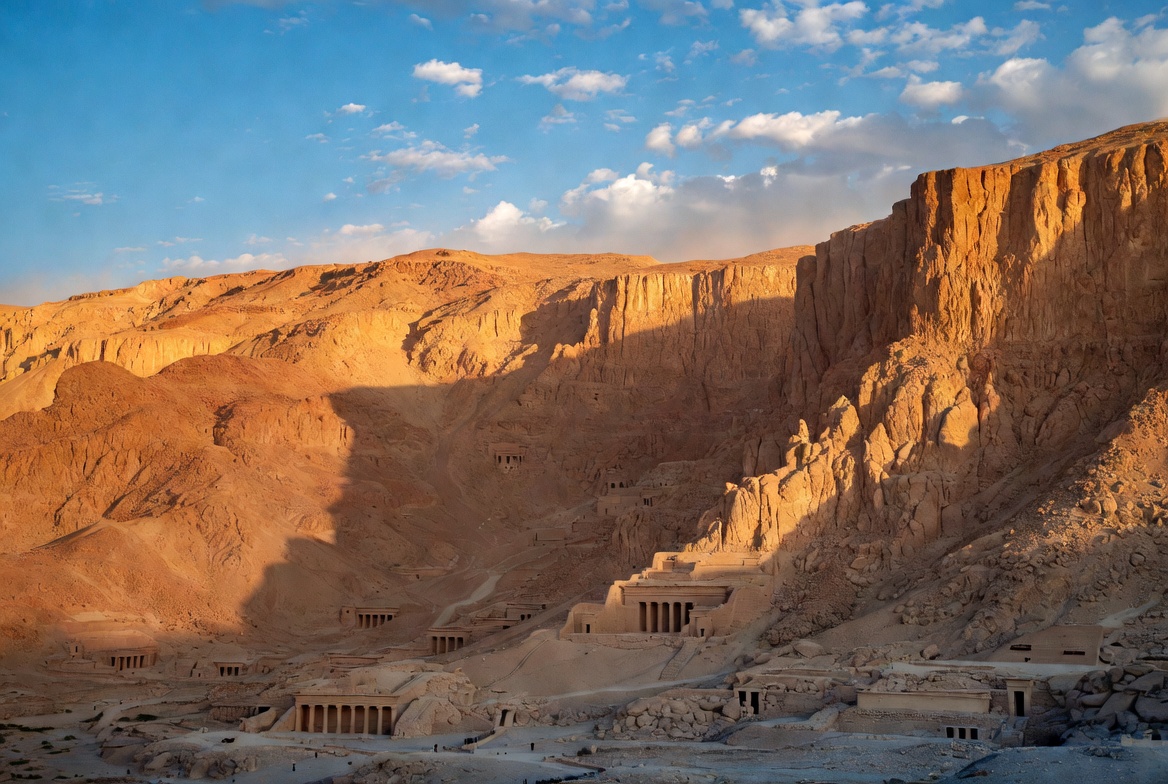
 The pyramid-shaped peak of al-Qurn watches eternally over the royal necropolis.
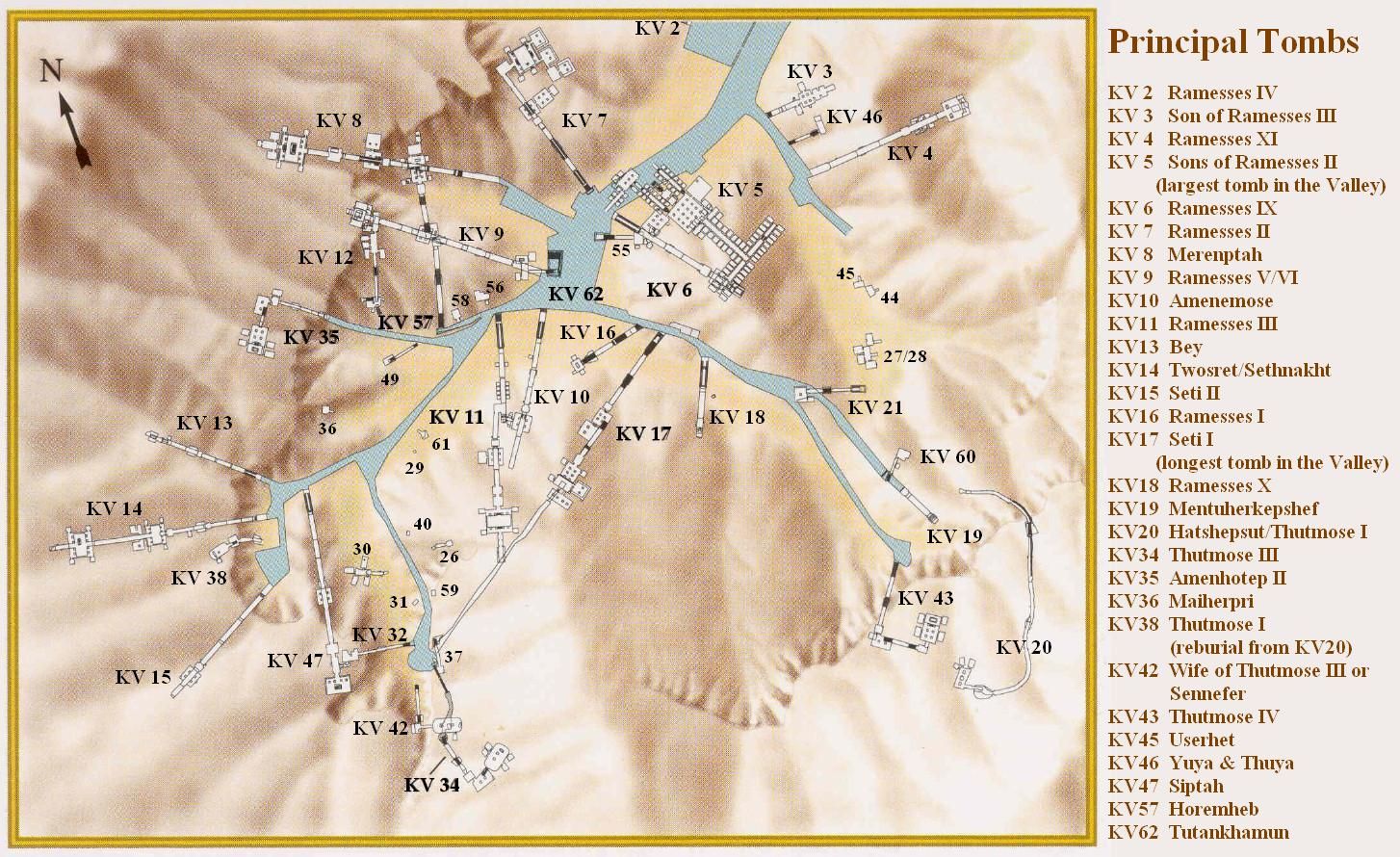
The Valley of the Kings Egypt, known in Arabic as Wadi Biban al-Muluk, occupies a dry, rocky gorge in the Theban Hills on the west bank of the Nile, approximately five kilometers from the river’s edge. The site sits at the edge of the Western Desert, in a landscape of extraordinary geological drama: pale golden cliffs rising abruptly from a flat valley floor, their surfaces carved by millennia of wind and the occasional violent flash flood.
The complex divides into two main sections. The East Valley is the principal burial ground, where the vast majority of royal tombs are situated and where visitors spend most of their time. The West Valley — sometimes called the Valley of the Monkeys — is smaller, more remote, and contains a handful of tombs including that of Amenhotep III, one of the most powerful and prosperous pharaohs of the Eighteenth Dynasty.
The geology of the valley played a significant role in shaping how tombs were built. The limestone of the Theban Hills varies considerably in quality, ranging from fine-grained, workable stone to coarse, structurally compromised rock. Layers of shale within the stone posed particular challenges: when exposed to moisture, shale expands, forcing apart the surrounding limestone and causing structural damage that conservators still struggle with today.
Quick Facts About the Valley
65 tombs and chambers, designated KV1 through KV65, with new discoveries still emerging through ground-penetrating radar.
KV5, built for the sons of Ramesses II, contains over 120 chambers — the largest tomb ever excavated in Egypt.
Approximately 1550–1070 BCE — nearly 500 years of continuous royal burial.
Designated World Heritage Site as part of “Ancient Thebes with its Necropolis” since 1979.
To date, 65 tombs and chambers have been discovered in the valley, designated by the prefix KV (for Kings’ Valley) followed by a number. These range enormously in scale and complexity, from simple undecorated pits like KV54 (a small cache deposit) to the staggeringly elaborate KV5, the tomb constructed for the sons of Ramesses II.
The Tombs: Architecture, Art, and the Science of the Afterlife

How the Tombs Were Built
The construction of a royal tomb in the Valley of the Kings Egypt was one of the great organizational achievements of the ancient world. The workforce — known in Egyptian as the weret khepesh, or “great gang” — lived in the purpose-built village of Deir el-Medina. This was a community of skilled craftsmen: stonecutters, plasterers, draftsmen, painters, sculptors — professionals who devoted their entire working lives to the construction of the royal tombs and who passed their specialized knowledge from father to son across generations.
Work on a pharaoh’s tomb typically began at or shortly after his accession to the throne. The timeline of construction was inherently uncertain: no one knew when the king would die, which meant the tomb had to be as far along as possible while still leaving flexibility for expansion. When a pharaoh died suddenly — as appears to have been the case with Tutankhamun — the existing tomb might be hastily adapted or even replaced.
Early New Kingdom tombs typically used a “bent-axis” design, with corridors that turned at sharp angles, creating a deliberate disorientation that may have had both practical (security) and symbolic (cosmic) significance. Later tombs of the Nineteenth and Twentieth Dynasties shifted to a “straight-axis” design — long, direct corridors that plunged deep into the mountain in a single unbroken line, symbolizing the direct passage of the deceased pharaoh toward eternal life.
“To enter a tomb in the Valley of the Kings is to walk into a three-dimensional religious text.”
The Sacred Art of the Tomb Walls
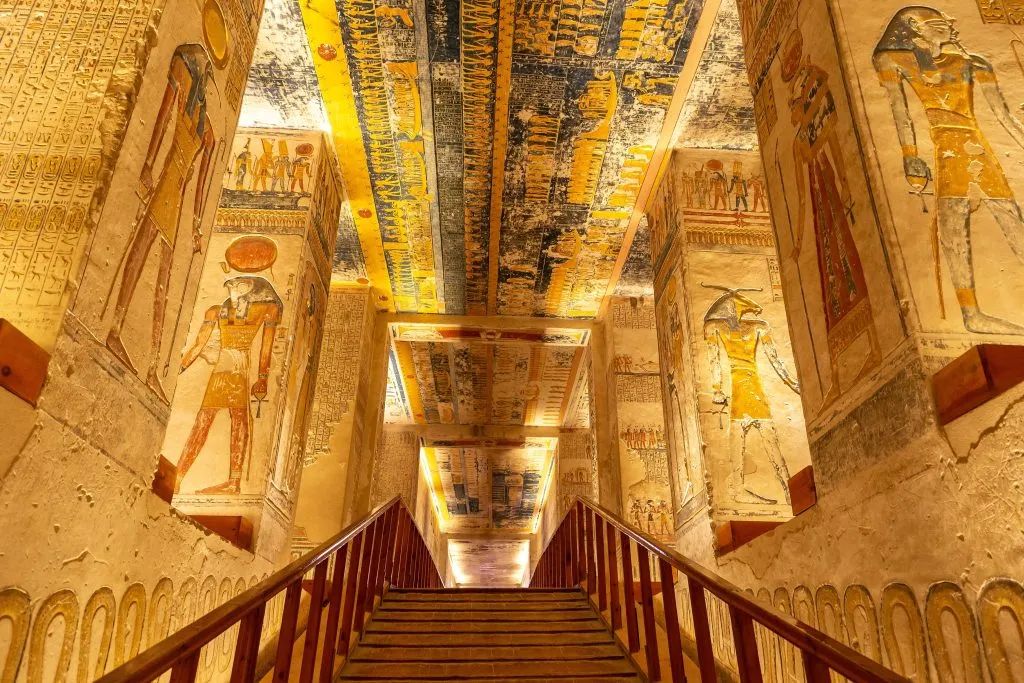
Every surface — walls, ceilings, columns, pillars, doorjambs — is covered in painted or carved imagery that served a precise theological function. These were not decorations in any ordinary sense. The ancient Egyptians believed with absolute conviction that images possessed inherent magical power: that a correctly drawn and properly consecrated image of a god, a ritual, or a mythological scene could literally cause the depicted event to occur in reality.
The deceased king, after passing through the ordeal of death, needed to travel through the Duat — the Egyptian underworld — and reach the Field of Reeds, the Egyptian paradise. This journey was perilous, filled with hostile forces, serpents, and gates guarded by terrifying demons. The tomb’s imagery was designed to equip the king for this journey and to guarantee its successful completion.
The Books of the Underworld
These texts were not read as scripture is read in modern religious contexts. They were magical instruments, painted or carved in specific locations within the tomb to activate their power at precisely the moments and in precisely the spaces where they were needed most.
The Most Important Tombs in the Valley of the Kings
 Tutankhamun’s golden mask — a moment when the ancient world re-entered the modern imagination.
KV62: The Tomb of Tutankhamun
No tomb in the Valley of the Kings Egypt — or arguably in the world — has captured the imagination of the modern era as completely as KV62, the tomb of the boy king Tutankhamun. Its discovery on November 4, 1922, by British archaeologist Howard Carter, after years of methodical searching funded by the wealthy Egyptophile Lord Carnarvon, was one of the defining events of the twentieth century.
What Carter found when he finally broke through the sealed doorway and held a candle into the darkness beyond was something no archaeologist had encountered before and may never encounter again: a royal Egyptian tomb that had escaped systematic plunder in antiquity. While the tomb showed signs of two ancient robberies, both had been detected and resealed by necropolis officials in the distant past. The bulk of Tutankhamun’s burial equipment — more than five thousand individual objects — remained virtually intact.
The treasures that emerged were extraordinary: the golden death mask, weighing eleven kilograms of solid gold; four gilded shrines nested within one another; golden furniture; alabaster vessels; royal jewelry of surpassing beauty; military equipment; board games; underwear; wine jars; the king’s favorite walking sticks. The irony of Tutankhamun’s fame is profound — he was, by the standards of the New Kingdom, a minor pharaoh. He became the most famous ruler in history purely by accident: because his tomb happened to be positioned beneath the debris thrown out during the cutting of a later tomb, which concealed it from ancient robbers and modern discovery alike.
💡 Did You Know?
Tutankhamun’s mummy remains in his tomb to this day — the only royal mummy still in place in the entire Valley of the Kings.
KV17: The Tomb of Seti I — The Most Beautiful
If Tutankhamun’s tomb is the most famous, the tomb of Seti I — KV17, also known historically as Belzoni’s Tomb — is by common consent the most beautiful. The Italian adventurer Giovanni Belzoni, who first entered it in 1817, reportedly wept when he first saw what the torchlight revealed.
At over 120 meters in length, KV17 is one of the deepest tombs in the valley. Its decorative program is the most complete and varied in the entire necropolis: every major funerary text appears here, rendered in a subtlety of color and fineness of line that has rarely been matched in any artistic tradition. The astronomical ceiling of the burial chamber is particularly extraordinary, depicting the constellations and the monthly phases of the moon with a precision that still astonishes modern viewers.
KV9: The Tomb of Ramesses VI
KV9 was originally begun for Ramesses V and usurped and greatly enlarged by his successor Ramesses VI. Its astronomical ceilings — depicting the entire journey of the sun god through the twelve hours of both day and night, framed by the body of the sky goddess Nut on either side — are among the most spectacular painted surfaces in ancient Egypt.
KV9 is also notable for another historical reason: it was directly above this tomb that the debris thrown out during its construction concealed the entrance to Tutankhamun’s tomb for three thousand years. The workers who cut Ramesses VI’s tomb inadvertently created the conditions for the greatest archaeological discovery of the modern era.
KV34: The Tomb of Thutmose III
High on the face of a cliff, accessible only by a steep metal staircase, the tomb of Thutmose III — sometimes called the “Napoleon of Ancient Egypt” for his extraordinary military campaigns — is one of the oldest and most atmospheric in the valley. The burial chamber is shaped in an unusual oval form, imitating the cartouche that enclosed a pharaoh’s name in hieroglyphs. The walls are painted in a deliberately archaic style: simple stick figures in red and black against a cream background, mimicking the appearance of a papyrus scroll rather than a formally painted temple wall.
KV57: The Tomb of Horemheb
Horemheb was the last pharaoh of the Eighteenth Dynasty, a military commander who spent his reign systematically erasing the legacy of the Amarna Period. His tomb is remarkable for showing the actual process of tomb decoration in mid-execution: some sections are complete polychrome paintings, others show figures carved in relief but not yet painted, and still others show only the preliminary sketch lines drawn by master draftsmen. Nowhere else in the valley is the sequence of artistic creation so visibly preserved.
KV5: The Tomb of the Sons of Ramesses II
Not currently open to visitors, KV5 is the tomb built for the many sons of Ramesses the Great. Re-excavated beginning in 1995 by Egyptologist Kent Weeks, it was discovered to be a vast, rambling complex containing more than 120 rooms — making it the largest tomb ever found in Egypt. Its full extent has still not been completely mapped.
The Workers Who Built the Valley: Deir el-Medina

Any complete account of the Valley of the Kings Egypt must acknowledge the people who created it: the skilled craftsmen of Deir el-Medina, the village built specifically to house the workers of the royal necropolis. This community gives us an extraordinarily intimate picture of daily life in New Kingdom Egypt.
The workers of Deir el-Medina were not slaves. They were paid professionals — stonecutters, painters, sculptors, scribes — who received their wages in grain, fish, vegetables, pottery, clothing, and other commodities. They lived with their families in a structured village, worshipped their own local gods, maintained their own courts of justice, and left behind a remarkable archive of written documents on pottery fragments (ostraca) that record everything from work rosters and wage disputes to love poems and satirical illustrations.
“The hands that painted eternity also wrote love poems on broken pottery.”
They also built tombs for themselves: the hillside above Deir el-Medina is dotted with small, exquisitely decorated tombs belonging to the craftsmen who spent their lives creating the great royal burials. Some of these tombs, particularly those of Sennefer and Nakht, contain paintings of everyday life — farming, feasting, hunting, music, and family scenes — that provide a warm, human counterpoint to the cosmic grandeur of the royal tombs nearby.
The Discovery of the Valley: Archaeology and Treasure Hunting
 Two centuries of excavation — and the valley still surprises us.
Ancient travelers already knew the valley. Greek and Roman visitors explored it — graffiti in ancient Greek and Latin still survives on some tomb walls — and the Roman geographer Strabo reported that around 40 tombs were accessible in his time. But after the fall of Rome and the Christianization of Egypt, the valley fell out of the consciousness of the wider world.
Systematic European exploration began in the eighteenth century, with the Jesuit priest Claude Sicard identifying the site as the royal necropolis of Thebes in 1708. The early nineteenth century brought a wave of ambitious and sometimes destructive excavators: Giovanni Belzoni, working for the British consul Henry Salt, discovered multiple major tombs between 1815 and 1822, including those of Seti I and Ramesses I.
By 1914, most Egyptologists believed the valley had yielded all its secrets. Howard Carter disagreed, and his disagreement changed history. Carter’s 1922 discovery of KV62 sparked worldwide Egyptomania, inspired a generation of archaeologists, and demonstrated conclusively that extraordinary discoveries still awaited the patient, methodical excavator. In 2005, the discovery of KV63 — a mummification cache containing sarcophagi, pottery, natron, and linen — proved again that the valley had more to reveal.
Practical Information: How to Visit the Valley of the Kings
 The visitor entrance to one of humanity’s most sacred archaeological landscapes.
📍 Location
The Valley of the Kings Egypt lies on the west bank of the Nile River, approximately five kilometers from central Luxor. It is part of the broader Theban Necropolis, which also includes the Temple of Hatshepsut (Deir el-Bahri), the Valley of the Queens, the Tombs of the Nobles, the Colossi of Memnon, and the Ramesseum.
🚐 Getting There
From Luxor: The most common approach is by taxi or organized tour. Cross the Nile by local ferry and proceed by taxi or minibus to the site. The journey takes approximately 20–30 minutes from central Luxor.
From Hurghada: The Valley of the Kings is one of the most popular day trips from Hurghada on the Red Sea. Tour operators run regular excursions that typically include transport by air-conditioned bus through the Eastern Desert, a professional Egyptologist guide, visits to the valley (with the option to see Tutankhamun’s tomb), and additional stops at Karnak Temple and the Temple of Hatshepsut. The full journey is a long day — 14 to 16 hours — but enormously rewarding. Browse our curated Luxor day tours from Hurghada for tested itineraries.
From Cairo: Direct flights connect Cairo to Luxor in about an hour, making a day trip feasible. Some operators offer overnight excursions that allow more thorough exploration.
By Nile Cruise: Nile cruise itineraries between Luxor and Aswan invariably include a stop at the Valley of the Kings Egypt. Passengers are transferred from their ships to the site and back, usually with a professional guide.
🎟 Tickets and Entrance Fees (2025–2026)
(Prices listed are approximate and subject to change — please verify locally before travel. We do not guarantee fees as they are set by Egyptian antiquities authorities.)
🕘 Opening Hours
The Valley of the Kings is generally open from 6:00 AM to 5:00 PM daily. Hours may vary during Ramadan and on public holidays, and specific opening times for individual tombs rotate periodically to allow conservation work. Arriving early — ideally at opening time — is strongly recommended: the light is better, the temperature is cooler, and the crowds are thinner.
⭐ Which Tombs Should You Visit?
- KV9 (Ramesses V/VI): Spectacular astronomical ceilings — absolutely worth the additional ticket.
- KV11 (Ramesses III): Large, free-access, exceptional “Hall of Beauties” side chambers.
- KV35 (Amenhotep II): Site of one of the great royal mummy caches; original ceiling decoration intact.
- KV2 (Ramesses IV): Well-lit, accessible — contains the only complete Book of Nut in the valley.
- KV62 (Tutankhamun): Modest in scale, unmatched in historical significance.
Essential Tips for Visiting the Valley of the Kings

The Valley of the Kings rewards deep knowledge. An expert Egyptologist guide will explain iconographic programs, identify scenes from the funerary books, and bring the ancient world to life in ways that no audio tour can replicate.
Despite modern lighting installations, corners and upper wall sections can be poorly illuminated. Additional light reveals details — particularly in painted ceilings — that are easily missed.
Rushing through the Valley of the Kings is one of the great travel mistakes. The site demands unhurried engagement. Spend time in each tomb. Look at the ceiling as well as the walls.
The combination of heat (temperatures can exceed 40°C in summer), crowds (over a million visitors annually), and physical exertion makes an early start essential.
The walk between the visitors’ center and the tomb entrances is exposed and shadeless. A hat, sunscreen, and a generous water supply are necessities, not luxuries.
Tomb interiors involve uneven surfaces, sloping ramps, steps, and occasionally low doorways. Sandals are not advisable.
Policies vary and update periodically. Some tombs permit phone photography without flash; others restrict all photography. Always follow signage — violations risk removal and fines.
🏺 Ready to Walk in the Footsteps of Pharaohs?
Let our certified Egyptologist guides bring the Valley of the Kings Egypt to life on a private or small-group day tour from Hurghada, Luxor, or Cairo.
Conservation Challenges: Protecting the Valley for the Future

The very success of the Valley of the Kings Egypt as a tourist destination poses its greatest threat. More than a million visitors annually bring with them something the ancient tomb builders never anticipated: humidity. Every human body in an enclosed space releases approximately 2.8 grams of moisture per visit, and the cumulative effect of millions of bodies in sealed chambers, over decades of mass tourism, has caused measurable damage to the salt-crystal structures underlying many tomb walls, leading to the flaking and deterioration of painted surfaces that survived three thousand years with minimal damage.
Authorities have responded with rotating tomb closures, strict visitor limits in the most fragile chambers, improved ventilation systems, and the development of replica tombs designed to serve high-volume visitor demand. A full-scale replica of Tutankhamun’s tomb, built near Luxor, allows visitors to experience its layout without contributing to environmental stress on the original.
Flash flooding, a perennial hazard since antiquity, continues to pose structural threats despite modern drainage improvements. The 2020 floods that affected the Luxor area served as a reminder that geology and climate are forces no engineering solution can entirely neutralize.
The Valley of the Kings and the Egyptian Concept of the Afterlife

No understanding of the Valley of the Kings Egypt is complete without some grasp of the religious framework that made it necessary. Ancient Egyptian belief about death was not a simple or static doctrine — it evolved over three thousand years — but certain core convictions remained consistent throughout the New Kingdom period.
The ancient Egyptians did not believe that death was an end. They believed it was a transformation: a dangerous, demanding transition from one form of existence to another. The deceased had to navigate the underworld, face judgment before the tribunal of the gods (with the heart weighed against the feather of Ma’at, the goddess of truth and justice), and successfully reach the Field of Reeds — an idealized continuation of earthly life, complete with crops, animals, family, and all the pleasures of the physical world.
“The Egyptians did not see death as an ending. They saw it as a doorway — and they spent lifetimes preparing the key.”
For a pharaoh, the afterlife held additional dimensions. The king was expected not merely to survive death personally but to be transformed into a divine being, joining the company of the gods and continuing to act for the benefit of Egypt in the cosmic realm. His tomb was the mechanism of this transformation: through prayers, images, and sacred texts, the dead king was equipped with everything he needed to make this journey and succeed in it.
The mummy — the preserved physical body — was essential to this theology. The Egyptians believed that the soul (ka and ba) required a physical home to return to, and that without a recognizable body, the deceased could not be reanimated. The seventy-day mummification process, the canopic jars containing preserved organs, the protective amulets placed throughout the wrappings — these were not superstition. They were the expression of a deeply coherent belief system about the nature of personhood, the structure of reality, and the relationship between the living and the dead.
Why the Valley of the Kings Remains Essential

The Valley of the Kings Egypt is not, in the end, simply a collection of impressively decorated underground rooms. It is the physical expression of a civilization’s deepest beliefs about what it means to be human, what death means, and what lies beyond it. It represents the concentrated effort of an entire culture — its artists, its theologians, its engineers, its priests, and its rulers — to answer the hardest question any human being has ever faced.
Standing in the burial chamber of Ramesses VI and looking up at the astronomical ceiling, with Nut stretching across the heavens and the sun making its eternal journey through the night, you are looking at an image that was placed there specifically to ensure that a dead king, more than three thousand years ago, would be able to navigate from one form of existence into another. Whether or not you share those beliefs, the seriousness and beauty with which they were expressed is enough to stop your breath.
The Valley of the Kings Egypt is one of the places where you feel most directly the weight and depth of human time — the extraordinary fact that people have been thinking about death and transcendence and the meaning of existence for thousands of years before us, and that some of them carved their answers, in paint and stone, deep into a limestone mountain on the edge of the Western Desert, where they have waited, patient and magnificent, for us to come and read them.
❓ Frequently Asked Questions

How many tombs can you visit in the Valley of the Kings?
The general entrance ticket includes access to three tombs from those currently open for visitors. Special-ticket tombs — like Tutankhamun (KV62), Ramesses VI (KV9), and Seti I (KV17) when open — require additional paid tickets.
Is Tutankhamun’s mummy still in the tomb?
Yes. Tutankhamun’s mummy remains in KV62 to this day, displayed in a climate-controlled glass case — making him the only royal mummy still resting in his original tomb in the entire Valley of the Kings Egypt.
Can I take photos inside the tombs?
Photography rules vary by tomb and update periodically. Some tombs allow phone photography without flash; others prohibit photography entirely. Photo permits or special tickets may be required. Always follow signage and staff instructions — violations can result in removal and fines.
How do I visit the Valley of the Kings from Hurghada?
The most comfortable way is via a guided Luxor day tour from Hurghada with air-conditioned transport, an Egyptologist guide, and combined visits to Karnak Temple and the Temple of Hatshepsut. Expect a 14–16 hour day.
What is the best time of year to visit?
October through April offers the most comfortable temperatures. Summer visits (May–September) are extremely hot — over 40°C is common — and require very early morning starts.
Are new tombs still being discovered?
Yes. KV63 was discovered in 2005, and ongoing ground-penetrating radar surveys continue to suggest undiscovered features beneath the valley floor. The Valley of the Kings Egypt still keeps secrets.
Is the Valley of the Kings worth visiting?
Without question. It is widely regarded as one of the most extraordinary archaeological sites on earth and a UNESCO World Heritage landmark. For lovers of art, history, religion, or human achievement, it is essential.
Final Thoughts: Your Journey Awaits
The Valley of the Kings Egypt is not a relic. It is a living conversation between ancient minds and modern visitors — a place where pigment still glows after three millennia, where stone still breathes the prayers of a vanished priesthood, where you can stand a few meters from a king who ruled the Nile when Stonehenge was new.
If there is one journey to take in your lifetime, let it be this one. And let us help you take it the right way: with knowledgeable guides, comfortable transport, flexible itineraries, and the kind of authentic local insight only a Hurghada-based travel team can provide.
⚱ Discover the Valley of the Kings Egypt with Hurghada To Go
Private guides · Air-conditioned transfers · Tutankhamun & Karnak combos · All-inclusive tours from Hurghada, Luxor & Cairo.
📣 Share & Follow Us
Follow Hurghada To Go for premium Egypt travel guides:
📨 Join Our Egypt Travel Insider List
Get exclusive itineraries, tomb-opening updates, and seasonal discounts straight to your inbox.
📚 Related Articles
Visit the Valley of the Kings, Karnak Temple & Hatshepsut on a single, expertly guided day.
Sail the river of pharaohs from Luxor to Aswan with all-inclusive luxury onboard.
The Grand Egyptian Museum, the Pyramids of Giza, and the Sphinx in a single day.
Dive deeper into Egyptian gods, sacred temples, and lost dynasties on our expert blog.