
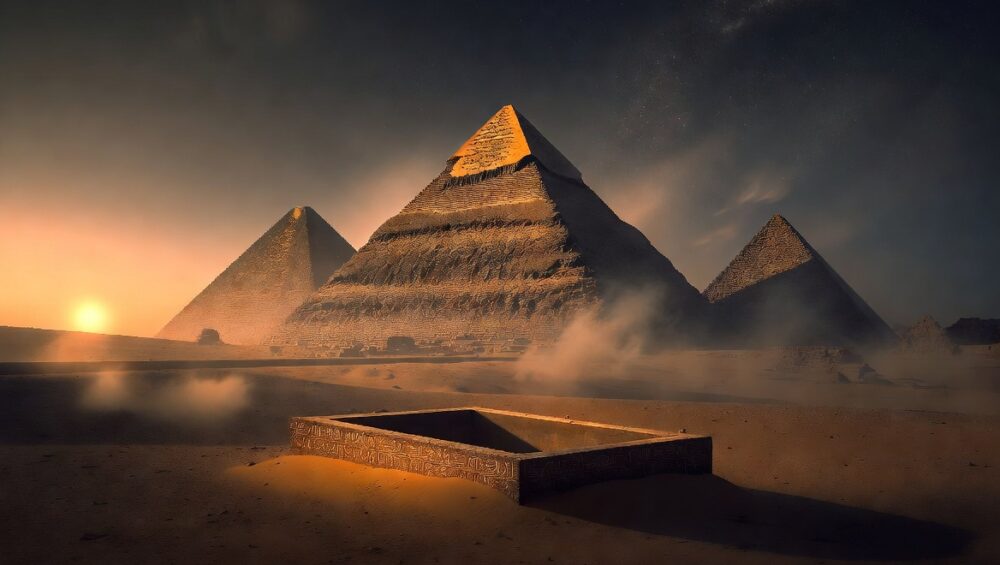
The Code of Egyptian Civilization — Part 7
Are the Pyramids Kings’ Tombs? The Riddle of Egypt’s Giant Edifices
When stones speak and tombs fall silent — an exciting confrontation between absent texts and academic narratives.
The Riddle of Egypt’s Giant Edifices
It was no coincidence, no royal whim, and no fleeting impulse that drove the ancient Egyptians to drag millions of stones — some hauled across distances of nearly 1,000 kilometers — into the heart of the desert to raise these colossal monuments. Behind such an enormous undertaking, there must have existed a motive far greater than mere burial. So we ask, again and again: Are the Pyramids Kings’ Tombs?
Today, archaeological consensus insists that the pyramids served as royal tombs, structures built to assist the pharaoh’s soul on its celestial ascent toward Ra. Yet despite the popularity of this narrative, dozens of pressing questions remain unanswered. Where are the mummies? Why are the largest pyramids absolutely silent — bare of inscription, devoid of name, empty of decoration? When we lay the evidence on the table, the question becomes impossible to ignore: Are the Pyramids Kings’ Tombs, or have we been reading the wrong story for two thousand years?
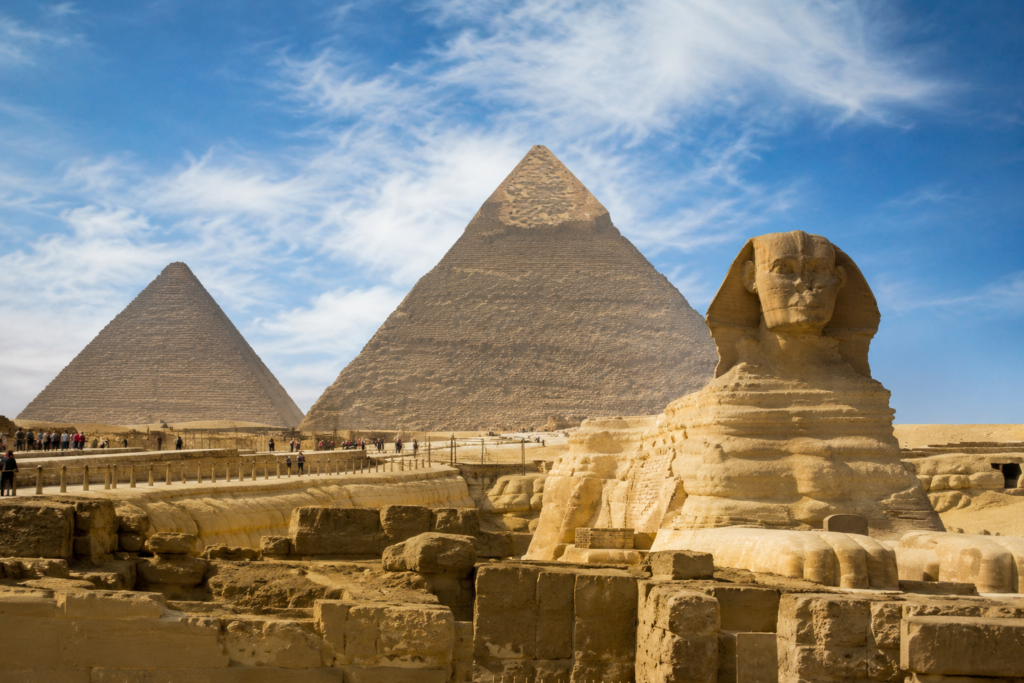 The pyramids of Giza stand silent — their stones holding answers we have yet to ask the right questions of.
“
If a pyramid was truly a tomb, why does the largest funerary monument in human history not bear a single funerary inscription?
Missing Core Features of Royal Tombs

An authentic ancient Egyptian royal tomb should display three unmistakable characteristics. First, the deceased’s name should appear repeatedly in prominent locations, alongside funerary texts, prayers, and ceremonial decorations. Second, the tomb should contain a mummy — or the recognizable remains of one. Third, the architectural plan should accommodate funeral processions, priestly rituals, and the dignified passage of the royal body.
When we apply these three criteria to the great pyramids, the result is staggering. The six largest pyramids in Egypt — the three at Giza, the two at Dahshur, and the one at Meidum — are completely devoid of any inscription, drawing, or hieroglyphic decoration. Even the satellite pyramids of the queens and princesses at Giza follow the same silent pattern. Out of more than 120 known pyramids, only nine small Sixth Dynasty examples bear inscriptions. So we must ask once more: Are the Pyramids Kings’ Tombs, or something else entirely?
Refuting the “Writing Hadn’t Developed” Excuse
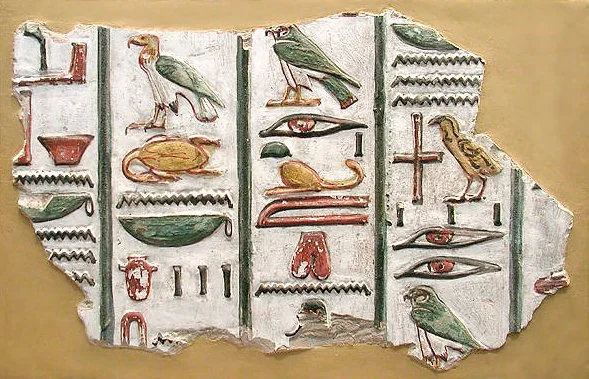 Hieroglyphic mastery existed centuries before the great pyramids — making their silence even more puzzling.
Some scholars attempt to explain the conspicuous silence of the great pyramids by claiming that Egyptian writing simply hadn’t evolved enough during the Third and Fourth Dynasties — only developing later, in the Sixth Dynasty. This explanation, however, collapses under the weight of historical evidence.
Archaeology preserves stunning examples of mature, sophisticated writing that predate or coincide with the pyramid age:
- The Hesy Ra Panel — magnificent Third Dynasty wooden carvings of a royal dentist, displayed today in the Egyptian Museum.
- Fourth Dynasty tomb scenes — painted, carved, and colored wall reliefs now housed in the Louvre Museum.
- The Narmer Palette — one of the earliest historical documents on Earth, displaying refined symbolic and narrative engraving.
These artifacts prove beyond doubt that the pyramid builders possessed full mastery of writing, engraving, and painting. So why did they not inscribe a single word inside their grandest monuments? The only logical explanation is that the original architects had no intention of placing funerary text inside them — because these structures were never meant to function as funerary chambers in the first place. Yet again the question echoes: Are the Pyramids Kings’ Tombs?
The Missing Mummies Mystery
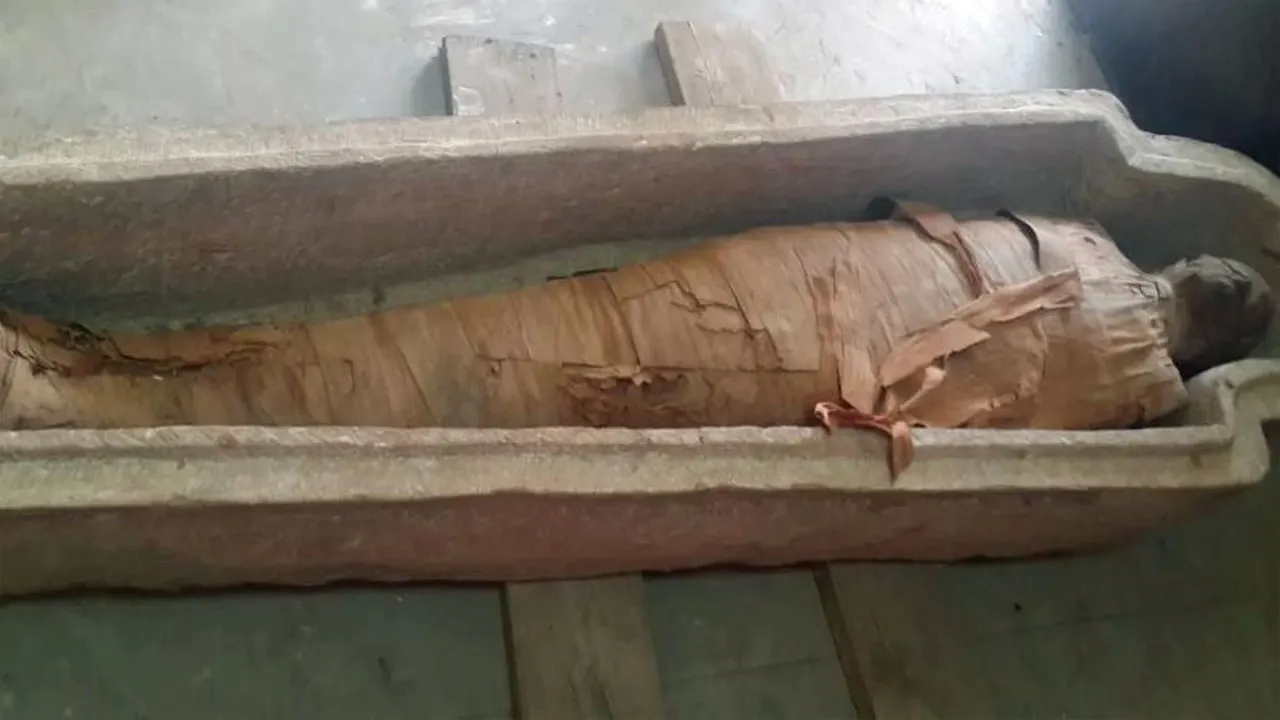 Empty sarcophagi, missing mummies — an archaeological pattern that defies the “tomb” explanation.
If pyramids were built to be tombs, logic demands that we should find royal mummies inside them. Yet renowned Egyptologist Dr. Mark Lehner has confirmed — with the full weight of field evidence — that of more than 120 pyramids excavated across Egypt, not a single original mummy belonging to the king for whom the pyramid was named has ever been recovered.
A Pattern Across the Pyramid Age
Pyramid of Menkaure
Howard Vyse’s 19th-century expedition uncovered remains dating to the 26th Dynasty — nearly 2,000 years after Menkaure’s reign. The chamber had clearly been reused.
Pyramid of Khafre
Giovanni Belzoni found bones inside — but they belonged to a bull, not a king.
The Great Pyramid of Khufu
Records from Caliph Al-Ma’mun’s 9th-century expedition describe multiple bodies and decayed shrouds — clearly late, communal reuse, not original royal burial.
Step Pyramid of Djoser
Only fragmentary arm and leg bones were found, plus 60 Ptolemaic mummies and a Yemeni trader’s wooden coffin in lower passages — all from much later periods.
Pyramid of Merenre
The mummy displayed in the Imhotep Museum was dated by Elliot Smith to the 18th Dynasty — not the Old Kingdom at all.
The convenient response — that all original mummies were stolen during periods of chaos — only deepens the contradiction. If preserving the king’s body for eternity was the entire purpose, then the pyramids represent the most spectacular failure in human architectural history. Are the Pyramids Kings’ Tombs? The bones don’t lie.
The Empty Sarcophagus of Sekhemkhet

In the 1950s, archaeologist Zakaria Goneim spent more than two grueling years excavating the unfinished pyramid of Sekhemkhet at Saqqara. Deep within the structure, he discovered something unprecedented: a perfectly intact, sealed alabaster sarcophagus that had clearly never been opened since the day it was placed.
Anticipation built. Officials gathered. Cameras rolled. For the first time in modern archaeology, the world believed it would witness an undisturbed royal mummy resting inside a pyramid.
The sarcophagus was opened slowly, ceremoniously… and it was completely empty.
“No tomb robber would reseal an alabaster lid perfectly after stealing a body. The implications are unavoidable.” — Zakaria Goneim, The Buried Pyramid
Goneim himself dismissed the theft theory entirely. The seal was original. The sarcophagus had never housed a king. He documented the entire experience in his book The Buried Pyramid, leaving the world with a haunting question: where, then, did the king’s body go — and was it ever there in the first place?
Why Did Sneferu Build Three Pyramids?

Pharaoh Sneferu is credited with the construction of three giant pyramids: the Meidum Pyramid, the Bent Pyramid, and the Red Pyramid. The traditional narrative struggles enormously with this fact, dismissing two of them as “failed experiments” — an explanation that strains belief considering the staggering resources, manpower, and planning involved in each one.
The Meidum Mystery
Started by Huni and finished by Sneferu, the Meidum Pyramid had reached an advanced state of completion — including its outer casing and a fully-built funerary temple. Then, inexplicably, Sneferu abandoned it and shifted his entire workforce to Dahshur. Neither king was buried there. No name was ever inscribed inside.
The Bent Pyramid Reconsidered
For decades, the Bent Pyramid’s sudden change of angle was explained as either structural panic or a desperate rush. But Italian architects Maragioglio and Rinaldi — along with multiple later engineering committees, both Egyptian and international — discovered the pyramid is structurally sound, with no signs of imminent collapse. Even more telling, its outer casing and surrounding temples were fully completed, suggesting the bent shape was deliberate from the start.
If it had truly been a failure, the logical, economically rational decision would have been to dismantle its enormous quantity of dressed stone for reuse in the next project. That never happened. The stones were left in place, deliberately preserved — another inconsistency that fractures the simple “tomb” narrative.
| Pyramid | Attributed King | Inscriptions | Original Mummy |
|---|---|---|---|
| Great Pyramid | Khufu | None | None Found |
| Khafre’s Pyramid | Khafre | None | Bull bones only |
| Menkaure | Menkaure | None | 26th Dynasty remains |
| Bent Pyramid | Sneferu | None | None Found |
| Red Pyramid | Sneferu | None | None Found |
| Meidum | Huni / Sneferu | None | None Found |
Engineering Contradictions That Defy Burial Logic

Imagine a funeral procession for a god-king of Egypt. Imagine priests in linen, courtiers chanting, the sacred body carried on a gilded bier. Now imagine forcing that procession through an entrance set 28 meters high in the side of a stone mountain, then squeezing it through passages just one meter by one meter, requiring participants to bend or crawl for hundreds of meters. It is impossible. It is undignified. It is the opposite of what royal funerary architecture must be.
The internal design of pyramids like the Red Pyramid simply does not accommodate the rituals required for a royal burial. There are no decorated chambers, no sarcophagi with names, no funerary objects matching the supposed occupant. Dr. Ahmed Fakhry, who excavated extensively at Dahshur, officially concluded that no evidence exists indicating the Red Pyramid was used as a royal burial place.
📍 Stand Before the Pyramids Yourself
Touch the stones. Walk the silent corridors. Feel the riddle for yourself.
The Sphinx Water Erosion Hypothesis: A Balanced Investigation

Standing eternal beside the pyramids, the Great Sphinx — with its lion’s body and likely recarved human face — is conventionally dated to around 2500 BCE during the reign of Khafre. But a controversial alternative theory, the Sphinx water erosion hypothesis, has shaken this date to its foundations.
The Hypothesis
Geologist Robert M. Schoch of Boston University, supported by author John Anthony West, examined the Sphinx in 1990. He observed that the erosion patterns on the Sphinx’s body and especially its enclosure walls show vertical, undulating, rounded fissures — the unmistakable signature of prolonged heavy rainfall and runoff, not wind and sand. Other Old Kingdom monuments at Giza show primarily horizontal wind erosion, making the Sphinx anomalously different.
If rainfall caused the erosion, the Sphinx must predate the arid Sahara — pushing its origin back to the African Humid Period, somewhere between 5,000 and 10,000 BCE, perhaps even further. Seismic readings of subsurface weathering depths reportedly support a far older excavation.
The Counterarguments
Mainstream Egyptologists and many geologists — including James Harrell, Lal Gauri, Mark Lehner, and Zahi Hawass — reject the hypothesis. They point to the Sphinx’s seamless integration into Khafre’s causeway and temple complex. Limestone blocks quarried from the Sphinx enclosure were used to build the adjacent Sphinx Temple, dating both to the Fourth Dynasty.
Alternative erosion mechanisms also exist: haloclasty (salt crystallization from groundwater and capillary action), Nile flood saturation of sand cover, and intense rainfall events that continued sporadically into the Old Kingdom. The lower elevation of the Sphinx enclosure made it uniquely vulnerable to wetting and salt damage compared to higher Old Kingdom tombs.
“The Sphinx continues to guard its secrets, fueling both rigorous scholarship and alternative inquiry.”
The water erosion hypothesis remains controversial and outside mainstream consensus as of 2026. However, it forces a healthy reconsideration of timelines and climate impacts. Whether the Sphinx is 4,500 or 12,000 years old, one truth remains: it does not give up its mysteries easily.
A Civilization That Built for the Living, Not Just the Dead

Throughout recorded history, civilizations have invested staggering resources in projects serving collective benefit — defense like the Great Wall of China, infrastructure like Roman aqueducts, irrigation systems, fortresses, and granaries. The idea that an entire ancient state mobilized millions of laborers for decades or centuries solely to construct a single, highly visible burial monument — one that practically advertised its valuable contents to thieves — conflicts with every economic and strategic principle we observe across human history.
So the question demands a final, honest answer. Are the Pyramids Kings’ Tombs? The mounting archaeological, engineering, geological, and historical evidence suggests that they may have served a far greater, more practical, more profound original purpose — one that we are only now beginning to glimpse through the cracks in the traditional narrative. The stones speak. We must learn how to listen.
Frequently Asked Questions
Are the Pyramids Kings’ Tombs according to recent evidence?
While mainstream Egyptology still maintains the funerary theory, the absence of original mummies, funerary inscriptions, and burial-suitable architecture in the largest pyramids has prompted serious re-examination among researchers worldwide.
Has any original royal mummy ever been found inside a pyramid?
No. Across more than 120 pyramids excavated in Egypt, not one original mummy belonging to the king for whom the pyramid was named has been recovered — only later remains and reused chambers.
Why did King Sneferu build three giant pyramids?
Traditional theory labels two of them as failed experiments, but engineering studies show all three are structurally sound and architecturally complete — suggesting the “multiple tombs for one king” explanation is insufficient.
What is the Sphinx water erosion hypothesis?
It is the geological theory proposed by Robert Schoch arguing that vertical erosion patterns on the Sphinx and its enclosure indicate exposure to heavy rainfall, suggesting a much older origin — possibly 5,000–10,000 BCE.
Can I visit the pyramids and Sphinx with Hurghada To Go?
Yes! We offer day trips, overnight tours, and guided pyramid excursions from Hurghada, Cairo, and other major destinations. Visit our tours page for full details.
Continue the Journey
Cairo Day Trips from Hurghada
Stand before the Pyramids of Giza and the Grand Egyptian Museum on a one-day adventure.
Luxor Full Day Tours
Walk the Valley of the Kings and witness Karnak Temple at sunrise.
Final Reflections: The Stones Are Still Speaking
For more than two centuries, the answer to “Are the Pyramids Kings’ Tombs?” has been delivered with confidence. But confidence is not evidence. The greatest pyramids contain no inscriptions. They contain no original mummies. Their interiors defy every requirement of a royal funeral. Their builders mastered writing yet refused to use it. Their kings built three pyramids each. And one sealed sarcophagus, opened after 4,500 years, was completely empty.
The pyramids guard a secret far older, far stranger, and far more wonderful than any single king’s burial. The stones are still speaking. Will you come and listen?
✉ Subscribe to the Series
Get every new article from The Code of Egyptian Civilization delivered straight to your inbox.