
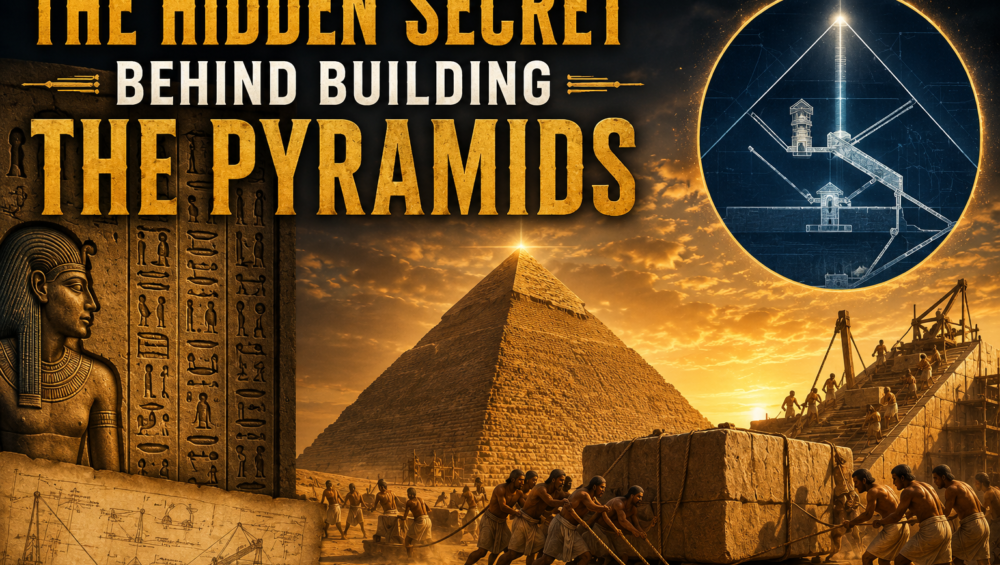
Code of Egyptian Civilization · Part Nine
The Hidden Secret Behind Building the Pyramids: The Chemical Hydrogen Reactor
Inside the Great Pyramid, an ancient machine awakens — salt-encrusted walls, copper electrodes, and the chemistry of an impossible civilization.
✍ By Ahmed Diaa
📅 Updated May 2026
From Acoustic Engineering to Chemical Alchemy
The hidden secret behind building the pyramids is no longer the quiet murmur of fringe theorists — it has become a serious investigation drawing in chemists, acoustic engineers, robotics specialists, and Egyptologists alike. In the previous chapter of our series, we dismantled the “tomb theory” piece by piece, demonstrating how the Great Pyramid behaves less like a mausoleum and more like a living, breathing machine. We traced the journey from acoustic resonance inside the King’s Chamber to engineer John Cadman’s practical hydraulic model, which proved that the Subterranean Chamber and its 100-meter shaft acted as a colossal pulse generator deep beneath the structure.
Now we descend further into the labyrinth. Today we leave the realm of pure mechanics and enter something far stranger: the chemical reactor hidden at the heart of the Great Pyramid. If the Subterranean Chamber was the engine, then the Queen’s Chamber and its narrow shafts hold the breathtaking chemical code — the formula for producing the gaseous fuel that once powered the entire system. This is the most secretive layer of the hidden secret behind building the pyramids, and the part where reality begins to feel like science fiction.
“
The pyramid was never silent. It hummed. It pulsed. It breathed hydrogen the way a furnace breathes flame.
Mechanism of the Passages and the Hydraulic System
Engineering analysis of the Great Pyramid’s internal passages reveals an obsession with precision that defies any funerary explanation. The corridors were carved straight as a surveyor’s line, polished smooth, and extended for unusually long distances. Why? Because they were not meant for priests, mourners, or pharaohs — they were designed to allow water to flow at high velocity over long distances, with no obstruction and minimal friction.
A winding or rough-walled passage would have absorbed pressure before it ever reached the chamber ceiling. The system mirrors modern industrial water pipelines, which are engineered perfectly straight to prevent pressure loss. Their narrow dimensions — barely wide enough to crawl through — reveal the truth: these were never funeral corridors. They were fluid conduits. This functional design choice forms one of the most undeniable elements of the hidden secret behind building the pyramids.

The Interlocking Stones and Vibration Resistance
To understand why the architects engineered such an exhausting floor system, we must connect the seismic dots. Above the rocky plateau, the floor was paved in two layers using an engineering technique known as “interlocking bricks.” The stones lock into one another like gears in a cathedral mechanism, granting the structure remarkable resistance to vertical shock loads.
In this case, those vertical loads were not the random tremors of an earthquake — they were the deliberate recoil pulses originating in the Subterranean Chamber. Thanks to this interlocking design, the vibrations traveled upward through the body of the pyramid, channeled with intent, and arrived inside the King’s Chamber as a focused, rhythmic energy. This single architectural detail spotlights the dynamic dimension of the hidden secret behind building the pyramids.
The interlocking-stone technique used at Giza pre-dates by thousands of years a similar method now used in modern earthquake-resistant skyscrapers in Tokyo and San Francisco. The ancient architects of Egypt anticipated structural seismic engineering long before the word “seismic” existed.
The Mystery of the Queen’s Chamber and the Salt Deposits
In the mid-19th century, the Scottish astronomer Piazzi Smyth pushed his lantern into the Queen’s Chamber and documented something extraordinary in his journal. The air carried a sharp, suffocating odor so unbearable that his Egyptian workers fled the room. The walls glistened with a thick, crystalline coating — nearly one and a half centimeters of salt encrusting the stone like frost on an arctic cave.
Most of that salt has since been scraped clean, but enough remained for chemical analysis in 1987. The results were striking: the deposits were composed of three primary compounds, each one telling part of the story.
Calcium Carbonate
Limestone — the residue of acid attacking the chamber’s rock walls.
Sodium Chloride
Rock salt — an unmistakable byproduct of an industrial chemical process.
Calcium Sulfate
Gypsum — the cement-binding agent fused between the limestone blocks.
The presence of such a dense, deliberate salt layer raises an inescapable question: how did it form? The Queen’s Chamber sits sealed, soundproof, and isolated from rain, wind, and surface weather. Natural origins are virtually impossible. Every chemist who has examined the data arrives at the same conclusion — it formed through a planned, intentional reaction inside the chamber. Acidic substances flowed in through two specific shafts, broke down the rock, and left their crystalline fingerprint on the walls. Another decisive thread in the hidden secret behind building the pyramids.
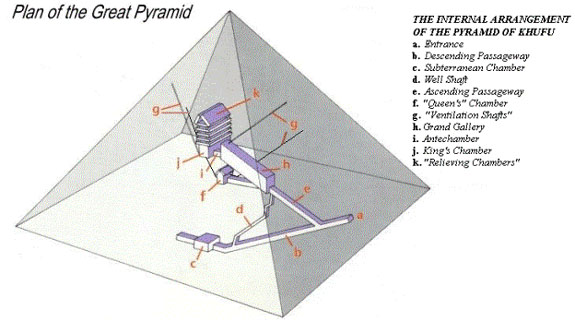 The Queen’s Chamber once shimmered with a thick crust of salt — the unmistakable trace of an industrial-grade chemical reaction.
The Chemical Reaction and Hydrogen Generation
The salt deposits were not scattered randomly. They concentrated in the upper half of the chamber, exactly where rising hot gas would deposit its residue. This vertical signature is the fingerprint of one specific gas above all others: hydrogen. The intense heat released by hydrogen as it rose from the chamber floor caused the stone walls to chemically degrade and shed mineral salts.
That hydrogen was the final product of a reaction triggered by two liquids flowing in from two narrow passages — the northern and southern shafts of the Queen’s Chamber. For decades, both shafts ended in mysterious blockages that no human could pass. Then in 1993, German robotics engineer Rudolf Gantenbrink, working with Siemens, designed a custom robot small enough to climb the 20 cm by 20 cm shafts. What it found stunned the world: a stone door, sealed at the end of each shaft, fitted with two copper handles.
Copper Electrodes and the Electrolysis Process
Consider the geometry. Each shaft is barely the size of a human palm. No man could pull a handle through such an opening. So what are the copper pieces actually for? The clue lies in their separation: they sit detached from each other at the bottom — the textbook configuration of two electrodes in an electrolytic cell. And the “door” itself is not perfectly flush with the floor; it sits slightly elevated, allowing liquids to slip beneath.
In collaboration with chemists and chemical engineers, the working equation behind the system has been formalized:
CHEMICAL EQUATION
Hydrogenated Zinc + Hydrochloric Acid → Hydrogen Gas + Zinc Chloride Solution
Hydrogenated zinc flows from the first shaft. Hydrochloric acid flows from the second. The two streams meet beneath the sealed door, ignite a violent chemical reaction inside the Queen’s Chamber, and produce hydrogen gas plus a bath of zinc chloride salt solution. This is the practical heartbeat of the hidden secret behind building the pyramids.
The supporting evidence is not subtle. The first shaft displays gradual corrosion of its copper from the bottom upward — exactly what hydrochloric acid would do over time. The second shaft holds two copper electrodes; the left-hand piece is coated in a dark oxidized layer while the right is comparatively clean. This is the textbook signature of electrolysis, where zinc deposits accumulate on one electrode and not the other. If a future analysis confirms zinc on the left rod, the case becomes closed.
Explorer Waynman Dixon, who first cleared one of these shafts in the 19th century, recorded in his notebooks that the stone surface inside the passages felt unusually soft — as if it had been chemically eaten away. Later, Dr. Brett Cohen of New York University published a refined version of the equation involving ammonium chloride and sulfuric acid, but the end product remained identical: hydrogen.
A Timeline of Discovery
1860s — Piazzi Smyth
Documents salt-coated walls and toxic odor inside the Queen’s Chamber.
1872 — Waynman Dixon
Discovers the sealed shafts and notes mysteriously softened stone interiors.
1987 — Chemical Analysis
Lab testing confirms calcium carbonate, sodium chloride, and gypsum residues on chamber walls.
1993 — Rudolf Gantenbrink
Robot “Upuaut” reveals the sealed stone door with two copper electrodes.
1998 — Christopher Dunn
Publishes The Giza Power Plant, formalizing the maser hypothesis.
The Grand Gallery: An Ancient Resonator
Once hydrogen gas is generated in the Queen’s Chamber, it travels upward into the awe-inspiring corridor known as the Grand Gallery. This soaring 47-meter passage, with its corbelled limestone ceiling and steeply inclined floor, has astonished every traveler who has ever stood beneath its eight stepped tiers. But its true purpose may have been acoustic.
In 1976 the renowned flautist Paul Horn was permitted to record inside the Grand Gallery. The result, his album Inside the Great Pyramid, captured haunting reverberations that producers struggled to explain. Researcher Christopher Dunn argues this is no coincidence — the Grand Gallery was engineered as a colossal resonator, amplifying the vibrations originating in the Queen’s Chamber and channeling them upward into the King’s Chamber.
To understand a resonator, picture the body of an oud or a Spanish guitar. Strip away the hollow wooden chamber and the strings become whispers. The hollow space is what gives sound its life. Drums, violins, pianos, harps — every great acoustic instrument relies on the same principle. Place a 440 Hz speaker inside a tuned wooden box and the box itself will vibrate. The Grand Gallery is that box, scaled to the dimensions of a temple.

The King’s Chamber: A Giant Maser at the Heart of the Pyramid
The Piezoelectric Effect and 1,500 Tons of Quartz
The King’s Chamber is constructed from approximately 1,500 tons of granite, and that granite contains up to 60% quartz crystal. Quartz exhibits the “piezoelectric effect” — a scientifically verified phenomenon by which the crystal generates electrical voltage when subjected to mechanical pressure or sound waves.
This pressure does not need to be physical. Sound waves alone can do the work. A 1,700 Hz acoustic wave aimed at quartz can produce a charge of approximately 100 millivolts. Now imagine that principle scaled to 1,500 tons of crystal-rich stone, fed continuously by amplified vibrations from the Grand Gallery. The implications are staggering.
The microphone you speak into every day functions on the same principle. Inside it lies a tiny crystal that vibrates as your voice strikes it, converting sound into electrical signals. The King’s Chamber is, in essence, a microphone — only its crystal weighs 1,500 tons. This breathtaking scale is the heart of the hidden secret behind building the pyramids.
From Laser to Maser: The 21 cm Wavelength Code
Most of us know the laser. Fewer know its predecessor — the maser. Invented in the early 1950s by American physicist Charles H. Townes (Nobel Prize, 1964), the maser amplifies microwaves through stimulated emission of radiation. It is used today in radio astronomy, atomic clocks, satellite communication, and deep-space tracking.
Every working maser requires the same essential components: a resonant cavity box, a hydrogen gas inlet, a waveguide tube, an exit port directly opposite, an intermediate crystal element, and a power source. Place these components on a checklist and walk into the King’s Chamber — and the room ticks every box.
The single most arresting detail is this: the northern shaft measures precisely 21 centimeters across. The natural emission wavelength of hydrogen at its 1.42 GHz hyperfine transition is also 21 centimeters. That is not architectural coincidence. That is engineering.
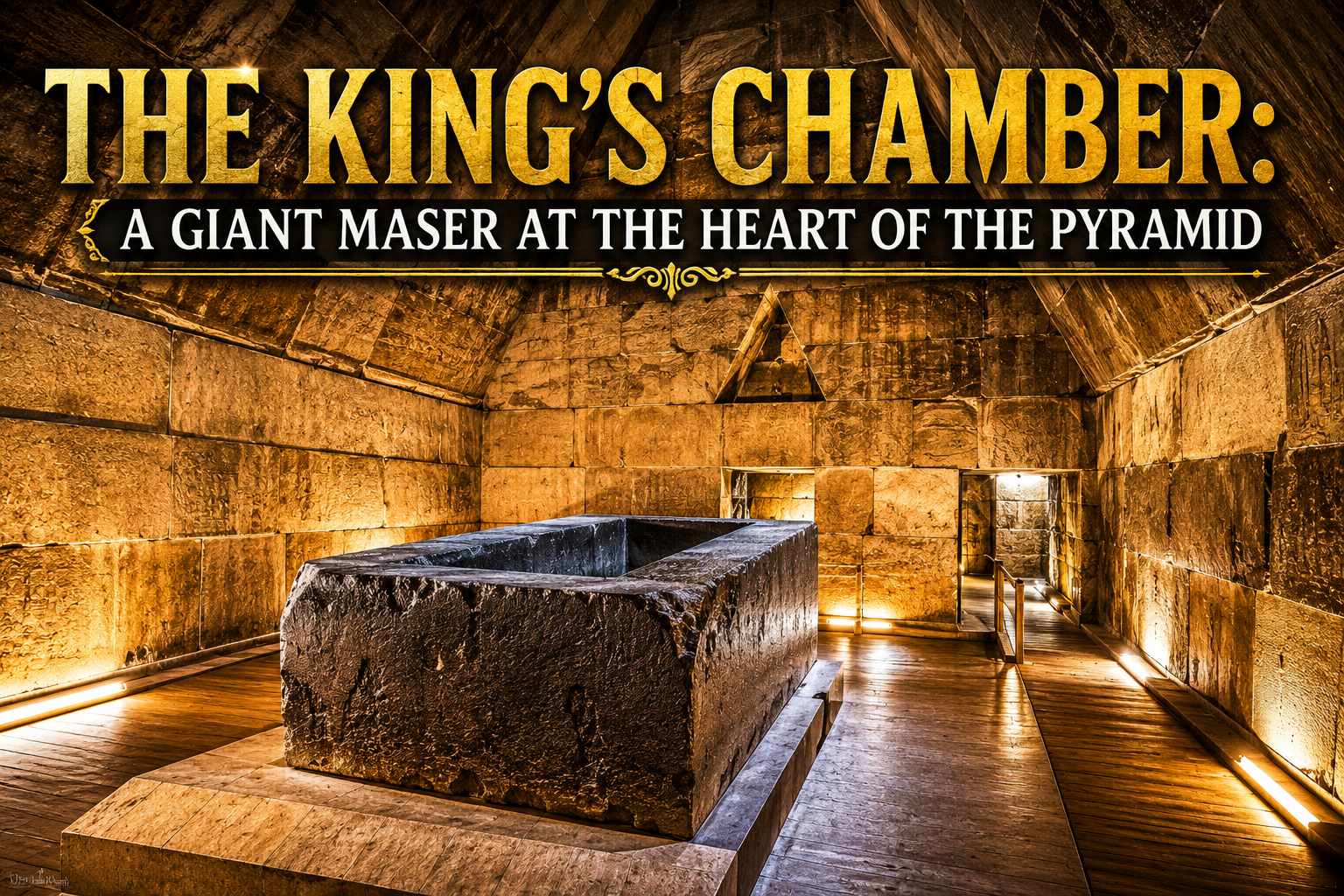 The King’s Chamber — a granite vault aligned by stone and crystal to the very wavelength of hydrogen.
The 21 cm hydrogen line is so important that NASA used it as the primary radio “language” on the Pioneer plaques sent into deep space — assuming any intelligent civilization in the cosmos would recognize hydrogen’s wavelength as a universal greeting.
The Sarcophagus: A Cavity Box, Not a Coffin
Every working maser requires a precise hollow cavity made of crystal, metal, or quartz. The King’s Chamber holds exactly one such object — the so-called “sarcophagus” carved from a single block of granite, polished mirror-smooth, and welded shut while empty. It was never used as a coffin. Dr. Zaki Iskander’s analysis of the dust inside found no organic remains of any kind. Dr. Zakaria Goneim, opening another sealed sarcophagus, also found it deliberately empty.
Engineering principle states the cavity should sit between the two opposing shafts — not against the wall as it is currently positioned. Christopher Dunn argues the sarcophagus was moved long ago, possibly by the same catastrophic event that shut down the entire system. Flinders Petrie examined it in detail and made a startling observation: when he raised the 3-ton box with iron levers, he discovered there were no fixing lines or guide grooves on the floor beneath it. Unlike the sarcophagus in the Pyramid of Khafre, which is anchored, this one was always meant to be movable. Egyptian tour guide Professor Mohamed Ibrahim has even confirmed witnessing it being shifted aside during cleaning.
The precision tolerances of these boxes are not the work of dynastic stonemasons with copper chisels. The sarcophagus inside the Lahun Pyramid, measured by Petrie himself, deviated from perfect straightness by no more than 1 part in 10,000. He stated unequivocally that this was the highest precision he had ever recorded on any artifact in his career — especially astonishing because it was carved from extraordinarily hard stone. Such precision served a function. Such precision is the hidden secret behind building the pyramids.
Evidence of an Internal Explosion
Flinders Petrie’s detailed survey of the King’s Chamber revealed something deeply unsettling. The walls had shifted outward by one to two inches (2.5–5 cm). The ceiling had risen approximately three inches (7.5 cm). Cracks splintered across the granite slabs above. To move a 300-ton wall by 2.5 cm requires colossal force — the kind released by a major energetic event.
Petrie attributed this to an earthquake. Yet the granite walls also bear another, harder-to-explain mark: a persistent reddening, a chromatic transformation that earthquakes cannot produce. We must distinguish carefully between two phenomena. Soot from the torches of Caliph Al-Ma’mun, Napoleon Bonaparte, and the early English explorers covered the chamber in carbon black — but that layer washes off completely. Photographs from the 1970s show the walls cleaned to their original tone after soot removal.
Heat damage, however, is permanent. It changes the granite’s internal mineral structure. The reddening visible today is not soot. It is thermal scarring — the geological tattoo of an enormous heat event. Piazzi Smyth specifically described the sarcophagus color as “chocolate brown,” the exact hue of polished red granite exposed to intense heat. One corner of that same sarcophagus is broken — but the fracture is fused, curved, and softened, as if molten heat had immediately followed the impact. In the Pyramid of Menkaure, Howard Vyse documented that the sarcophagus lid, originally basalt, had turned a burnt brown long before it was lost at sea.
“
The pyramid did not die slowly. It died in an instant — in heat, in violence, in a burst of energy too large for the chamber to contain.
When all evidence is read together — the displaced walls, the cracked ceiling, the moved sarcophagus, the reddened granite, the fused fracture — one explanation harmonizes all the data. A runaway reaction, an energy event that exceeded the chamber’s tolerances, produced extreme heat that burned the walls, expanded the granite, fractured the ceiling, and shut the entire system down forever. From that moment, the pyramid’s great machine fell silent. This is the climactic dimension of the hidden secret behind building the pyramids.
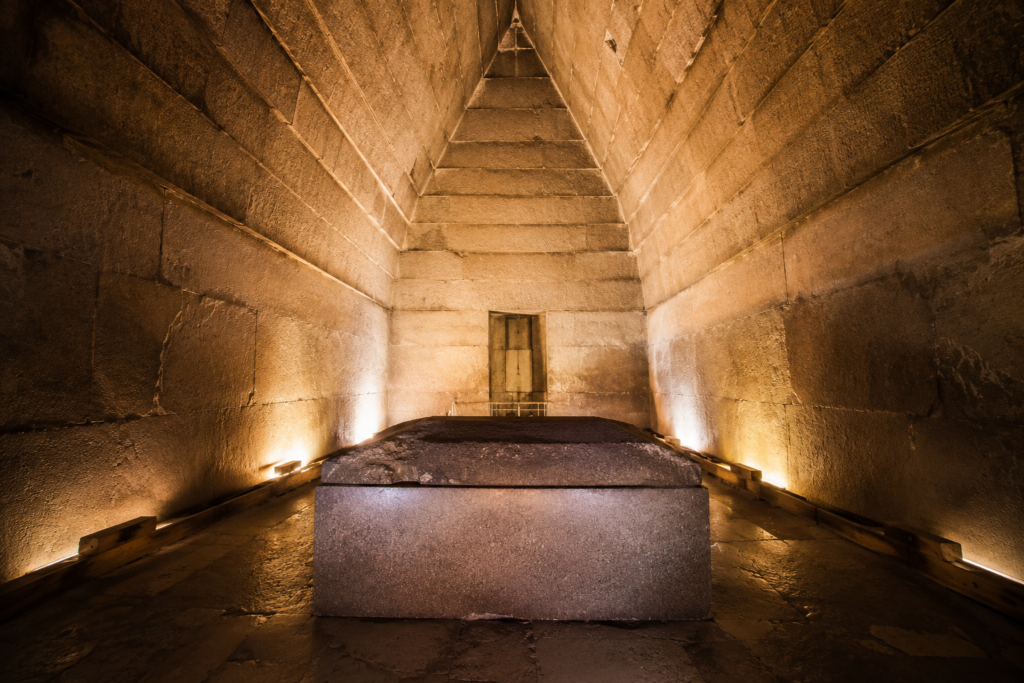 Thermal scarring on ancient granite — a permanent fingerprint of intense, unnatural heat.
Conclusion: The Code of “Pyramids”
The reddened granite, the chocolate-brown sarcophagus, the fused and curving fractures — these are not the artifacts of an indifferent earthquake. They are the violent physical signature of a chemical and hydraulic system that pushed beyond its safety margin at one fateful moment in history. That moment ended the operating life of the Great Pyramid’s giant engine.
The very name we use today — pyramid, from Greek “pyramidos” — carries a curious linguistic root: pyr, meaning “fire.” A name applied later by Greek travelers may have echoed an ancient Egyptian truth that had been quietly remembered for millennia. The pyramids were structures of fire. Of heat. Of energy.
In Part Three of our series, we will reconstruct the operating scenario from beginning to end — the first drop of water flowing into the Subterranean Chamber, the first acoustic pulse, the first burst of hydrogen, and the final spark of microwave energy beamed from the southern shaft. The hidden secret behind building the pyramids is finally being decoded.
Frequently Asked Questions
What is the hidden secret behind building the pyramids?
+
According to the alternative engineering theory advanced by Christopher Dunn and developed in the Code of Egyptian Civilization series, the hidden secret behind building the pyramids is that the Great Pyramid functioned as a power plant: a hydraulic engine, a chemical hydrogen reactor, and a giant maser combined into one machine carved from stone.
Was the Queen’s Chamber really a chemical reactor?
+
Researchers point to the thick salt layer recorded by Piazzi Smyth, the suffocating odor he noted, the chemical composition (calcium carbonate, sodium chloride, calcium sulfate), the corroded copper electrodes inside the shafts, and the physical layout of the chamber as evidence of a planned chemical reaction producing hydrogen gas.
What is a maser and how does it relate to the pyramid?
+
A maser (Microwave Amplification by Stimulated Emission of Radiation) is a 20th-century device that produces coherent microwave beams. Theorists argue that the King’s Chamber contains all the architectural components of a hydrogen maser: a granite cavity, a 21 cm waveguide matching hydrogen’s natural wavelength, opposing input/output shafts, and a hollow quartz-rich crystal element (the sarcophagus).
What evidence supports an internal explosion in the King’s Chamber?
+
Flinders Petrie documented walls displaced by 2.5–5 cm, a ceiling raised approximately 7.5 cm, multiple cracks, and persistent thermal reddening of the granite. The sarcophagus shows a fused, curved fracture indicative of post-impact heat exposure — consistent with a powerful internal energy event.
Does mainstream Egyptology accept this theory?
+
No. Mainstream Egyptology classifies the Great Pyramid as a royal tomb constructed for Pharaoh Khufu around 2560 BCE. The maser/power-plant hypothesis is considered alternative or fringe research. However, certain physical anomalies it highlights are real, and the discussion continues to inspire interdisciplinary debate.
Can I visit the Great Pyramid from Hurghada?
+
Absolutely. HurghadaToGo offers daily Cairo and Giza day tours by minivan and by flight, including expert-guided visits to the Great Pyramid, the Sphinx, and the Grand Egyptian Museum.
Ahmed Diaa
INVESTIGATIVE HISTORIAN · HURGHADATOGO
Author of the Code of Egyptian Civilization series, Ahmed Diaa specializes in alternative scientific history, ancient engineering, and the lost technologies of Egypt’s deep past. He works with HurghadaToGo to bring travelers closer to the real mysteries of Egypt.
SHARE THIS ARTICLE
Related Articles
SERIES
Code of Egyptian Civilization — Part 1
DAY TRIP
Cairo Day Trip from Hurghada by Flight 2026
LUXOR
Valley of the Kings: Secrets of Ancient Egypt